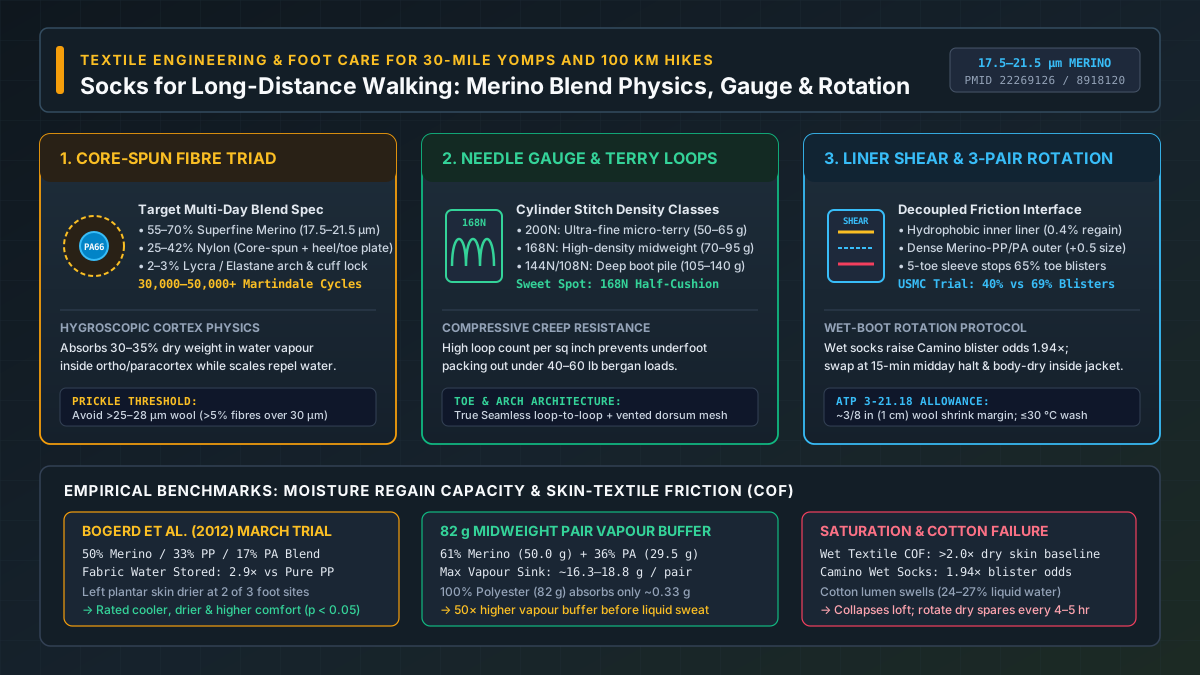
Selecting the wrong socks for long distance walking causes rapid wool-cortex saturation, wet-bagging fabric folds, and severe plantar blisters long before the finish of a 30-mile yomp or 100 km hike. Matching a core-spun Merino-Nylon-Elastane blend (55–70% superfine Merino, 25–42% Nylon, 2–3% Elastane) and circular knitting needle gauge (200N, 168N, or 144N) to your boot volume and midday halt rotation prevents epidermal shear breakdown across multi-day marches.
Whereas our pillar guide to choosing the best long-distance walking socks establishes the foundational 5-Check sequence (fit first, ruling out cotton, matching shoe room, basic layering, and spare counts), this technical specification examines the textile physics, commercial knit constructions, and wet-boot rotation protocols required for multi-day treks and loaded marches. The table below benchmarks the five primary sock fibre systems and three circular-knit cushion classes so you can match yarn chemistry and terry loop density to your footwear volume and route climate.
| Fibre / Cushion Parameter | Target Technical Specification | Moisture Regain & Sorption Physics | Mechanical & Abrasion Profile | Primary Footwear & March Application |
|---|---|---|---|---|
Superfine Merino Wool Share (55–70%) |
17.5–21.5 µm fibre diameter (40–50% when paired with Polypropylene) |
15–17% standard regain (20 °C / 65% RH); absorbs 30–35% dry weight as water vapour inside hydrophilic cortex before feeling clammy |
Exothermic heat of sorption buffers halt-to-march cooling; avoids the >25–28 µm cutaneous prickle threshold (>5% fibres over 30 µm) |
Core thermal and vapour-buffering component in 3-season and winter trekking socks |
Nylon / Polyamide Core & Plating (25–42%) |
Continuous filament PA 6 or PA 6,6 core-spun or plated at heel, forefoot, and toe |
4.0–4.5% standard moisture regain; adds minimal vapour sink but prevents wet structural collapse |
Raises Martindale abrasion resistance from ~10,000–15,000 cycles (pure wool) to 30,000–50,000+ cycles; prevents wet-bagging elongation |
Essential structural skeleton across calcaneal heel pocket, plantar metatarsal heads, and dorsal toe box |
Elastane / Lycra Spandex (1–5%, optimal 2–3%) |
Segmented polyurethane filament knitted into cuff ribbing, ankle flex zone, and arch brace | <1.0% moisture regain; hydrophobic elastic core |
Provides circumferential snap-back recovery so the sock cannot rotate or migrate under the heel during 8+ hour wet marches |
Mid-foot arch compression band, Y-heel lock, and micro-crew or boot-crew shaft |
Polypropylene (17–24%) & Polyester (0.4% regain) |
Super-hydrophobic Endurofil (PP) in outer blends or 70% Coolmax/Dri-Wright (PET) in liners |
0.0–0.1% regain (PP) and 0.4% regain (PET); zero internal absorption—transports liquid via inter-fibre capillary grooves |
Accelerates liquid water expulsion after bog immersion and cuts overnight tent drying time; decouples shear in 2-layer systems | Wet UK moorland yomps (Bridgedale/Danish Endurance blends) and inner shear liners (Wrightsock/Injinji) |
| Cotton Benchmark (Failure Reference) | Cellulosic staple fibre (>20% share fails endurance requirements) |
7.0–8.5% standard regain, but cellulosic lumen absorbs 24–27%+ liquid water |
Swells when wet, collapses air loft, loses elastic recovery, and doubles skin-textile friction (COF >2.0× per PMID 18331977) |
Reject for all long-distance walking, trail running, and loaded marching |
Light (200N) vs. Mid (168N) vs. Heavy (144N/108N) Gauge |
200N (50–65 g), 168N (70–95 g), 144N/108N (105–140 g Men’s L pair) |
Pair vapour buffer scales with dry Merino mass: ~9 g (200N) to ~17 g (168N) to ~28 g (144N/108N) |
168N high-density underfoot terry resists pack creep under 40–60 lb bergans; 144N pads stiff leather collars |
200N: snug trail runners (>18 °C); 168N: 3-season boots (5–18 °C); 144N: B1/B2 mountain & combat boots (<5 °C) |
Fibre Physics and Core-Spun Blend Ratios: Why 100% Merino Fails by Mile 20
Buyers searching for the best socks for long distance hiking frequently assume that a higher wool percentage automatically delivers a superior sock. In textile engineering, 100% Merino wool is structurally unsuited to endurance foot care. When wool absorbs sweat and experiences repetitive plantar compression (1,000 to 1,300 cycles per mile) inside a boot, unreinforced wool staple yarns suffer rapid abrasive pilling (~10,000–15,000 Martindale cycles) and plastic creep (“wet-bagging”). Once a sock elongates by even 4–6% across the footboard, excess fabric folds under the calcaneus and metatarsal heads, concentrating shear stress directly onto the stratum corneum.
To combine the internal vapour capacity of natural wool with the tensile durability of synthetic filament, technical hosiery mills rely on a three- or four-fibre engineering triad:
- Superfine-to-Fine Merino Wool (
55% to 70%in standard blends;38% to 50%in polypropylene-assisted wet-weather blends): High-grade hiking socks specify Merino fibres measuring17.5 to 21.5 µmin diameter. At this fine micron gauge, individual keratin shafts buckle softly under light normal loads, staying well below the biomechanical cutaneous prickle threshold (>25–28 µmmean diameter, or where>5%of fibres exceed30 µmand mechanically trigger superficial nociceptors). Structurally, each Merino fibre is a composite cylinder: an outer sheath of overlapping epicuticle scales coated in a covalently bound lipid monolayer (18-methyleicosanoic acid,18-MEA) that repels liquid water droplets, surrounding a hydrophilic inner cortex (divided into ortho- and paracortex segments rich in polar peptide and salt linkages). Water vapour molecules diffuse through tiny gaps between the hydrophobic scales and bind chemically inside the cortex—allowing Merino wool to absorb15% to 17%of its dry weight at standard conditions (20 °C,65%RH) and up to30% to 35%of its dry weight in water vapour before liquid moisture wets the fibre surface. As water vapour binds to cortical polar groups, wool releases exothermic heat of sorption, buffering the chill that otherwise strikes damp feet when a marcher halts on an exposed ridge. - Nylon / Polyamide (
25% to 42%): Polyamide (PA 6orPA 6,6) exhibits a low standard moisture regain (4.0% to 4.5%) but exceptional wet and dry tenacity. Rather than simply blending loose nylon and wool staples in a carding drum, premium walking socks use core-spun yarn (wrapping17.5–21.5 µmMerino staple fibres around a continuous high-tenacity nylon filament core) and zonal nylon plating (knitting a backing yarn of pure nylon parallel to the wool loop across the heel cup, forefoot pad, and dorsal big-toe box). Core-spinning and plating keep soft Merino scales against the skin while raising Martindale abrasion endurance to30,000–50,000+cycles. - Elastane / Lycra Spandex (
1% to 5%, typically2% to 3%): Even core-spun nylon-wool yarns need elastomeric recovery to accommodate foot volume expansion (~4–8%diurnal and exercise oedema over a long march). Knitting2–3%Lycra throughout the leg shaft, ankle flex zone, and mid-foot arch band provides continuous radial recovery so the heel pocket stays locked onto the calcaneus after8+ hoursin wet conditions. - Hydrophobic Polypropylene (
17% to 24%Endurofil) and Channeled Polyester (0.4%regain Coolmax / Dri-Wright): Polypropylene (0.0% to 0.1%regain) and multi-channel polyester (0.4%regain) absorb virtually zero moisture into the polymer matrix. Instead, they move liquid sweat along external inter-fibre capillary channels. Incorporating17–24%polypropylene into a wool-nylon outer sock (as used in Bridgedale FusionTech and Danish Endurance Premium blends) trades a small fraction of cortical vapour storage for substantially faster liquid drainage after stream wades and faster overnight drying inside a cold tent.
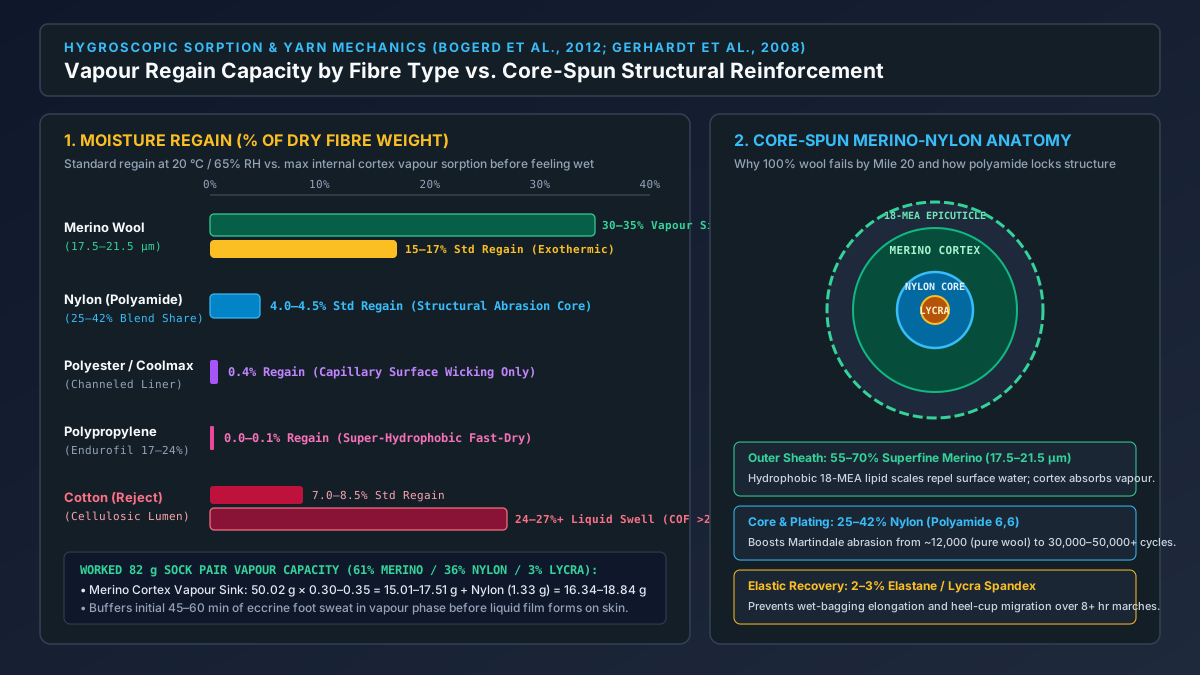
Controlled military trials confirm how this hygroscopic buffering alters the in-boot microclimate. In a 4-day field study of 37 military recruits marching 6.5 km/day (Bogerd et al., 2012, PMID 22269126) paired with a controlled n = 12 laboratory treadmill study (Bogerd et al., 2011, PMID 21669907), recruits wore a 50% Merino wool / 33% polypropylene / 17% polyamide blend sock on one foot and a 99.6% polypropylene / 0.4% elastane synthetic sock on the opposite foot. At the end of the marches, the Merino-blend sock stored 2.9 times more moisture inside the fabric matrix than the pure polypropylene sock, yet left plantar skin significantly drier at 2 of 3 measured foot sites (p < 0.05) and was rated significantly cooler, less damp, and more comfortable by the recruits. By locking sweat vapour inside the wool cortex, the blend kept free liquid water off the stratum corneum.
Takeaway: Specify 55–70% superfine Merino (17.5–21.5 µm), 25–42% core-spun/plated Nylon, and 2–3% Elastane for general long-distance walking, or substitute 17–24% Polypropylene for part of the wool share when marching through saturated bogs where overnight air-drying is restricted.
Circular Knitting Gauge (200N vs. 168N vs. 144N/108N) and Zonal Terry Architecture
As demonstrated in recent tribological research on the sock-skin interface (Journal of Foot and Ankle Research, 2022, PMID 35986404), knit loop geometry, terry pile density, and interfacial moisture govern the sock-skin coefficient of friction (COF) far more strongly than raw dry fibre labels alone. Two socks with identical 60% Merino / 38% Nylon / 2% Lycra ingredient labels will perform completely differently under a 50 lb bergan if one is knitted on a coarse, low-density cylinder with loose loops and the other on a high-density 168-needle machine.
Circular Hosiery Needle Count Classes
In industrial circular knitting, needle gauge (N) denotes the total number of latching needles arranged around the circumference of a 3.5- to 4.0-inch diameter hosiery cylinder:
200-Needle (200N)— Ultra-High-Density Fine Gauge (50–65 gpair weight, Men’s L): Packing 200 needles around the cylinder requires superfine, tightly twisted core-spun yarn. It produces a sleek, flat outer face and a thin, ultra-dense micro-terry loop sole with zero dorsum bulk. Choose200NLight Cushion socks for snug trail running shoes, approach shoes, summer fastpacking above18 °C, or when wearing a thin Merino outer sock over a separate toe liner where boot volume is tight.168-Needle (168N)— High-Density Mid-Gauge Sweet Spot (70–95 gpair weight, Men’s L): The benchmark specification for 30-mile yomps, 100 km challenges, and 3-season mountain walking (5–18 °C). A168Ncylinder accommodates slightly loftier yarn while packing enough terry loops per square inch to resist compressive creep (“packing out”) under a40–60 lbload. While loose low-gauge terry flattens into a hard, dead layer by Mile 15, dense168Nmicro-loops spring back between strides to maintain underfoot air volume and shear absorption.144-Needle and 108-Needle (144N / 108N)— Coarse Heavyweight Expedition Gauge (105–140 gpair weight, Men’s L): Fewer, larger needles accept heavy multi-ply wool yarns to form a deep,360-degreefull-sock terry pile across the sole, heel, malleoli, and shin shaft. Reserve144N/108NFull-Cushion socks for high-volume B1/B2 mountaineering boots, rigid full-grain leather combat boots (sized+0.5larger to preserve toe splay), and cold/wet moorland marches below5 °Cwhere stiff boot tongues and collars press heavily against the anterior tibialis and shin.

Five Anatomical Construction Zones to Verify Before Buying
When inspecting a sock inside-out before a training walk, verify how the knit transitions across five anatomical zones:
- Non-Constricting Lycra Rib Cuff & Shin Shaft: Must hold the shaft cleanly above a
6- to 8-inchboot collar without sliding down into the ankle crease or acting as a venous tourniquet—satisfying the US Army ATP 3-21.18 Foot Marches (Appendix E) rule of “no tightness or fullness.” - Reinforced Y-Heel Gore & Extended Achilles Pad: Deeply contoured Y-stitch heel pockets prevent excess fabric fold at the sides of the calcaneus, while high-density terry loops extending
5–7 cmup the posterior Achilles tendon shield the skin from rigid leather heel counters during steep ascents. - Circumferential Elastic Arch Brace & Ankle Flex Dart: A
2–3%elastane compression band around the plantar fascia and navicular arch (such as Smartwool’s4 Degree Elite Fit Systemor Bridgedale’s arch lock) stops torsional sock rotation. Directly over the anterior ankle bend, an open-knit flex zone dart prevents thick terry fabric from bunching into a hard horizontal ridge under the boot eyelets. - Dorsum Open-Mesh Ventilation Lanes: The top of the foot presses against the padded boot tongue and does not bear bodyweight. Removing terry loops from the dorsum and replacing them with open-mesh knit chimneys reduces instep volume and allows upward convective vapour expulsion at every step.
- True Seamless (Loop-to-Loop) Toe Closure & Dorsal Nail Guard: Cheap socks close the toe tube with an overlocked ridge seam that presses directly into the nail beds and dorsal interphalangeal joints on long descents. Insist on a hand-linked or Rosso loop-to-loop flat seam paired with nylon plating across the big-toe box (e.g., Darn Tough
True Seamlessor SmartwoolShred Shield).
Takeaway: Match 168-needle Midweight Half-Cushion socks (70–95 g) to standard 3-season hiking and patrol boots, step down to 200-needle Light Cushion (50–65 g) for low-volume trail shoes, and step up to 144N/108N Full Cushion (105–140 g) only when your boots are sized with sufficient forefoot and instep volume.
Commercial Merino-Blend & Anti-Blister Sock Specifications Compared
To translate textile specifications into field kit selection, the table below compares eight proven commercial models across six leading manufacturers, detailing their exact factory fibre breakdowns, knit constructions, and optimal march applications.
| Brand & Model | Exact Fibre Breakdown | Needle Gauge & Cushion Architecture | Key Structural & Anti-Shear Engineering | Optimal Footwear & March Profile |
|---|---|---|---|---|
Darn Tough Vermont — Hiker Micro Crew Midweight with Cushion (#1466) |
61% Merino Wool, 36% Nylon, 3% Lycra Spandex |
168N class fine-gauge high-density knit; mid-level terry loop underfoot, heel pocket, and Achilles (~82 g pair) |
Core-spun Merino over nylon skeleton; True Seamless loop-to-loop toe; vented arch/instep panels; lifetime abrasion warranty |
Benchmark 3-season 30-mile yomp and 100 km walking sock for standard-volume mid-cut boots |
Darn Tough Vermont — Light Hiker Micro Crew (#1972 / #1967) & Decade Stripe (#1992) |
#1972: 54% Nylon, 43% Merino Wool, 3% Lycra Spandex (#1992 Midweight: 58% Merino, 40% Nylon, 2% Lycra) |
200N class ultra-fine gauge (#1972, ~58 g pair); thin low-profile micro-terry under plantar sole only |
Higher polyamide ratio preserves tensile strength in a thin knit; elastic arch band and multi-zone open mesh | Snug trail runners, summer 50–100 km ultras (>18 °C), or durable outer layer over a thin liner |
Darn Tough Vermont — Hiker Boot Full Cushion (#1405) & Mountaineering Heavyweight (#1953 / #5011) |
#1405: 66% Merino Wool, 32% Nylon, 2% Lycra; #1953/#5011: 70–74% Merino, 24–28% Nylon, 2% Lycra |
144N class heavy gauge (~108–132 g pair); full 360° high-density terry loop from toe to cuff |
Maximum cortical vapour capacity (~25–28 g per pair) and shin collar padding against stiff leather tongues |
Cold/wet winter yomps (<5 °C), heavy bergans, and roomy B1/B2 mountain or military combat boots |
| Smartwool — Performance Hike Light Cushion Crew & Classic Edition Full Cushion Crew | Performance Light: 56% Merino, 11% Nylon, 31% Recycled Nylon (42% total PA), 2% Elastane; Classic Full: 66% Merino, 33% Nylon, 1% Elastane |
168N body-mapped zonal mesh (Performance Light) vs. classic full-terry loop surround (Classic Full) |
Indestructawool high-density heel/forefoot zones; 4 Degree Elite Fit System (two-elastic ankle/arch gusset); Shred Shield toe |
Multi-day trail backpacking where anatomical arch and ankle torsion lock is required to stop heel slip |
| Bridgedale — Hike Midweight Merino Performance & Explorer Heavyweight Merino Performance | Hike Midweight: 18% Merino, 26% New Wool (44% wool), 38% Nylon, 17% Endurofil (PP), 1% Lycra; Explorer Heavy: 28% Merino, 19% New Wool (47% wool), 34% Nylon, 18% Endurofil, 1% Lycra |
Zonal shock-pad terry underfoot (Hike Midweight) and heavy full-loop expedition pile (Explorer Heavyweight, 144N/108N class) |
FusionTech spinning wraps wool with super-hydrophobic Endurofil polypropylene (0.05% regain) and nylon; Y-heel gore |
Wet UK moorland yomps, peat bogs, and multi-day treks requiring rapid water expulsion and overnight tent drying |
| Danish Endurance — Merino Wool Hiking Crew Socks (Premium & Classic) | Premium: 38% Merino Wool, 35% Polyamide (Nylon), 24% Polypropylene, 3% Elastane (Classic: 38% Merino, 30% Acrylic, 30% Polyamide, 2% Elastane) |
Mid-gauge crew with full heel-to-toe plantar terrysole padding and vertical upper-foot cooling lanes | High polypropylene share (24% in Premium) accelerates capillary drying; targeted mid-foot arch compression |
Multi-pair rotation packs for multi-day treks and temperate trail walking on a practical budget |
| Wrightsock — CoolMesh II & Merino Stride (Double-Layer Anti-Blister) | CoolMesh II: Inner 70% Dri-Wright II Polyester, 26% Nylon, 4% Lycra; Outer 71% Polyester, 24% Nylon, 5% Lycra. Merino Stride: Inner 70% Dri-Wright II Polyester, 26% Nylon, 4% Lycra; Outer 68–71% Merino, 24% Nylon, 5% Lycra |
Dual concentric flat-knit layers joined at toe seam and cuff; mid-foot Stabilizer Zone elastic band |
Hydrophobic inner layer (0.4% regain) stays dry against skin while shear motion occurs between inner and outer plies |
Walkers prone to plantar/heel shear blisters who want a pre-joined 2-layer system that cannot bunch separately |
| Injinji — Outdoor Midweight Mini-Crew Merino (NuWool) & Trail Midweight (Coolmax) | Outdoor Merino: 75% Merino Wool, 22% Nylon, 3% Lycra Spandex; Trail Synthetic: 58% Nylon, 39% Coolmax EcoMade Polyester, 3% Lycra |
Fine-gauge anatomical 5-toe glove construction with midweight terry loop underfoot | Individual fabric sleeves wrap all five digits, eliminating skin-on-skin interdigital friction and allowing natural forefoot splay | Standalone sock or ultra-thin liner for hikers suffering toe-to-toe blisters on long descents (65% of ultra blisters per PMID 25275735) |
Takeaway: Choose Darn Tough #1466 or Smartwool Performance Hike for all-around 168N durability, Bridgedale Hike Midweight (with 17% Endurofil polypropylene) when marching through saturated bogs, Wrightsock Merino Stride for integrated dual-layer shear decoupling, and Injinji where blisters form between the toes.
Two-Sock Liner Shear Mechanics vs. Single-Layer High-Density Merino
Whether you should wear a single high-density Merino-blend sock or a two-sock system (a thin hydrophobic inner liner under a thicker wool-blend outer sock) is one of the most debated questions in foot care for hikers. Both the American Academy of Dermatology (AAD) blister guidelines (“wear nylon or moisture-wicking socks; if wearing one pair does not help, try wearing two pairs”) and the US Army ATP 3-21.18 Foot Marches manual endorse two-sock layering under specific footwear conditions.
The USMC Parris Island Trial (PMID 8918120) and Why the Outer Sock Dictates Success
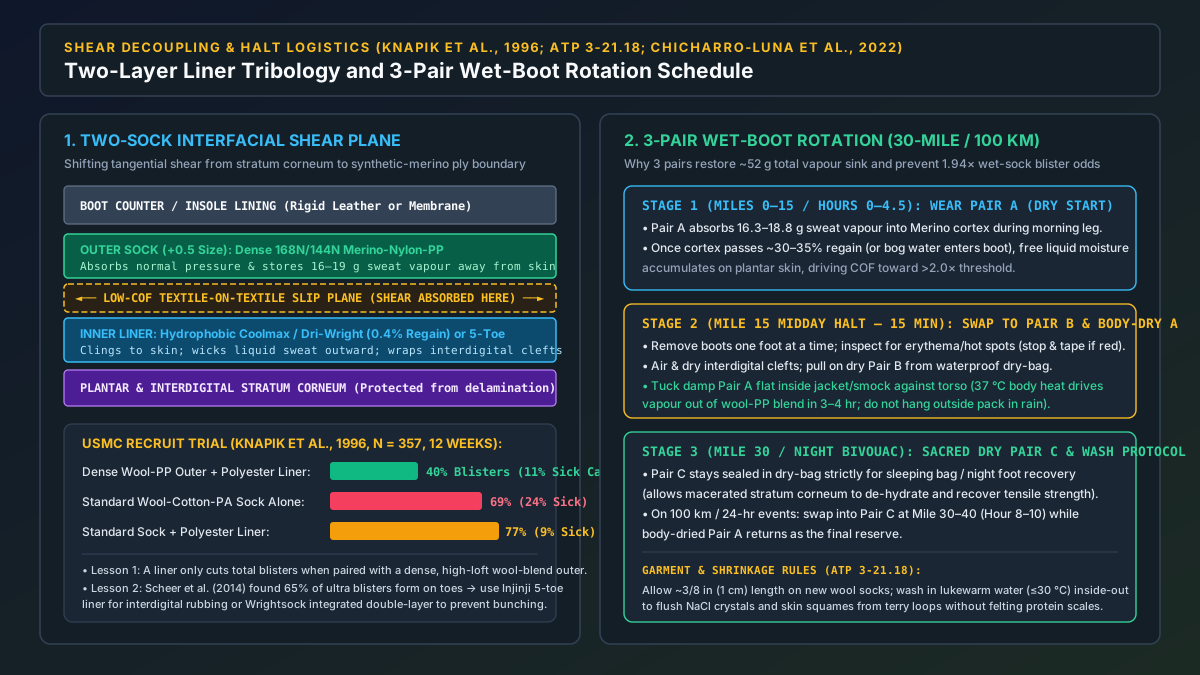
In a landmark prospective trial conducted by the US Army Research Institute of Environmental Medicine (Knapik et al., 1996, PMID 8918120), 357 US Marine Corps recruits undergoing 12 weeks of basic training at Parris Island were assigned to one of three boot-sock systems:
- Standard Military Sock Alone: A single wool-cotton-nylon cushion-sole sock (
50%wool,30%cotton,20%nylon) →69%total blister incidence, with24%requiring sick-call medical attention for severe blisters or cellulitis. - Standard Military Sock + Thin Polyester Liner: Adding a hydrophobic polyester liner underneath the standard wool-cotton-nylon sock →
77%total blister incidence (no reduction in overall blisters, because the cotton-containing outer sock still collapsed when wet), though severe sick-call cases dropped to9%. - Dense Wool-Polypropylene Outer Sock + Thin Polyester Liner: A thick, high-loft wool-polypropylene outer sock worn over the thin hydrophobic polyester liner →
40%total blister incidence (p < 0.001reduction vs. both other groups) and11%sick-call cases.
That trial establishes two mechanical rules for two-sock layering:
- Decoupled Shear + Outward Capillary Gradient: The inner liner must be a smooth, hydrophobic synthetic (
70%+polyester/Coolmax at0.4%regain, polypropylene at0.05%regain, or filament nylon) that clings tightly to the skin without absorbing liquid water. The outer sock must be a dense, high-loft wool-nylon or wool-polypropylene blend that absorbs sweat wicked through the liner and absorbs normal pressure from the boot. Because the textile-on-textile friction coefficient between the smooth synthetic liner exterior and the outer sock interior (μ_liner-outer) is lower than the wet skin-to-sock coefficient (μ_skin-liner), tangential shear displacement happens between the two sock plies rather than delaminating the prickle layer (stratum spinosum) of the epidermis. - The
+0.5Size Allowance Rule: As specified in ATP 3-21.18 Appendix E, whenever a marcher wears two pairs of socks, the outer sock must be at least a half size larger so the inner liner is not compressed into wrinkles and the forefoot is not squeezed inside the toe box. If your trail shoes or boots are fitted snugly for a single midweight sock, cramming a second pair inside increases normal force (F_n) across the fifth metatarsal head and interdigital spaces, causing blisters rather than preventing them. In snug footwear, either wear a pre-joined thin double-layer sock (such as Wrightsock Merino Stride) or stick to a single168NMerino-Nylon sock paired with targeted microporous paper blister tape on known hot spots.
Targeting Interdigital Blisters with Five-Toe Liners (PMID 25275735)
Standard tubular socks enclose all five toes in a single fabric pocket, leaving the medial and lateral surfaces of digits 1 through 5 rubbing skin-on-skin. In a prospective study of 50 ultra-endurance runners competing in a 219 km (136-mile) 5-day stage race (Scheer et al., 2014, PMID 25275735), 76% developed foot blisters by Day 4, and 65% of all blisters formed on the toes. When steep downhill braking forces the forefoot forward and splays the toes into each other, wearing an anatomical five-toe liner (such as Injinji Trail/Outdoor) or applying a thin interdigital barrier as detailed in our anti-chafe and barrier formulation guide for runners and marchers eliminates direct skin-on-skin toe shear.
Takeaway: Use a two-sock system (hydrophobic polyester or 5-toe liner + +0.5 size dense Merino-blend outer) only when your boots have the volume for both layers to lie completely flat without toe constriction.
Wet-Boot March Rotation Protocol and Worked 30-Mile / 100 km Vapour Budget
Even the finest 61% Merino / 36% Nylon / 3% Lycra sock has a finite cortical vapour sink. In a cross-sectional study of 203 hikers completing stages on the Camino de Santiago (Chicharro-Luna et al., 2022, PMID 35144880), finishing the walk in wet socks nearly doubled the odds of developing foot blisters (OR = 1.94, 95% CI 1.04–3.61), whereas the baseline ratio of natural to synthetic fibre alone did not protect walkers once their socks were saturated. Furthermore, Gerhardt et al. (2008, PMID 18331977) demonstrated that normal epidermal hydration raises skin-textile friction by 26% in men and 43% in women, while a completely wet textile against skin more than doubles the coefficient of friction (>2.0×).
Once your socks transition from storing bound cortical water vapour to holding free liquid water between the terry loops, you must rotate to a dry pair.
Worked Calculation: Vapour-Phase Sorption Capacity Across a 30-Mile Yomp and 3-Pair Rotation
To understand why a midday sock change is a physical requirement rather than a luxury on a 30-mile (48 km) yomp or 100 km endurance challenge, calculate the exact gram capacity of your socks against physiological foot sweat production:
1. Single-Pair Vapour Sorption Budget (82 g Men’s Large 168N Midweight Pair):
Compare three 82 g sock pairs of identical dry mass across different fibre blends:
- Option A — Core-Spun Merino Blend (
61%Merino =50.02 g,36%Nylon =29.52 g,3%Lycra =2.46 g):- Standard Hygroscopic Regain (
16%Merino,4.5%Nylon at65%RH):M_std = (50.02 g × 0.16) + (29.52 g × 0.045) + (2.46 g × 0.01) = 8.00 g + 1.33 g + 0.02 g = 9.35 g - Maximum Vapour-Phase Sink Before Clammy Threshold (
30–35%Merino cortex +4.5%Nylon):M_max = (50.02 g × 0.30 to 0.35) + 1.33 g = 15.01–17.51 g + 1.33 g = 16.34 g to 18.84 g of bound water vapour
- Standard Hygroscopic Regain (
- Option B — Wet-Moorland Merino-Polypropylene Blend (
44%Wool =36.08 g,38%Nylon =31.16 g,17%Endurofil PP =13.94 g,1%Lycra =0.82 g):- Maximum Vapour-Phase Sink:
M_max = (36.08 g × 0.30 to 0.35) + (31.16 g × 0.045) + (13.94 g × 0.0005) = 10.82–12.63 g + 1.40 g + 0.01 g = 12.23 g to 14.04 g of bound water vapour(slightly smaller vapour tank, but17%PP expels liquid bog water roughly35–40%faster during body-heat drying).
- Maximum Vapour-Phase Sink:
- Option C — Pure Polyester Synthetic Sock (
97%Polyester =79.54 g,3%Lycra =2.46 g):- Maximum Internal Fibre Sorption (
0.4%Polyester regain):M_max = (79.54 g × 0.004) + 0.02 g = 0.34 g(virtually zero internal vapour storage;98%of sweat immediately enters the inter-fibre capillary spaces as liquid water).
- Maximum Internal Fibre Sorption (
2. Matching Sock Capacity Against 8-Hour Loaded March Sweat Output:
During loaded marching (40–55 lb bergan at 3.0–3.5 mph), both feet combined produce roughly 15 to 30 mL (15 to 30 g) of eccrine sweat per hour, totaling 120 to 240 g over an 8-hour, 30-mile yomp.
- Even when breathable non-membrane leather or mesh boots evaporate
60–75%of foot vapour through the upper and ankle bellows (~72–180 gvented),30 to 60 gof residual moisture remains trapped inside the boot microclimate over 8 hours. - A single Option A Merino-blend pair saturates its
16.3–18.8 gcortical vapour sink around Hour 3.5 to Hour 4.5 (Mile 12 to Mile 15). Walking past Mile 15 without changing socks forces the remaining15–40 gof moisture to condense as free liquid water on the plantar skin, triggering the>2.0×wet-textile friction spike. - Rotating across a 3-Pair System (
Pair Aat Mile 0 +Pair Bat Mile 15 +Pair Cat night/Mile 30, plus body-dryingPair Afor a second cycle) expands your cumulative cortical vapour buffer to3 × 17.6 g = 52.8 g(or~70 gwith one body-heat drying cycle), matching the entire un-vented moisture load of the march.
The 3-Pair Wet-Boot Rotation & Body-Heat Drying Routine
Adopt the field rotation protocol synthesised from US Army ATP 3-21.18 Appendix E, NHS blister guidance, and our guides to keeping feet dry when hiking in rain and reusing hiking socks across multi-day treks:
- Carry Three Dedicated Pairs in Separate Waterproof Dry-Bags:
- Pair A (March Start): Worn from Mile 0 to the midpoint halt (
Hour 0 to Hour 4–4.5). - Pair B (Midday Halt Swap): Kept in a sealed
2 Lroll-top dry-bag at the top of your rucksack for the scheduled halfway change. - Pair C (Sacred Night / Camp Pair): Sealed inside your sleeping-bag dry-sack. Never wear Pair C inside wet boots during the day unless you are on a continuous 24-hour
100 kmstage (where Pair C enters service at Mile 35–40 while body-dried Pair A acts as the final reserve). Keeping feet completely dry inside the sleeping bag for6–8 hoursovernight allows macerated plantar keratin to dehydrate and recover its shear modulus.
- Pair A (March Start): Worn from Mile 0 to the midpoint halt (
- Execute the 15-Minute Midday Halt Change (Mile 12–15):
- Stop for
15 minuteshalfway through the day’s mileage. Remove one boot at a time (so the bare foot never steps onto wet mud or grit). - Wipe away dried
NaClsalt crystals and trail dust between the toes, air-dry the skin for5 minutes, and inspect the calcaneus, fifth metatarsal, and interdigital clefts. If any spot is red or painful, follow the immediate stop and dressing threshold in how to avoid blisters when hiking and apply protection from your hiking foot care kit checklist. - Pull on dry Pair B, verifying zero wrinkles across the heel pocket and instep.
- Stop for
- Dry Damp Pair A Using Torso Body Heat (
37 °C), Not Exterior Pack Dangling:- In humid UK weather, hill fog, or rain, tying damp socks to the outside of a rucksack exposes them to rain and snagging while achieving zero evaporation. Instead, follow the ATP 3-21.18 method: shake grit from damp Pair A, turn them inside-out, and lay them flat inside your jacket or smock over your base layer across the chest or kidneys. Core body warmth (
~37 °C) creates a continuous vapour-pressure gradient that drives moisture out of a168NMerino-Nylon or Merino-Polypropylene sock in3 to 4 hoursof marching.
- In humid UK weather, hill fog, or rain, tying damp socks to the outside of a rucksack exposes them to rain and snagging while achieving zero evaporation. Instead, follow the ATP 3-21.18 method: shake grit from damp Pair A, turn them inside-out, and lay them flat inside your jacket or smock over your base layer across the chest or kidneys. Core body warmth (
- Account for Wool Shrinkage & Lukewarm Washing (
≤30 °C):- ATP 3-21.18 directs allowing approximately
3/8 inch(~1 cm) of extra length on new wool socks for initial relaxation shrinkage, and washing socks in lukewarm water (≤30 °C) rather than hot water (>40 °C), which felts Merino epicuticle scales and permanently shrinks the footboard. When boots themselves are saturated at camp, pair your sock rotation with the field stuffing and air-circulation steps in how to dry hiking boots overnight.
- ATP 3-21.18 directs allowing approximately
Takeaway: Swap out of damp Merino socks at a scheduled 15-minute midday halt (Mile 12–15) before the ~17 g cortical vapour buffer overflows, dry the removed pair flat inside your jacket against torso heat, and guard Pair C strictly for overnight skin recovery.
Pre-March Sock Specification & Fit Checklist
Before stepping off on a progressive ruck march training session, a 30-mile yomp, or a multi-day trail walk, verify every pair in your pack against this engineering checklist. Additional foot-prep protocols are indexed in our foot care category and the main field guides index:
- Fibre triad verified on the packaging:
55–70%superfine Merino wool (17.5–21.5 µm),25–42%core-spun/plated Nylon, and2–3%Elastane/Lycra—or38–47%wool +17–24%Polypropylene (Endurofil) for wet bog routes. Zero cotton (0%). - Needle gauge matched to boot volume:
200NLight Cushion (50–65 g) for snug trail shoes;168NMidweight Half-Cushion (70–95 g) for 3-season hiking and patrol boots;144N/108NFull Cushion (105–140 g) only in boots sized+0.5larger. - Standing load fit & shrinkage check passed: Standing with full weight on both feet inside laced boots produces zero fabric folds under the heel or toes and zero tourniquet tightness at the cuff, with
~3/8 inch(1 cm) allowance on brand-new wool socks. - Two-sock or 5-toe shear fix confirmed in training: If using a hydrophobic polyester liner or Injinji 5-toe liner for interdigital blisters, the outer Merino sock is sized
+0.5larger and both plies have been tested together over a10+ milepractice walk. - Three-pair wet-boot rotation packed: Pair A worn at start, Pair B sealed in a top-pocket dry-bag for the Mile 12–15 (15-minute) midday halt swap, and Pair C sealed in the sleeping-bag dry-sack for overnight stratum corneum recovery.
Takeaway: Confirm every sock’s fibre blend, needle gauge, standing boot fit, and three-pair dry-bag rotation on a loaded training walk before stepping off on a 30-mile yomp or multi-day trek.