A warm heel two hours into a walk is a different job from a blister that already holds fluid. Search results for blister tape for hiking mix prevention products with dressings for a blister you already have. The randomized trial in this guide studied paper tape on ultramarathon runners, applied before the race to skin that was still intact.
Paper tape in one 2016 trial reduced blisters among desert ultramarathon runners. The abstract does not cover shop blister tapes, moleskin, or a dressing for a blister that has already formed. On intact skin, the American Academy of Dermatology (AAD) suggests adhesive moleskin or another soft bandage on problem areas. Once a blister exists, the NHS says to cover it with a soft plaster or padded dressing, and not to burst it yourself.
This page is general information, not medical advice. We used the PubMed abstract of the paper-tape trial, the NHS blisters page (last reviewed 22 November 2023), and the AAD blister page (accessed 11 October 2026). We did not read the full trial paper, and we did not test any tape.
Key points
- A hot spot on intact skin and a fluid-filled blister need different coverings.
- The trial studied paper tape in 128 runners at four 2014 desert ultramarathons. It reported a 40% reduction in blisters. Most runners still got one.
- A roll sold as blister tape, a sheet of moleskin, and a hydrocolloid dressing are not the material named in that abstract.
- Stop if the skin hurts or turns red. If a blister looks infected, get medical help.
How can you tell a hot spot from a blister?
A hot spot is intact skin that feels warm or sore where the shoe rubs. A blister is a pocket of fluid under the skin. The NHS describes ordinary blisters as small pockets of clear fluid. Blood blisters look red or black. An infected blister can be hot and filled with green or yellow pus, and the surrounding skin may look red. That redness is harder to see on brown or black skin.
The AAD says to stop the activity if you feel pain or discomfort, or if your skin turns red. Walking through that stage is how a hot spot becomes a blister. On a loaded walk, use the same look you would for foot checks before, during and after a loaded walk: shoe off, look at the skin, then choose a covering.
Takeaway: Look at the skin before you choose a product. Fluid under the skin means you are covering a blister, not trying to prevent one.
What did the paper-tape trial study?
The trial is Lipman and colleagues, “Paper Tape Prevents Foot Blisters” (Pre-TAPED II), in the Clinical Journal of Sport Medicine, September 2016 (PMID 27070112). The notes below come from the PubMed abstract. Method details that appear only in the full paper are left out.
| Item | What the abstract reports |
|---|---|
| Question | Whether paper tape prevents foot blisters in multistage ultramarathon runners |
| Design | Multisite prospective randomized trial |
| Races | The 2014 RacingThePlanet events: 250 km (155 miles) over 6 stages, in the Jordan, Gobi, Madagascar, and Atacama deserts |
| Runners | 128 enrolled. Mean age 39.3 years (range 22 to 63). Body mass index 24.2 (range 17.4 to 35.1). 31 women, listed as 22.5% of the group |
| What was taped | Paper tape on one randomly selected foot, on the runner’s blister-prone areas, or on a randomly chosen spot if the runner had no blister history |
| Comparison | Untaped areas of the same foot |
| Outcome counted | A blister anywhere on the study foot |
| Reported effect | Paper tape reduced blisters by 40% (P < 0.01, 95% confidence interval 28 to 52). Number needed to treat, as printed: 1.31 |
| What still happened | 106 runners (83%) developed 117 blisters. The abstract calls treatment successful in 98 runners (77%). Most people who blistered had one blister (78%). Toes accounted for 58 blisters (50%) and the heel for 27 (23%). 94 blisters (80%) had appeared by the end of stage 2 |
Enrollment split across the four races: 19 runners in Jordan (15%), 35 in the Gobi (27%), 21 in Madagascar (16%), and 53 in the Atacama (41%).
The abstract also says treatment success was associated with earlier stages (odds ratio 74.9) and with time spent running (odds ratio 0.66). It does not define those time measures in the text we read, so this page does not convert them into hours or stage counts.
The authors’ conclusion, as printed: paper tape prevented both the incidence and frequency of foot blisters in these runners.
Read the 40% figure next to the 83% figure. The 40% is the comparison with untaped skin. The 83% is the share of runners who still developed a blister somewhere on the study foot. Tape covered selected areas. The outcome counted a blister anywhere on that foot. Both numbers are in the abstract. We did not reanalyze them, and we did not read how the full paper defined “treatment success.”
The abstract does not name a brand, a width, or a number of layers. It does not say the tape was waterproof, and it does not give a time for how long the tape stayed on.
Takeaway: The result belongs to paper tape, applied before a multi-day desert ultramarathon, judged against untaped skin on the same foot.
Where does that result stop?
Use the trial for the people and the material it names. This boundary is our reading of the abstract, not extra findings from the full paper.
| The abstract includes | The abstract does not include |
|---|---|
| Adults running about 155 miles over six desert stages in 2014 | A day hike, a wet woodland path, or a loaded walk in boots |
| Paper tape, named as paper tape | A shop product sold as blister tape, kinesiology tape, moleskin, cloth tape, or a hydrocolloid dressing |
| Tape applied before the race, on blister-prone skin or a random spot | Tape applied to a blister that already holds fluid |
| Untaped areas of the same foot as the comparison | A head-to-head test of two brands |
| A reported 40% reduction, with most runners still blistering | A promise of no blisters, a wear time in rain, or a result for children |
Product pages and trail videos can show how someone sticks a strip to a heel. They are not a second trial. This guide does not rank brands. We have no measurement of how long any tape stays on when the sock is wet.
Socks still do a separate job. Fit, fiber, and a dry spare pair are in the long-distance walking sock guide. Powder and petroleum jelly, which the AAD suggests for friction on problem areas, are in the anti-chafe balm guide.
Takeaway: The abstract’s result applies to paper tape in that race. A different product, or a blister that has already formed, needs its own source.
Which covering matches the skin you have?
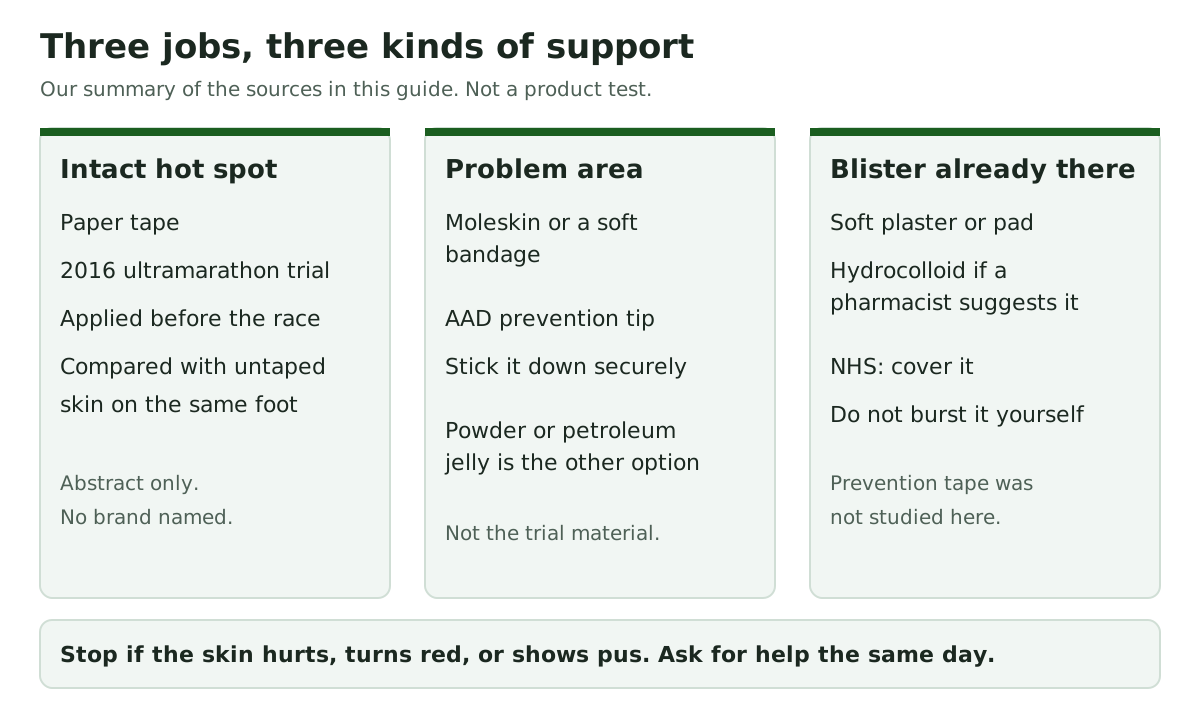
| If you see this | Covering the sources describe | Source | Limit |
|---|---|---|---|
| Intact skin that rubs, before a blister forms | Paper tape, in the ultramarathon trial above | Lipman et al., 2016 abstract | Any labeled blister tape is a different product until the label says otherwise |
| A problem spot on the feet or thighs, skin still intact | Adhesive moleskin or another soft bandage, stuck down securely. Powder or petroleum jelly is the AAD’s other friction option | AAD blister page, accessed 11 October 2026 | Moleskin was not the tape in the trial |
| A blister that has already formed | A soft plaster or padded dressing. Wash gently and pat the skin dry. A pharmacist can suggest a plaster or a hydrocolloid dressing. The NHS says a hydrocolloid can protect the blister, help reduce pain, and speed healing | NHS blisters page, last reviewed 22 November 2023 | The dressing is for this blister. The NHS also says not to burst it yourself |
| A blister on a pressure spot, such as the sole | Padding cut into a ring with a hole in the middle, placed around the blister, then a bandage over the padding and the blister | AAD | No brand, and no promise that the ring removes the pain |
| Skin that is hot, pus-filled, or red around the blister | Stop the self-care and get help. The next section lists the signs | NHS and AAD | Tape is not a treatment for infection |
The AAD moleskin line is prevention advice from dermatologists. It is a different kind of support from a randomized comparison. The NHS lines are first-aid for a blister you already have. Keep those two next to the trial and you are looking at an experiment, a clinical prevention tip, and a health-service instruction for a wound that exists.
Takeaway: Match the covering to the skin in front of you, then follow that product’s own label.
What should you check on the label before you leave?
Run this list the day before a long walk, with the shoe you will actually wear.
- The skin you plan to cover is intact: warm or sore, with no fluid pocket.
- The package says what it is: paper tape, moleskin, or a dressing meant for a blister.
- You have read the label for who it is for, and for any warning about broken skin or adhesive reactions.
- If a plaster or tape has irritated your skin before, you ask a pharmacist before you try another adhesive.
- A short strip lies flat in the shoe, with no fold under a seam or the heel counter.
- You have a dry spare sock, as in the sock guide, so tape is not your only plan for wet feet.
- You will stop if you feel pain or discomfort, or if the skin turns red, which is the AAD’s stop line.
- If a blister is already there, you pack a soft plaster or padded dressing and you leave the roof of the blister in place. The NHS says not to burst it yourself and not to peel the skin off a burst blister.
Takeaway: The label says whether the product is for intact skin or for a blister. The trial does not replace that label.
When should you stop and get help?
The NHS says blisters often heal on their own within a week, and that you will not usually need a GP. It also says not to burst a blister yourself, not to peel the skin off a burst blister, and not to wear the shoes that caused it until it heals. Wash your hands before you touch a burst blister, let the fluid drain, and then cover it.
The AAD says most blisters heal in one to two weeks if you leave them alone, and to cover a blister loosely with a bandage, with the middle of the bandage slightly raised. It says to avoid popping or draining a blister, because that can lead to infection. The same AAD page describes a home method for a large, very painful blister. This guide does not repeat those steps. The NHS says a GP might drain a large or painful blister with a sterilised needle, and might prescribe antibiotics if it is infected.
Get help, rather than another layer of tape, if any of these show up:
- The blister is very painful or keeps coming back.
- The skin looks infected: hot, with green or yellow pus, or with redness around it. Redness can be harder to see on brown or black skin. The AAD adds increased pain or swelling as a reason to see a doctor or a board-certified dermatologist.
- The blister is in an unusual place, such as the eyelids, mouth, or genitals, or several blisters appeared with no clear cause.
- A burn, scald, sunburn, or allergic reaction caused it.
In the UK, the NHS routes those situations to NHS 111, by phone or online. Outside the UK, use the urgent-care service where you are. A pharmacist can help you choose a plaster or dressing so an ordinary blister stays clean while it heals. That suggestion comes from the NHS. It is not a healing promise from this site.
This page is written for adults who can feel their feet. If you have diabetes, poor circulation, or reduced feeling, ask a doctor or podiatrist before you tape or pad your skin. An open wound that is not a simple friction blister belongs with a clinician as well.
Takeaway: Cover a simple blister and leave the roof intact. Heat, pus, spreading redness, or a blister you cannot explain is a reason to get help the same day.
Related reading
- Long-distance walking socks cover fit, fiber, and a dry spare pair.
- Anti-chafe balm covers powder and petroleum jelly for skin that rubs.
- Foot checks on loaded walks cover when to take the shoe off.
More foot-care notes are under foot care and all articles. This site is independent. The about page says who runs it.
How this guide was put together
We compiled this page on 11 October 2026 from the PubMed abstract of Lipman et al. 2016 (PMID 27070112), the NHS blisters page last reviewed 22 November 2023, and the AAD page on preventing and treating blisters, accessed the same day. We did not obtain the full trial paper, so anything that is only in the full methods is omitted. We did not test tapes, time how long they stay on, or take products from manufacturers. The comparison tables, the diagram, and the checklist are our summary of those sources. They are not new measurements.
Takeaway: The numbers on this page are the abstract’s numbers, from desert ultramarathon runners in 2014.