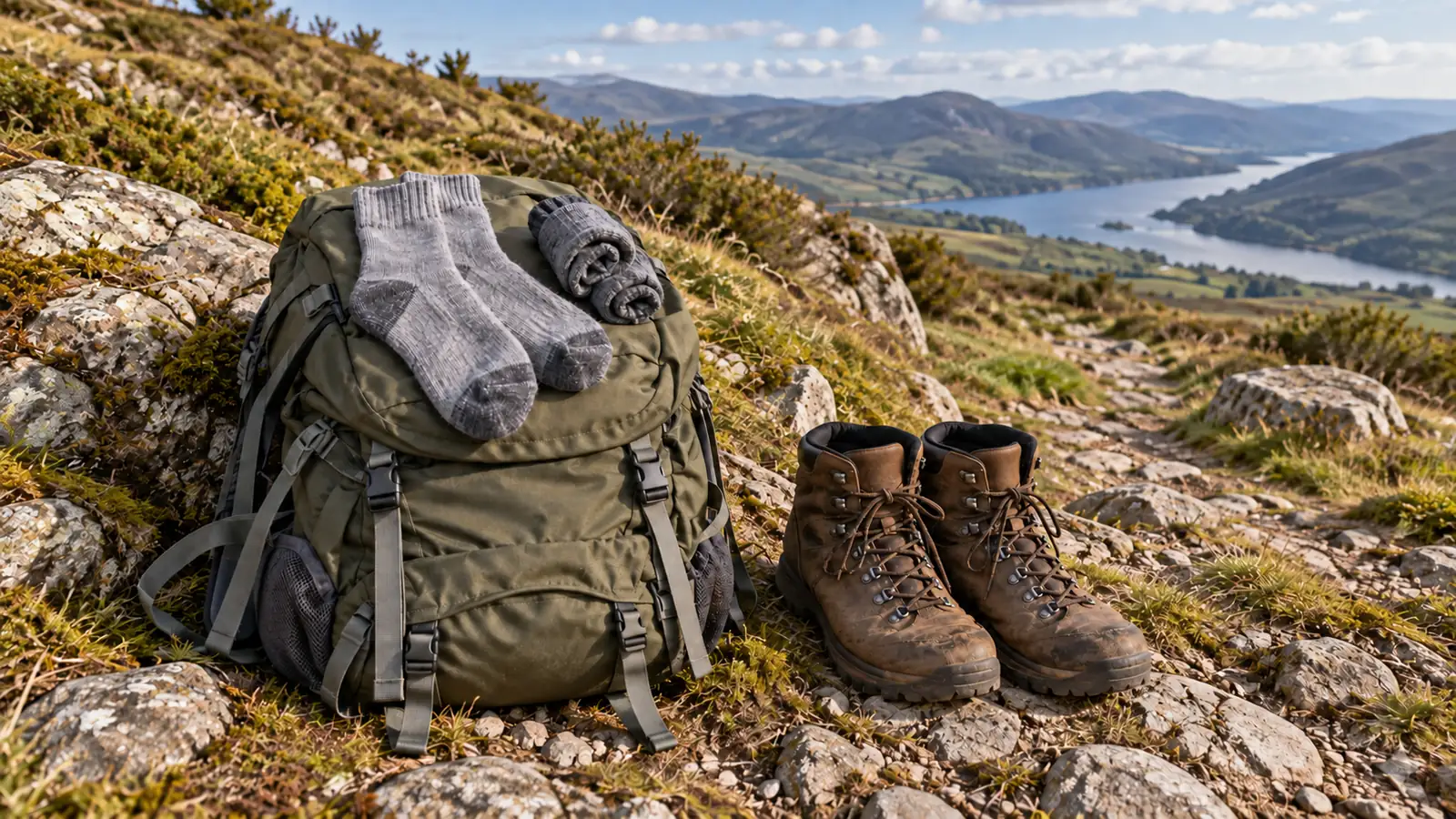
Choose the wrong socks for a long walk and a hot spot can turn into a blister long before you finish. Pick socks that fit without wrinkles, are made mostly of synthetic fiber or a wool blend rather than cotton, and carry a dry spare pair to change into when they get damp.
The best socks for long distance walking are the ones that keep friction and moisture down in your own shoes: a snug, wrinkle-free fit, a synthetic or wool-blend knit, cushioning only where the shoe has room, and a plan to change them. Fiber alone does not settle it. In a 2022 study of 203 walkers on the Camino de Santiago, walking in wet socks was linked with 1.94 times the risk of foot blisters, while the natural-to-synthetic fiber mix was not linked with blisters at all.
It sits with our other foot care guides for long-distance walkers. This guide is compiled from public health sources, a published US Army foot-march manual and peer-reviewed studies. We did not test any socks, and we do not rank brands. It is general information, not medical advice.
Quick specs: what to check on a walking sock
Check fit first, then fiber, cushion, seams and spares; the table lists each item with the source behind it.
| Input or item | Typical value or source | Why it matters |
|---|---|---|
| Fit | No tightness or loose fabric when standing with weight on both feet (US Army foot-march manual, 2017 edition) | Loose socks wrinkle and rub; tight socks wear out fast and restrict blood flow |
| Fiber | Nylon or moisture-wicking socks, not cotton (American Academy of Dermatology, 2026); synthetic or wool blends in studies | Cotton holds sweat, and damp skin rubs harder against fabric |
| Cushion | A cushioned sole if the shoe has room for it (US Army manual, 2017; NHS) | Adds padding, but a sock that makes the shoe tight creates new pressure points |
| Seams | Flat toe seam, knots and seams outside, no holes (US Army manual, 2017) | Lumps and worn patches concentrate rubbing |
| Spare pair | At least one dry pair on any walk of several hours (our recommendation); change when damp | Wet socks were linked with more blisters in two Camino studies (2020, 2022) |
| Liner or two pairs | Thin synthetic liner under a thicker sock; outer pair at least a half size larger (US Army manual, 2017) | A dense outer sock plus liner lowered blisters in a 1996 recruit study; a liner under the standard sock did not |
| Toe socks | Theoretical support only (Hoffman, 2016) | May help between-toe rubbing; not proven to cut blisters |
Takeaway: Use the table as a shopping list, and reject any sock that fails the fit row. | Compression | No difference from regular socks in a 2025 review of running trials | Walking and blister effects not shown; ask a doctor if it is for swelling or circulation |
Why socks matter so much on a long walk
Socks matter because blisters on long walks are caused by repeated rubbing, and the sock is the layer that decides how much of that rubbing reaches your skin. A sock can add friction (when it is wet, wrinkled or the wrong size) or take some of it away (when it fits, stays drier and pads the pressure points).
A 2014 review by Joseph Knapik in the Journal of Special Operations Medicine describes foot blisters as the result of boots rubbing on the foot until skin layers separate and fluid seeps in. It lists four ways to prevent them: properly sized footwear, conditioning the feet through regular walking with a load, socks that reduce friction and moisture, and possibly antiperspirants on the feet. A 2016 review by Martin Hoffman adds that the number of rubbing cycles counts too, which is why distance itself is a risk factor.
Moisture is the part a sock can change most. In a 2008 laboratory study, skin friction against fabric rose steadily as the skin became more hydrated, and a completely wet fabric produced more than twice the friction of dry fabric on natural skin. That study tested forearms against a hospital textile, not feet in socks, so treat it as an explanation of the mechanism rather than a sock rating.
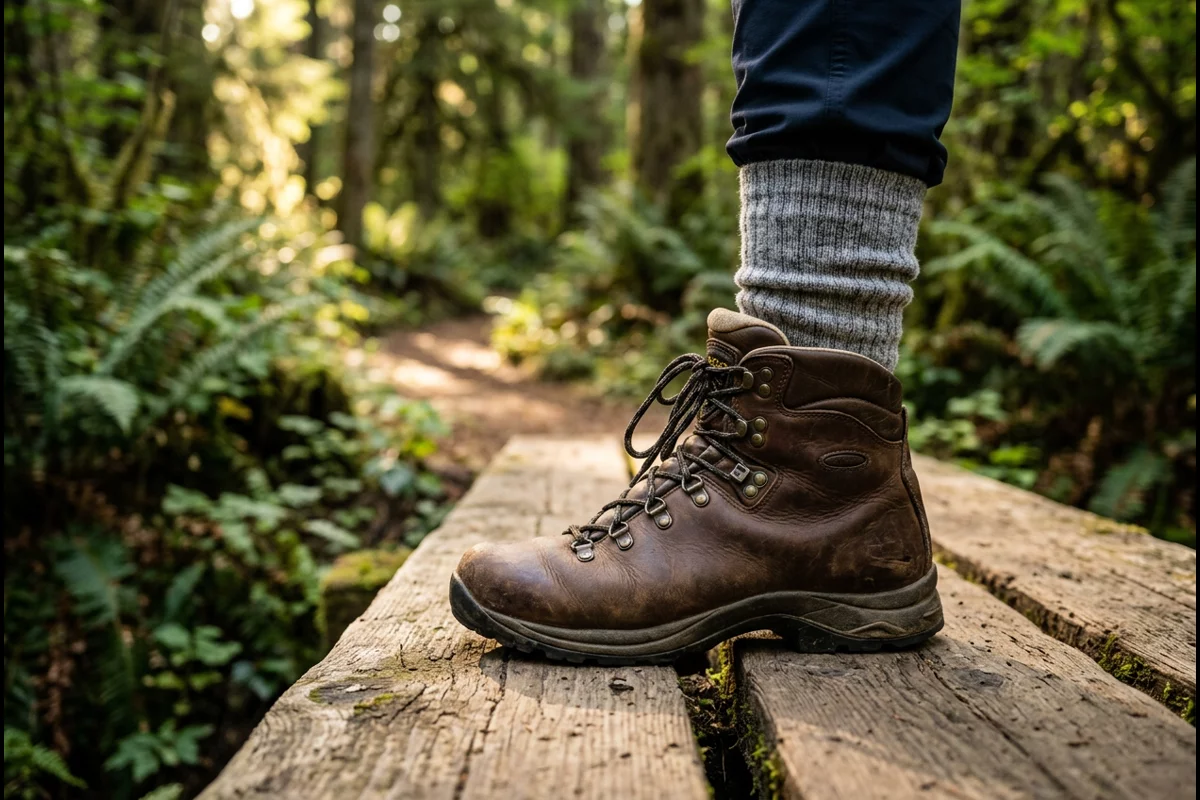
The field evidence points the same way. Two studies of walkers on the Camino de Santiago in Spain found that having wet socks at the end of the day was a risk factor for blisters: one of 315 walkers in 2020, and one of 203 walkers in 2022, where the risk was 1.94 times higher (95% confidence interval 1.04 to 3.61).
Takeaway: Judge a sock by how it handles friction, moisture and fit in your own shoe, not by its fiber label alone.
The 5-Check Sock Choice
The 5-Check Sock Choice is a simple order of decisions for choosing walking socks: fit first, then fiber, thickness, layering and finally how many spares you carry. Each later choice depends on the earlier ones; a perfect fiber cannot rescue a sock that wrinkles, and a thick sock is useless if the shoe has no room for it.
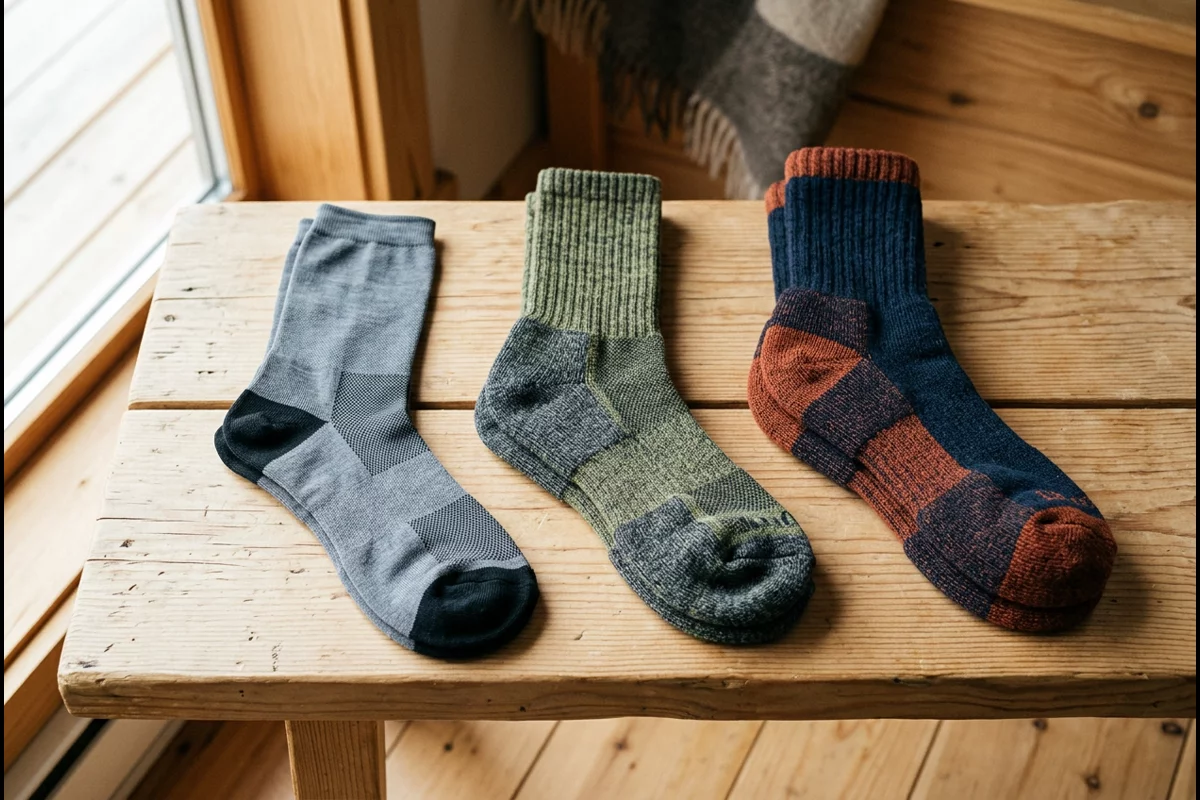
- Fit: the sock sits smooth with no tight bands or loose fabric.
- Fiber: synthetic or wool blend, not cotton, for long days.
- Thickness: cushioning that suits the weather and your comfort, within the room your shoe has.
- Layering: liner, two pairs, toe socks or compression only for a specific reason.
- Spares: enough dry pairs for your mileage and weather.
This is our way of ordering the published advice. It is not an industry standard or a clinical protocol.
Takeaway: Work through fit, fiber, thickness, layering and spares in that order, and stop at the first check a sock fails.
Step 1 — Check the fit before the fabric
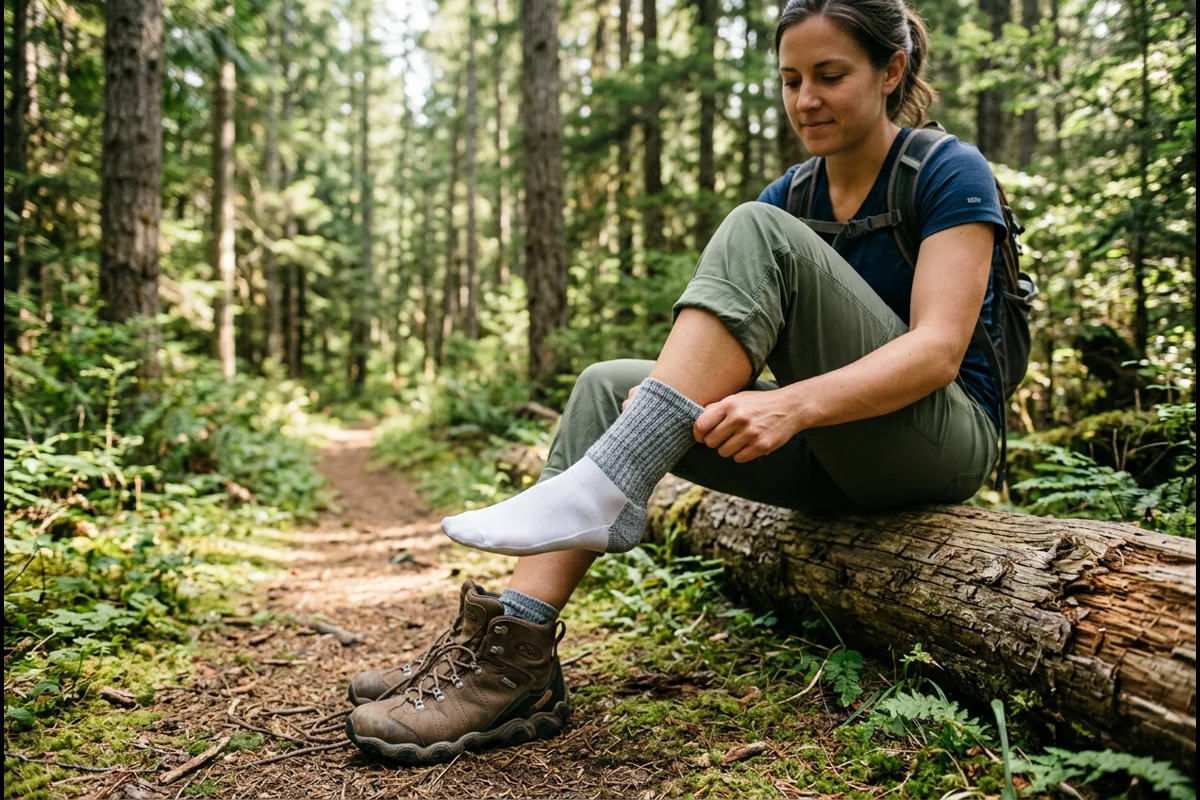
A walking sock fits when it lies flat with no wrinkles and no tight spots while you stand with your weight on both feet. That is the check described in the US Army’s foot-march manual (ATP 3-21.18, 2017 edition): socks that fit correctly show “no tightness or fullness”.
The same manual explains why both errors matter. Socks that are too large wrinkle inside the boot and rub the feet, causing blisters and abrasions. Socks that are too small wear out quickly and reduce blood flow in the foot. For new wool socks it advises allowing about 3/8 inch (about 1 cm) for shrinkage, and it says to wash socks in lukewarm water because hot water can shrink them.
How to check fit at home:
- Put the socks on with the shoes you will walk in, lace up, and stand with weight on both feet.
- Run a finger along the heel and the top of the toes; you should feel no fold or bunching.
- Check that the heel pocket sits on your heel, not above or below it.
- Walk around for a while, then take the shoe off and look for creases pressed into the skin.
Fit also depends on the shoe. The American Academy of Dermatology says shoes should not be too tight or too loose, and the NHS suggests wearing new shoes for short periods until they are comfortable. If a sock only fits when your shoes are loose, the shoe is the problem, not the sock.
Takeaway: If a sock wrinkles or pinches in your walking shoes, reject it before you look at anything else.
Step 2 — Choose the fiber: synthetic, wool blend or cotton?
For long walks, choose socks made mostly of synthetic fibers (nylon, acrylic, polyester, polypropylene) or a wool blend, and keep cotton for short, dry outings. The American Academy of Dermatology recommends nylon or moisture-wicking socks to prevent foot blisters, and advises avoiding cotton during activity because it soaks up sweat and moisture, which can lead to friction and chafing (our guide to preventing chafing covers the rest of the body).
The research behind fiber choices is thinner than sock marketing suggests, and the results do not all agree:
| Fiber question | What a study found | Limit of the finding |
|---|---|---|
| Acrylic vs cotton | Acrylic socks gave fewer and smaller blisters than identical cotton socks in 35 runners (1990) | A repeat with a generic cushion-sole sock in 1993 found no advantage for either fiber |
| Wool blend vs polypropylene | A 50% merino, 33% polypropylene, 17% polyamide blend felt cooler, less damp and more comfortable than a polypropylene sock over 4 days of 6.5 km (4 mile) marches; two of three skin sites were drier (2012) | Measured comfort and skin moisture, not blister counts |
| Synthetic vs natural share | The proportion of natural to synthetic fiber was not linked with blisters among 203 Camino walkers (2022) | Observational; sock wetness mattered, fiber did not |
| Fiber vs knit | In dry lab tests, knit structure affected sock-skin friction most; polyester vs cotton made almost no difference (2022) | Dry laboratory condition only |
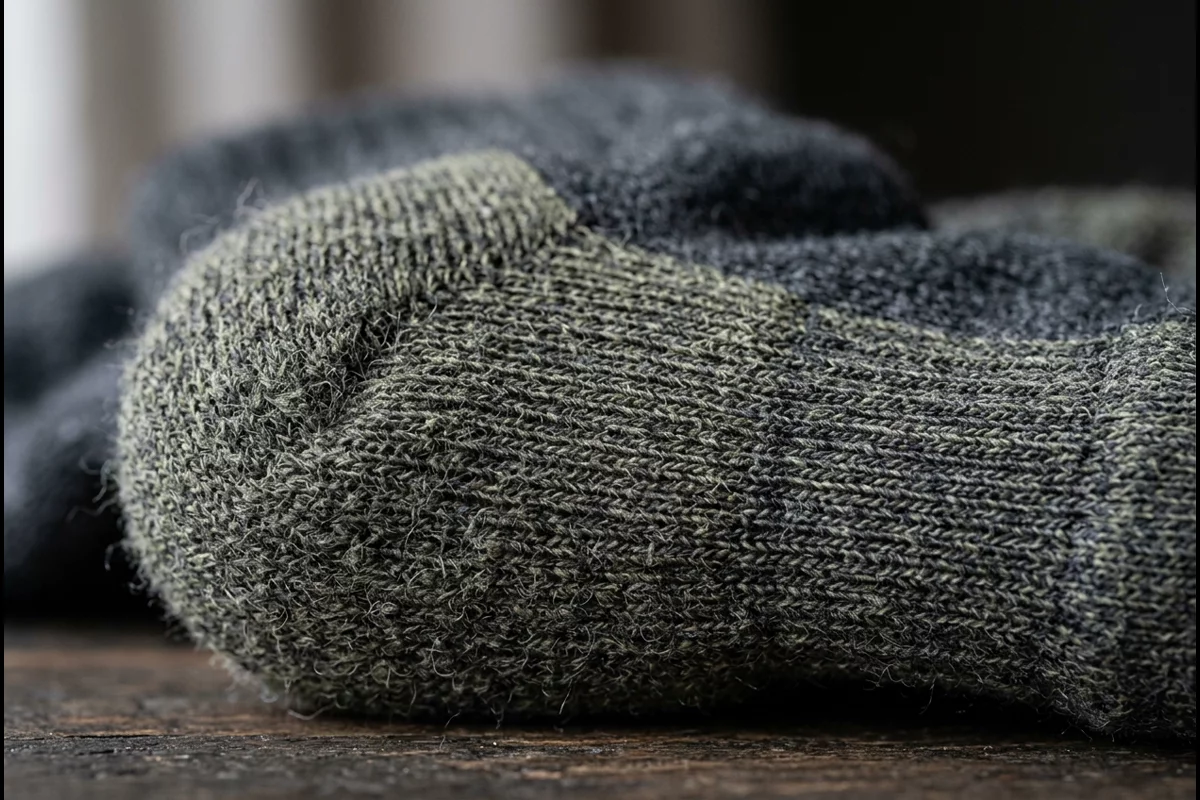
Our reading: fiber matters mainly through what it does when wet. Cotton holds water against the skin, so it is the one fiber worth avoiding for a long day. Between good synthetics and wool blends, comfort, warmth and how quickly the sock dries in your conditions are better guides than any claim that one fiber prevents blisters. In the 2012 field study the wool blend stored 2.9 times more moisture than the polypropylene sock yet was rated less damp, In the companion 2011 laboratory study the polypropylene sock tended to hold less water, but the difference did not show up in any measurement taken on the skin of the foot.
If you are allergic to wool, the same Army manual suggests nylon, acrylic or polypropylene as alternatives.
Common mistake: Buying a pricier fiber to fix blisters that are really caused by a sock that is too big or a shoe that slips at the heel. Fix fit first.
Takeaway: Rule out cotton for long days, then choose between synthetic and wool blend on comfort and drying, not on promises.
Step 3 — Are thick or thin socks better for walking?
Thicker, cushioned socks are better for long walks only when your shoes have room for them. The NHS suggests thick socks during exercise, such as moisture-wicking sports socks, and the 2017 Army manual prefers cushion-soled socks for marching. But a thick sock in a shoe sized for a thin one turns padding into pressure.
No study we found compares sock thicknesses directly for long walks. The 1990 and 1993 fiber studies only add a hint: the authors reported the acrylic advantage when the sock had anatomical padding, and none with a generic cushion sole. Thickness is therefore a comfort and fit choice to confirm on practice walks, not a proven blister fix.
A practical way to decide (our suggestion, not a tested rule):
- Thin or light cushion: snug shoes, hot weather, or when you wear a liner underneath.
- Medium cushion under the forefoot and heel: most all-day walking in shoes or boots with normal volume.
- Thick, full cushion: roomy boots, cold weather, or heavy loads, as long as your toes still move freely. If you are building up to carrying weight, see how much weight to start with.
Keep the thickness the same from training to the walk itself. Changing to a much thicker sock on the day changes how the shoe fits.
Takeaway: Choose a cushion level that leaves your shoe comfortable, confirm it on a long practice walk, and keep it the same on the day.
Step 4 — Decide on liners, two pairs, toe socks or compression
Add a layer or a special sock only to solve a specific problem: a liner or second pair for persistent blisters, or toe socks for rubbing between the toes. Compression socks have not shown a benefit in running studies, and walking was not tested. None of these has strong proof as a general blister preventer.
| Option | What it is for | What the evidence says | Strength |
|---|---|---|---|
| Thin liner under a thicker sock | Moves rubbing between the two sock layers | In 357 US recruits in basic training, a dense wool-polypropylene outer sock over a polyester liner had 40% blister incidence vs 69% with the standard sock (1996) | One trial, military boots |
| Two ordinary pairs | Same idea, using what you have | AAD suggests trying two pairs if one does not help; the Army manual says the outer pair should be at least a half size larger | Expert advice |
| Toe socks | Separate each toe to reduce toe-to-toe rubbing | A 2016 review lists double-layer and toe socks as having theoretical support but needing more research | Theory only |
| Compression socks | Graduated pressure on the lower leg | 28 running trials found no difference from regular socks in physiology, performance or perceived effort (2025) | Moderate to very low certainty |
Two details from the 1996 trial are worth knowing. Adding a polyester liner to the standard military sock did not lower overall blister incidence (77% vs 69%), but fewer recruits in that group developed blisters or cellulitis needing medical attention (9% vs 24%). The overall drop came only from the dense outer sock plus liner, where 11% needed medical attention.
Toe socks are worth a try if your blisters form between or on top of the toes. A 2014 study of a 219 km (136 mile) multi-day race found that 65% of blisters formed on the toes, so this is a common site, but no study we found shows that toe socks reduce them.
For compression, the running evidence tells you about heart rate, speed and perceived effort, not about walking or blisters. In the United States, medical support stockings are regulated by the FDA as medical devices (21 CFR 880.5780). If you are thinking of compression for swelling, varicose veins or any circulation problem, ask a doctor or pharmacist first.
Takeaway: Treat liners and toe socks as fixes for a known problem, and do not expect compression socks to prevent blisters.
Step 5 — Plan spares and sock changes
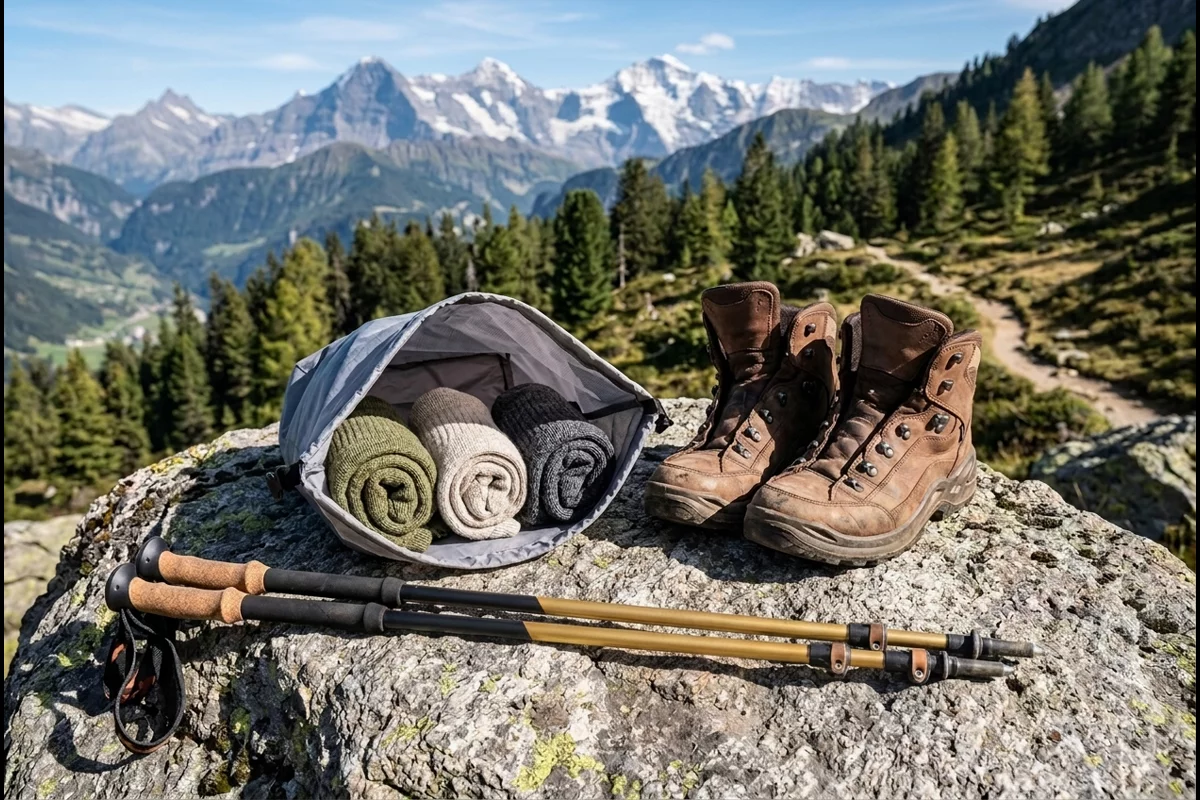
Carry at least one dry spare pair on any walk of several hours, and change into it at a planned stop or as soon as your socks feel damp. Wet socks were a blister risk factor in both Camino studies, and the 2022 authors recommended changing socks during long stages to keep the feet dry.
The 2017 Army manual gives a routine for long marches that civilian walkers can borrow without the military setting:
- Halfway through a long day, stop for about 15 minutes, change socks and powder the feet.
- Take off one shoe at a time at rest stops, check the feet and deal with any red patch.
- Dry damp socks inside a shirt next to the body or tied to the outside of the pack, and only wear them again once fully dry.
- Change socks every day; wash them in lukewarm water.
At rest stops, look for red, tender skin along the sides of the feet (our foot checks for loaded walks set out the full before, during and after routine), which the manual notes can develop into blisters on long marches. The American Academy of Dermatology advises stopping the activity if you feel pain or discomfort or your skin turns red.
Common mistake: Saving the spare pair “for later” while walking on in soaked socks. The dry pair does the most good before a hot spot forms.
Takeaway: Decide when you will change socks before you start, and change early rather than late.
Which socks for summer, cold rain and multi-day walks?
Match the number and type of socks to how long you walk and how wet your feet will get: the hotter, wetter and longer the walk, the more spares you need and the more drying time matters. The grid below is our summary of the advice above, not a tested system. It is set by walking time rather than miles, because pace and terrain vary: at an easy 20 minutes per mile, for example, 12 miles (about 19 km) is four hours of walking, so an all-day walk of 15 to 20 miles (24 to 32 km) means six hours or more on your feet.
| Walk | Hot or summer | Mild and dry | Cold or wet |
|---|---|---|---|
| Day walk, a few hours | Light synthetic or thin wool blend; one spare | Medium-cushion synthetic or wool blend; one spare | Wool blend, medium or thick if the boot has room; one spare in a dry bag |
| All-day walk | Light, quick-drying pair; two spares; change at midday | Your trained-in pair; one or two spares; change at midday | Wool blend; two spares kept dry; change when damp |
| Multi-day walk | Two or three pairs in rotation, washed and dried each evening | Two or three pairs in rotation | Three pairs if possible, with a dry pair reserved for camp |
For summer walking, sweat is the main source of moisture, so a thinner sock and more frequent changes usually beat a thicker one. In cold rain, no sock stays dry once water comes over the top of the shoe, so the spare pairs in a waterproof bag matter more than the fiber you start in. On multi-day walks the limit is drying time: plan a rotation so you never start a day in damp socks.
Takeaway: Count your spare pairs from the length of the walk and the weather, and keep at least one pair dry at all times.
What the research can and cannot tell you
The research supports a few clear points (keep feet dry, avoid cotton, get the fit right, train gradually) and leaves the question of the single best sock open. Most studies are small, many are military, and the results on fibers and special socks conflict.
| Study | Who | Main finding | Limit |
|---|---|---|---|
| Worthing et al., 2017 (systematic review) | 11 controlled studies of running, hiking and marching | Too little high-quality evidence to support socks, antiperspirants or barriers for blister prevention; moderate evidence that paper tape may help | Mixed methods, no pooled result |
| Chicharro-Luna et al., 2022 | 203 Camino walkers | Wet socks linked with 1.94 times the blister risk; fiber mix not linked | Cross-sectional |
| Chicharro-Luna et al., 2020 | 315 Camino walkers | Kilometres on asphalt and wet socks were risk factors | Cross-sectional |
| Knapik et al., 1996 | 357 US recruits in basic training | Dense outer sock plus liner: 40% blisters vs 69% standard sock | Military boots and training |
| Scheer et al., 2014 | 50 runners, 219 km over 5 days | 76% had blisters by day 4; sock type, powders, lubricants and taping showed no reduction | Small, observational |
| Telles et al., 2025 (review) | 28 running trials | Compression socks no different from regular socks | Running, not walking |
The US Army manual’s own summary of the research (2017, Appendix E) states that heavy loads increase blisters, that regular conditioning with load carriage induces skin adaptations that lower the chance of blisters, and that sudden increases in march intensity or distance probably make blisters likely regardless. In other words, socks are one part of blister prevention; how quickly you build up distance is another, which is why a loaded-walk plan that changes one variable at a time matters as much as the socks.
For the 2016 paper-tape trial itself, including who was studied and which products that abstract does not cover, see blister tape for hiking.
Takeaway: Use the research to rule out bad choices, then confirm your final choice on a long practice walk.
When this does not apply
This guide assumes healthy feet and ordinary walking or hiking. It does not apply, or needs a professional’s input, in these cases:
- Diabetes, poor circulation or reduced feeling in the feet: ask a doctor or podiatrist which socks and footwear to use and how to check your feet.
- An existing blister, infection or wound: follow the NHS advice on blisters, and get help from a doctor or NHS 111 (or your local equivalent) if a blister is very painful, keeps coming back or shows signs of infection such as heat, pus or spreading redness.
- Compression for a medical reason: medical support stockings are regulated devices; the choice of pressure and fit belongs to a clinician.
- Aching bones, numbness or swelling: changing socks is not a way to sort these out; ask a doctor or podiatrist.
- Military-specific requirements: the Army figures quoted here come from the 2017 edition of a manual that has since been replaced; any service member should follow current orders and equipment rules.
Takeaway: If your feet have a medical condition or an injury, get professional advice before relying on sock choice.
Your sock checklist before a long walk
Use this checklist the week before a long walk to confirm your socks, shoes and spares work together:
- Socks lie flat with no wrinkles or tight bands in the shoes you will wear.
- No cotton socks for walks of several hours.
- Cushion level suits the room in your shoe; toes can still move.
- Seams are flat, and the socks have no holes or thin patches.
- You have walked at least a few hours in this exact sock and shoe pair, ideally as part of a gradual training plan if the walk is long or loaded.
- Spare pairs packed for your mileage and weather, at least one kept dry.
- Planned sock change at a midday or halfway stop.
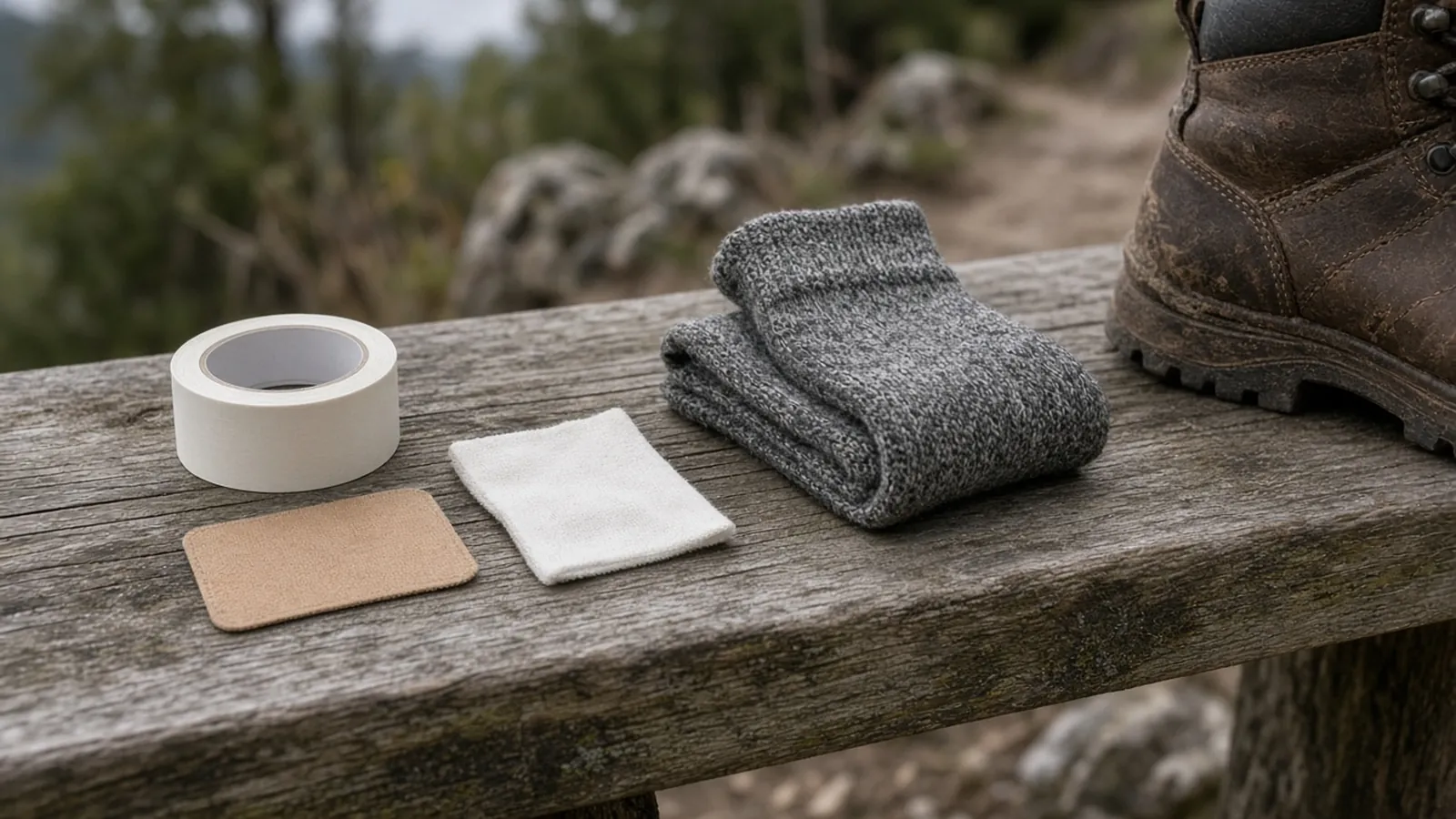
- Tape or soft padding packed for known hot spots, and a friction barrier such as balm or petroleum jelly if you also chafe elsewhere.
- You know when to stop: pain, discomfort or reddened skin.
For more on looking after your feet on the move, browse our foot care guides or see all articles. This is an independent information site; read about the site for who runs it and what it does not cover.
Takeaway: Test the whole sock, shoe and spare-pair setup on a practice walk before the long one.
Related reading:
- Ruck march training plan — Build up loaded walks gradually and check your feet each session.
- Anti-chafe balm and chafing prevention — Prevent rubbing on thighs, underarms and under pack straps.
How this guide was put together
We compiled this guide from public sources read on October 7, 2026: the American Academy of Dermatology’s blister page (last updated July 6, 2026), the NHS blisters page (last reviewed November 22, 2023), Appendix E of the US Army’s ATP 3-21.18 Foot Marches (April 2017 edition, released for public distribution; later editions exist and we could not retrieve them), the US Code of Federal Regulations, and the abstracts of peer-reviewed studies listed in the sources below. We did not test socks, measure anything ourselves or receive products from manufacturers, and we do not name or rank brands. Study results are reported with the population and conditions in which they were found. The scenario grid, the checklist and the “our suggestion” notes are our own planning advice built from those sources, not measured thresholds.
Takeaway: Research figures on this page come from named public sources; planning advice is labelled as ours, and none of it comes from our own testing.