Selecting the wrong anti chafe balm for runners and loaded marchers causes rapid barrier wash-off, salt-crust abrasion, and raw epidermal damage long before the finish line. Matching the barrier formulation—whether an anhydrous wax stick, a hydrophobic petrolatum-lanolin salve, or a breathable dimethicone silicone gel—to the mechanical load and moisture regime of each body zone prevents skin breakdown across high-cadence runs and heavy yomps.
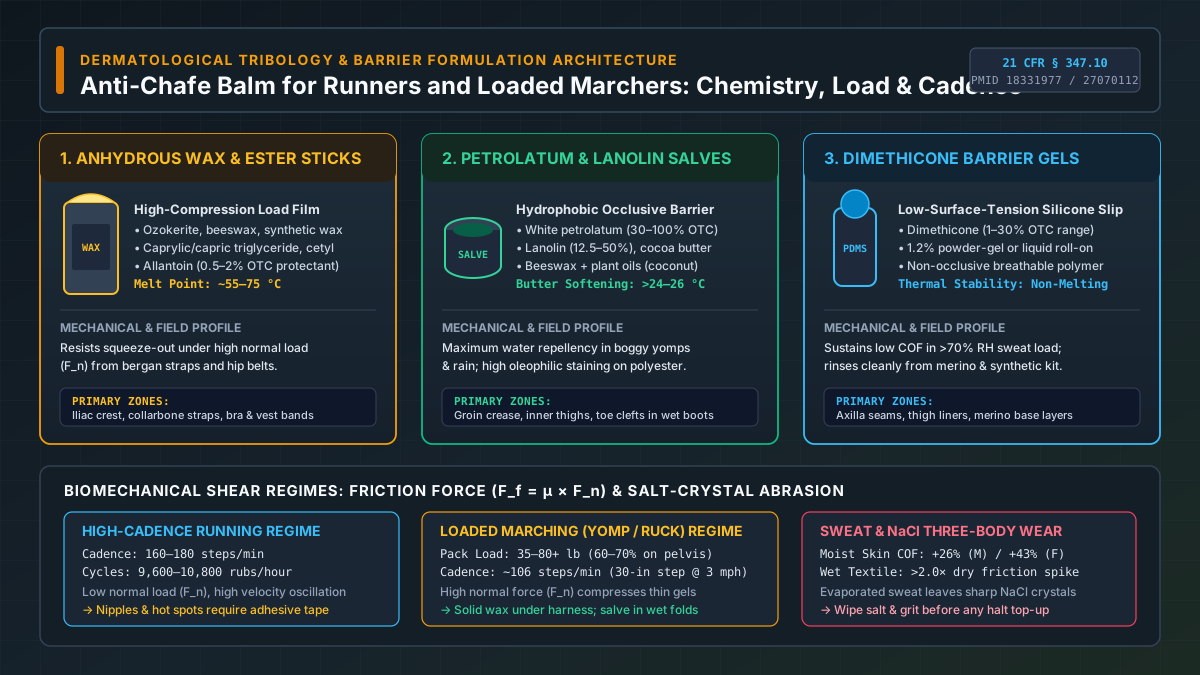
Whereas our general anti-chafe balm explainer introduces basic skin-protection habits for casual walks, endurance running and military-style loaded marching subject the skin to two distinct tribological regimes: high-frequency velocity oscillation (160–180 steps/min) versus high normal-force compression under a 35–80+ lb bergan (~106 steps/min at 3 mph). The table below compares the three primary barrier classes alongside porous paper tape so you can allocate the right chemistry to each contact patch before you dress.
| Barrier Class & Format | Representative Ingredients & Regulatory Baseline | Tribological & Thermal Behaviour | Sweat Resistance & Wash-Out Profile | Primary Anatomical Zones |
|---|---|---|---|---|
| Anhydrous Wax & Fatty-Ester Solid Sticks | Caprylic/capric triglyceride, cetearyl/stearyl alcohol, ozokerite or synthetic wax, tribehenin, cetyl esters, allantoin (0.5–2% under 21 CFR § 347.10), tocopherol |
Semi-solid, water-free waxy film with high melting point (~55–75 °C). Resists compression squeeze-out under high normal force (F_n) from pack straps and waistbands |
Does not dissolve in rain or sweat, but wet skin-on-skin rubbing mechanically abrades thin layers over 1.5–3 hours. Low garment transfer if set for 10–15 min |
Iliac crest hip-belt shelf, clavicle/trapezius bergan straps, sports bra bands, hydration vest borders |
| Petrolatum, Lanolin & Plant-Butter Salves | White petrolatum (30–100%), lanolin (12.5–50%), cocoa butter (50–100% under 21 CFR § 347.10), coconut oil, beeswax (Cera alba) |
High-viscosity hydrophobic occlusive coat. Cuts initial boundary friction in skin folds and stays pliable in cold bog or rain; plant-butter blends soften rapidly above 24–26 °C |
Maximum water repellency during river crossings and multi-hour downpours, but traps heat and binds strongly to oleophilic polyester and merino crimps | Inner thighs, perineal/groin crease, interdigital toe clefts in wet boots |
| Dimethicone (PDMS) Barrier Gels & Roll-Ons | Dimethicone (1–30% under 21 CFR § 347.10; e.g. 1.2% in powder-gel drug labels, or concentrated liquid roll-ons with aloe and vitamin E) |
Low-surface-tension polydimethylsiloxane polymer spreads into a microscopic, non-occlusive slip plane that does not melt under body or pack heat | High resistance to sweat wash-off in humid heat (>70% RH) without clogging pores; rinses out cleanly from synthetic and merino base layers at 30 °C |
Axilla (underarms), inner thighs paired with synthetic liners, under fitted technical shirts |
| Porous Paper Tape & Adhesive Guards | Medical-grade microporous paper tape, soft adhesive plaster, or moleskin applied to clean, dry, un-greased skin | Mechanical sacrificial shield: transfers shear stress from the epidermis to the outer backing of the tape (40% blister reduction in PMID 27070112) |
Stays bonded through sweat when applied to dry, lipid-free skin before activity; fails immediately if applied over any balm or oil residue | Runner’s nipples (singlet bounce), calcaneal heel pocket, and known metatarsal hot spots |
Formulation Chemistry: Wax Sticks vs. Petrolatum-Lanolin Salves vs. Dimethicone Gels
Searching for the best anti chafe balm without reading the ingredient panel often leads athletes to apply a low-viscosity coconut-oil salve under a 55 lb rucksack hip belt—where pack heat and pelvic pressure squeeze the melted oil straight into the waistband foam within five miles. Under US Food and Drug Administration over-the-counter monograph rules (21 CFR Part 347, § 347.10), products marketed with drug claims to protect chafed skin must use specific active ingredients within defined concentration windows: white petrolatum (30–100%), lanolin (12.5–50%), cocoa butter (50–100%), mineral oil (50–100%), dimethicone (1–30%), zinc oxide (1–25%), allantoin (0.5–2%), or topical starch (10–98%). Cosmetic anti-chafe sticks and balms use many of the same waxes, esters, and silicones without filing a drug monograph label.
Understanding how these three chemical families behave under load and sweat lets you match the container to the session:
- Anhydrous Wax and Fatty-Ester Solid Sticks: Formulated around microcrystalline, ozokerite, beeswax, or synthetic waxes suspended in medium-chain triglycerides (
caprylic/capric triglyceride) and long-chain fatty alcohols (cetearylorstearyl alcohol), solid sticks have a crystalline melting point between55 °Cand75 °C. Because they contain zero water (anhydrous), they do not evaporate or wash off in light rain. Their structural rigidity makes them the primary choice where normal load (F_n) is high—underneath a rucksack hip belt along the iliac crest, across the collarbones under shoulder webbing, or along a hydration-vest rib strap. Some sticks addallantoin(0.5–2%) as a skin protectant orzinc oxideandsilicato absorb surface dampness. - Petrolatum, Lanolin, and Plant-Butter Ointments: Pure white petrolatum (
30–100%hydrocarbons) and anhydrous lanolin (12.5–50%wool-wax esters) form a thick, hydrophobic film that blocks water penetration during boggy moorland yomps, stream wades, and cold winter rain. Natural salve tins frequently replace petrolatum with cocoa butter, shea butter, coconut oil (Cocos nucifera), and beeswax. While beeswax raises the softening point, unrefined coconut oil melts at24–26 °C. Inside a warm groin crease or a heated pack pocket, high-coconut-oil salves liquefy rapidly, requiring more frequent renewal than heavier petrolatum-lanolin or petrolatum-dimethicone-starch pastes (which combine hydrocarbon occlusion withaluminum starch octenylsuccinateto reduce greasy tack). - Dimethicone (Polydimethylsiloxane) Barrier Gels and Roll-Ons: Silicone polymers exhibit very low surface tension, allowing a small drop or roll-on swipe to spread across the stratum corneum into a thin, breathable, hydrophobic slip layer. For example, the DailyMed Drug Facts label for Monistat Chafing Relief Powder Gel specifies
Dimethicone 1.2%as an OTC skin protectant suspended in a volatile cyclopentasiloxane/dimethicone crosspolymer base that dries to a silky, powder-like finish. Higher-concentration liquid silicone roll-ons omit the powdery crosspolymer to leave a slick film suited to high-humidity running (>70%RH) where thick waxes feel draggy and petrolatum traps excessive sweat.
Takeaway: Match solid anhydrous wax sticks to high-pressure strap and belt lines, reserve hydrophobic petrolatum or lanolin-beeswax salves for skin-on-skin folds and cold wet immersions, and use dimethicone gels where breathable slip and clean fabric wash-out are priorities.
Dermatological Tribology: Sweat Hydration, COF Spikes and Salt-Crystal Abrasion
Skin chafing (superficial frictional dermatitis) and friction blisters share the same mechanical driver: repetitive shear force acting parallel to the skin surface. In classical contact tribology, the frictional shear force (F_f) acting on the stratum corneum follows the relation:
F_f = μ × F_n
where μ is the coefficient of friction (COF) between the skin and the opposing surface (adjacent skin, base-layer textile, or webbing strap) and F_n is the normal force pressing perpendicular to the skin.

Moisture alters μ dramatically. In a controlled in vivo tribological study of 22 healthy adults, Gerhardt et al. (2008, PMID 18331977) measured the friction of human volar forearm skin rubbed against textile across varied epidermal hydration states. On dry skin against dry fabric, baseline COF typically sits around μ ≈ 0.35–0.50. Moving from very dry skin to normally hydrated skin increased the coefficient of friction by 26% in men and 43% in women because absorbed water plasticizes the keratinised corneocytes, softening surface asperities and expanding the real area of adhesive contact. When the textile itself became completely wet against natural skin, the coefficient of friction spiked more than twofold (>2.0×, a >100% increase) compared with dry fabric.
Two compounding mechanisms turn that hydration spike into raw skin during long runs and loaded marches:
- High-Cycle Velocity vs. High Normal Load (
F_n): An endurance runner moving at160–180 steps/mincompletes9,600 to 10,800stride oscillations every hour. Even where normal force (F_n) is modest—such as a damp singlet brushing the chest or medial thighs grazing at mid-stance—multiplying a doubled wet-textileμacross40,000+cycles in a marathon delaminates the superficial stratum corneum. Conversely, a loaded marcher carrying a35–80+ lbpack at a standard3 mph(20 min/mile) pace steps at roughly106 steps/min(30-inchstep length), but transfers60–70%of pack weight onto the iliac crest via the hip belt. That high normal force (F_n) multiplies shear stress at every pelvic tilt. - Evaporative Salt-Crystal Three-Body Wear: Eccrine sweat contains roughly
0.5–2.0 g/Lof sodium chloride (NaCl). During windy ridge runs, desert ultras, or long summer marches, water evaporates from the edges of shirt seams, waistbands, and thigh liners, leaving behind microscopic, cubicNaClcrystals encrusted in the fibres. Once salt crystals precipitate between two rubbing surfaces, the contact mechanics shift from smooth two-body boundary sliding into three-body abrasive wear. Smearing fresh chafing cream for runners directly over dried salt crust or trail grit simply suspends those abrasive particles in grease, creating a grinding paste.
Published epidemiological studies confirm how widespread friction injury remains across endurance cohorts:
- In a 2024 cross-sectional study of
259sports university students in Germany (Scientific Reports, PMID 38783013), 34% reported exercise-induced chafing, alongside blistering (57%), skin dryness (57%), and erythema/redness (45%). - In a 2023 survey of
533French trail ultramarathon runners (Damoisy et al., PMID 37166255), 79% of runners who used preventative measures applied an anti-friction cream, yet total race distance remained the dominant driver of skin breakdown—underscoring why a single pre-race application cannot survive ultra-distance shear without kit adjustments and scheduled halt maintenance. - Where focal normal pressure and shear strip lubricants away, mechanical shielding outperforms creams: in the randomized Pre-TAPED II trial of
128desert ultramarathon runners (Lipman et al., 2016, PMID 27070112), applying porous paper tape to intact foot skin reduced blister incidence by 40% compared with untaped zones.
Takeaway: A barrier balm works by interposing a low-shear sacrificial film (μ_low) that keeps water out of the stratum corneum; once sweat evaporates into salt crust, you must wipe the salt away before renewing the film.
Anatomical Friction Zone Mapping: High-Cadence Running vs. Loaded Marching
Every anatomical friction zone has a distinct mechanical driver and dominant failure mode. Treating all six zones with a single tub of petroleum jelly ruins technical garments and leaves high-pressure strap zones unprotected.

Use the zone table below alongside our inner-thigh rucking liner checks and paper blister tape evidence guide to configure your pre-start routine:
| Anatomical Zone | Primary Mechanical Driver | Optimal Barrier Choice | Dominant Failure Mode & Field Correction |
|---|---|---|---|
| 1. Inner Thighs & Groin Crease (Intertriginous) | Medial thigh adduction (9,000+ cycles/hr running; long uphill strides marching) + trapped apocrine/eccrine sweat |
Dimethicone barrier gel (warm/humid runs) or petrolatum-lanolin-beeswax salve (cold rain/bog) + fitted quick-dry liner | Failure: Liner hem rides up into the wet contact patch. Fix: Stop, wipe salt crust, dry skin, pull down or swap liner so hem stays below the rubbing zone before reapplying |
| 2. Axilla (Underarms) & Lat Seams | Continuous arm-swing pendulum against damp raglan/set-in seams or hydration-pack armhole bindings | Dimethicone roll-on/gel or thin anhydrous wax stick applied 10–15 min before dressing |
Failure: Thick petrolatum traps sweat and permanently stains oleophilic polyester gussets. Fix: Switch to flatlock-seam tops and silicone or dry-feel ester sticks |
| 3. Nipples & Anterior Chest (Runner’s Nipple) | Vertical bounce of sweat-soaked or salt-stiffened synthetic singlet over 10,000+ strides (worsened by cold wind papillation) |
Porous paper tape, soft adhesive plaster, or dedicated nipple guards applied to clean, dry, un-greased skin | Failure: Wet singlet acts like sandpaper and strips balm by Mile 10–15. Fix: Apply mechanical adhesive guards before sweating; use thick wax/salve only on short runs |
| 4. Iliac Crest, Lumbosacral Pad & Waistband | High normal force (F_n) from a 35–80+ lb pack hip belt transferring 60–70% of load onto the pelvis + vertical micro-slip |
Anhydrous wax stick (55–75 °C melt point) along pelvic crest and sacrum + tucked flat-seam base layer |
Failure: Ointments soak through shirt into hip-belt foam padding. Fix: Cinch hip belt firmly onto the iliac shelf and use only a solid wax stick |
| 5. Clavicle, Trapezius & Sternum Harness | Downward and anterior-posterior strap shear across collarbones and ribs as soft flasks or heavy bergan loads oscillate | Anhydrous wax stick along neck/collarbone borders and under sports bra or sternum-strap bands | Failure: Loose shoulder straps allow pack bounce. Fix: Tension load-lifter and sternum straps first, then coat border skin with a solid stick |
| 6. Calcaneal Heel Pocket & Interdigital Toes | Confined boot humidity, heel lift on climbs, and forefoot splay on descents | Porous paper tape on known heel/metatarsal hot spots; thin petrolatum-dimethicone-starch salve between toes only | Failure: Greasing the whole foot prevents blister tape from sticking at Mile 8. Fix: Keep tape zones strictly oil-free; pair with properly fitted merino or synthetic walking socks |
Engineering Rule-of-Thumb — The Zero-Lipid Tape Boundary: Never apply petrolatum, lanolin, plant butters, or dimethicone within
3 cmof any skin area where you plan to apply porous paper tape, kinesiology tape, moleskin, or adhesive nipple guards. Even trace silicone or lipid migration lowers peel adhesion below the shear threshold of a damp sock or singlet. Tape clean, dry skin first, then apply balm to separate interdigital or intertriginous zones.
Takeaway: Separate mechanical taping zones (nipples, heel hot spots) from lubricated sliding zones (thighs, groin, axilla, strap lines) before opening any balm container.
Distance & Humidity Reapplication Matrix and Worked 30-Mile Halt Model
No OTC drug monograph or cosmetic balm label establishes a universal hour or mile duration; product directions from both Body Glide and the Monistat DailyMed label state to apply as needed. On the trail, waiting until you feel a sting means the stratum corneum is already abraded—at which point the American Academy of Dermatology (AAD) blister prevention guidance directs stopping activity rather than coating damaged skin.
To stay ahead of boundary-film breakdown, tie skin and kit inspections to route distance, relative humidity (RH), and scheduled march halts:
| Route Profile & Duration | Environmental & Sweat Load | Pre-Start Application Protocol (Mile 0) | On-Route Inspection & Salt-Wipe Interval | Field Pocket Kit Carried |
|---|---|---|---|---|
10-Mile Run / Standard March (2.5–3.5 hours) |
Dry weather, <65% RH, moderate sweat rate |
Apply thin wax stick to strap/waistband lines and dimethicone or salve to thighs 10–15 min before dressing |
Single midpoint check at Mile 5–6 (~90 min halt) if testing new kit; otherwise post-session wash |
Travel mini-stick (10–15 g) or 1 single-use foil packet in shorts/belt pocket |
Marathon / 20-Mile Loaded March (4–6.5 hours) |
Warm or humid (65–80% RH), sustained sweat evaporation and salt buildup |
Pre-tape nipples and heel hot spots on dry skin; apply dimethicone gel or wax stick to axilla, thighs, and pelvic shelf | Inspect every 6–8 miles (~2 hours). Wipe dried salt crust with a damp wipe, pat dry, and renew barrier on intact skin |
2–3 single-use dimethicone/salve foil packets + mini wax stick + 2 alcohol-free wet wipes |
30-Mile+ Yomp / Ultramarathon (7–12+ hours) |
Severe (>80% RH, heavy rain, bog trotting, or river crossings) |
Full zone separation: paper tape on focal shear points; hydrophobic petrolatum-lanolin-beeswax salve in groin/thighs; wax stick under harness | Inspect every 5–6 miles (90–120 min) and immediately after water immersions. Swap salt-stiffened liner/socks before reapplying |
Wet-dry zip pouch: 5 single-use foil packets, travel wax stick, wet wipes, microfibre drying square, spare liner & socks |
Worked Calculation Example: 30-Mile Loaded March vs. Ultramarathon Shear & Halt Budget
To plan your field skin-care kit alongside our ruck march training plan and pacing tables, calculate both the cumulative mechanical shear cycles and the required number of on-route inspection halts and single-use barrier packets.
1. Cumulative Stride Cycles and Pelvic Normal Force (F_n):
- 30-Mile Ultramarathon Runner (
15 min/milepace =5.0 hoursmoving time at170 steps/min):Total Stride Cycles = 300 min × 170 steps/min = 51,000 steps(25,500medial thigh and arm-swing rub cycles per side). - 30-Mile Loaded Marcher (
17 min/milepace =8.5 hoursmoving time at106 steps/minwith a55 lb/25 kgbergan):Total Stride Cycles = 510 min × 106 steps/min = 54,060 steps(27,030cycles per side). With a properly tensioned hip belt transferring65%of the55 lbload onto the iliac crest, the pelvic shelf supports a sustained normal load ofF_n = 55 lb × 0.65 = 35.75 lbf(159 N). If sweat saturation doubles the unprotected textile COF fromμ = 0.40toμ = 0.80, frictional shear force across the lumbosacral and iliac belt line jumps fromF_f = 0.40 × 159 N = 63.6 Nto127.2 Nper pelvic oscillation. Maintaining an intact wax-ester boundary film (μ ≈ 0.20–0.25) cuts that tangential shear back down to31.8–39.8 N.
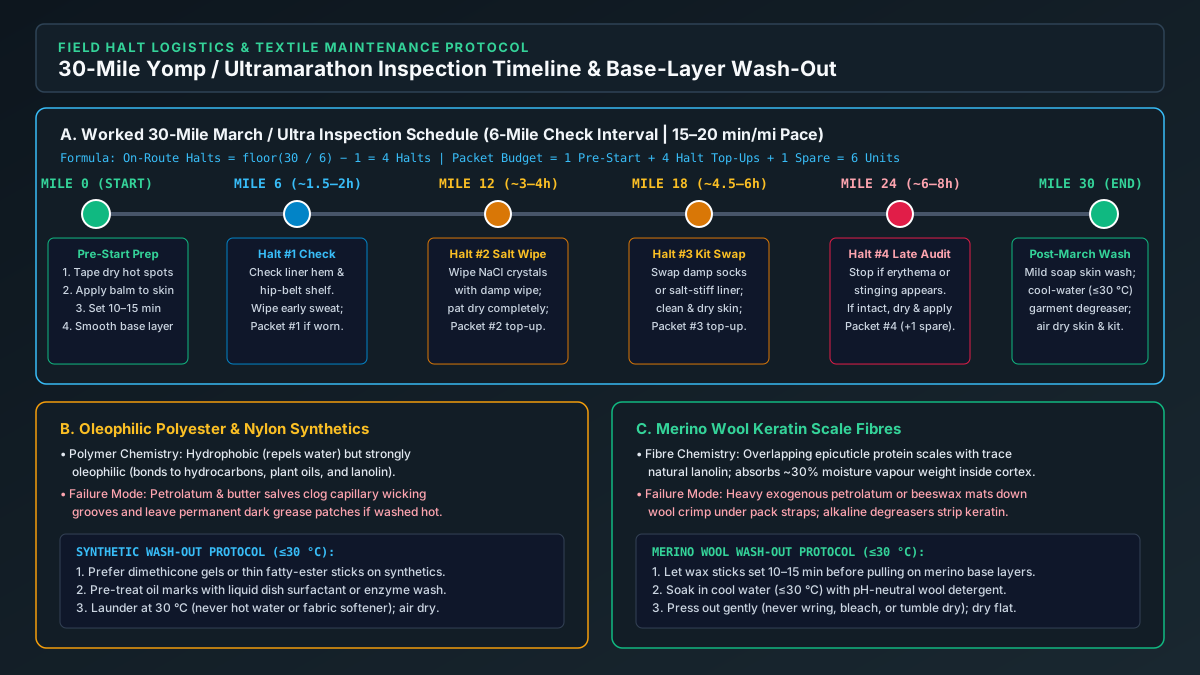
2. Inspection Halt and Single-Use Packet Budget (6-Mile Check Interval):
Using a planned inspection interval of I = 6 miles over a total route distance of D = 30 miles:
On-Route Inspection Halts = floor(D / I) - 1 = floor(30 / 6) - 1 = 4 halts (at Miles 6, 12, 18, and 24)
Total Barrier Packet Budget = 1 (Pre-Start at Mile 0) + 4 (On-Route Halt Top-Ups) + 1 (Contingency River/Squall Spare) = 6 single-use units
Using individual foil packets (or scraping a clean portion from a tin with a clean knuckle) prevents cross-contaminating a bulk tub with sweaty, grit-covered fingers at Mile 18. At each of the 4 halts, follow a strict four-step gate:
- Inspect skin and garment alignment: Check whether the thigh liner hem has crept upward or the shirt has bunched under the hip belt.
- Apply the stop threshold: If you see erythema (redness), broken skin, or a forming blister, do not apply anti-chafe balm. Follow our guide on how to avoid blisters on long walks and when to stop at the first hot spot and the NHS blister care guidance: stop the rubbing source and protect damaged skin with a sterile padded dressing or plaster.
- Remove salt crystals and dry: On intact, non-painful skin, wipe away evaporated
NaClsalt crust and trail dust with an alcohol-free wet wipe or damp corner of a cloth, then pat completely dry with a clean microfibre square. - Renew the boundary layer: Apply a thin, even coat extending
2–3 cmbeyond the contact patch before smoothing the dry liner or base layer back into place.
Takeaway: For a 30-mile effort, schedule 4 on-route skin checks (Miles 6, 12, 18, and 24), carry 5 on-route top-up doses plus your pre-start application, and always wipe away salt crystals before reapplying to intact skin.
Base-Layer Fabric Compatibility: Oleophilic Synthetics vs. Merino Wool Wash-Out
Applying the right barrier in the field should not ruin expensive technical base layers in the wash. Synthetic polymers and natural wool fibres interact very differently with hydrocarbons, waxes, and silicones:
Polyester, Polypropylene and Nylon Synthetics
- Fibre Chemistry: Technical synthetic fabrics are hydrophobic (they absorb less than
0.4–4%moisture by weight) but strongly oleophilic (oil-loving). Their petrochemical polymer chains form strong van der Waals bonds with non-polar hydrocarbons (white petrolatum,mineral oil), plant triglycerides (coconut oil), andlanolin. - Degradation Mode: Heavy petrolatum or butter salves smeared at the underarms, collarbones, or inner-thigh gusset clog the microscopic capillary grooves engineered to wick sweat outward. If washed in warm or hot water (
>40 °C), the melted oils polymerise into dark, translucent grease patches that trap body odour (Corynebacteriumvolatiles) and permanently deaden breathability. - Wash-Out Protocol: Prefer dimethicone gels or thin fatty-ester sticks under synthetic shirts and compression liners. When laundering petrolatum- or wax-contacted synthetics, pre-treat contact zones with a few drops of liquid dish surfactant or an enzyme-active sports wash, work it gently into the fibres with your fingers, and machine-wash in cool water (
≤30 °C) without liquid fabric softener (which coats wicking channels in cationic tallow).
Merino Wool Base Layers and Walking Socks
- Fibre Chemistry: Merino wool is a natural keratin protein fibre sheathed in overlapping microscopic epicuticle scales with a trace hydrophobic lipid monolayer (
18-methyleicosanoic acid). Its hydrophilic inner cortex absorbs up to~30%of its dry weight in moisture vapour before feeling clammy. - Degradation Mode: Heavy exogenous petrolatum or stiff beeswax pastes glue the wool crimp together under bergan shoulder straps and hip belts, creating stiff, abrasive patches that attract trail dust. Conversely, trying to strip grease out of merino wool using alkaline heavy-duty degreasers, biological protease enzymes, or hot water (
>40 °C) attacks the protein scales and causes irreversible felting and shrinkage. - Wash-Out Protocol: When wearing merino tops or moisture-wicking merino walking socks, use water-dispersible dimethicone barrier gels or let an anhydrous wax stick set on your skin for
10–15 minutesbefore pulling the garment on. After the march, soak the garment in cool water (≤30 °C) with a pH-neutral wool detergent, gently press the suds through the strap and underarm zones without wringing, rinse in cool water, and dry flat away from direct heat.
Takeaway: Protect synthetic wicking channels and merino wool scales by applying solid sticks 10–15 minutes before dressing, choosing dimethicone gels under delicate base layers, and laundering all barrier-contacted kit at 30 °C or below.
Pre-Start & Halt Field Checklist
Before stepping off on a marathon build-up run or a loaded march, run through this verification sequence. Additional kit and hygiene protocols are available in our personal care guides and the field guides index:
- Zone separation completed on dry skin: Nipples and known heel/metatarsal hot spots taped with porous paper tape or adhesive guards before touching any balm or grease.
- Strap and hip-belt interface coated: Anhydrous wax stick (
55–75 °Cmelt point) applied along the iliac crest, lumbosacral pad, collarbones, and sports bra or vest rib straps10–15 minutesbefore dressing. - Intertriginous folds protected: Dimethicone barrier gel (for warm/humid runs and synthetic/merino base layers) or petrolatum-lanolin-beeswax salve (for cold rain, bog, or river crossings) applied to inner thighs and groin crease.
- Garment coverage verified in motion: Quick-dry liner hem extends below the medial thigh rubbing patch without rolling upward during a full stride, and the base layer lies flat without wrinkles beneath the hip belt.
- Halt kit packed in an external pouch: Single-use foil packets or mini stick, alcohol-free wet wipes for
NaClsalt-crust removal, and a dry microfibre square stored in a hip-belt or vest pocket for 6-mile inspection stops.