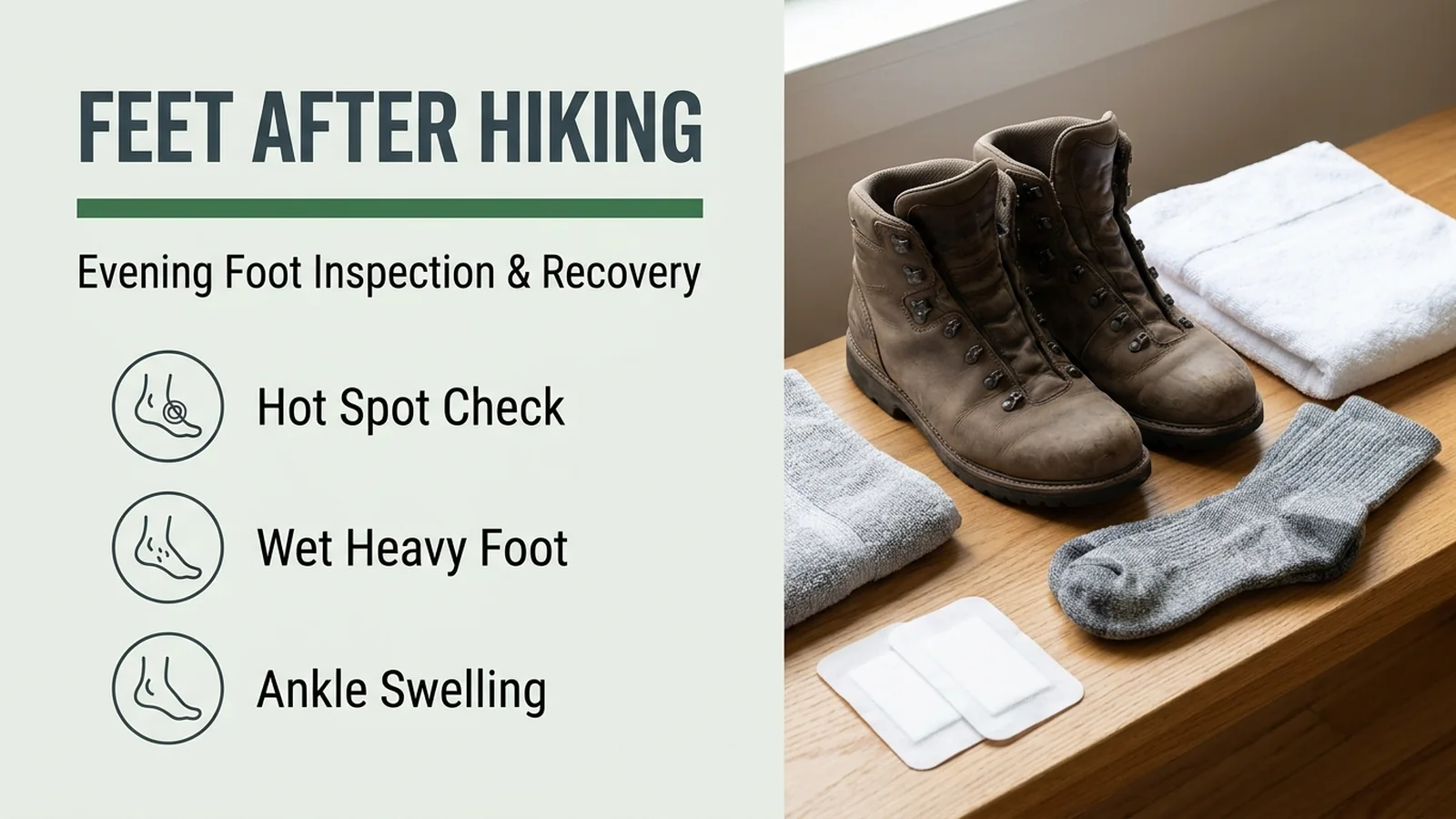
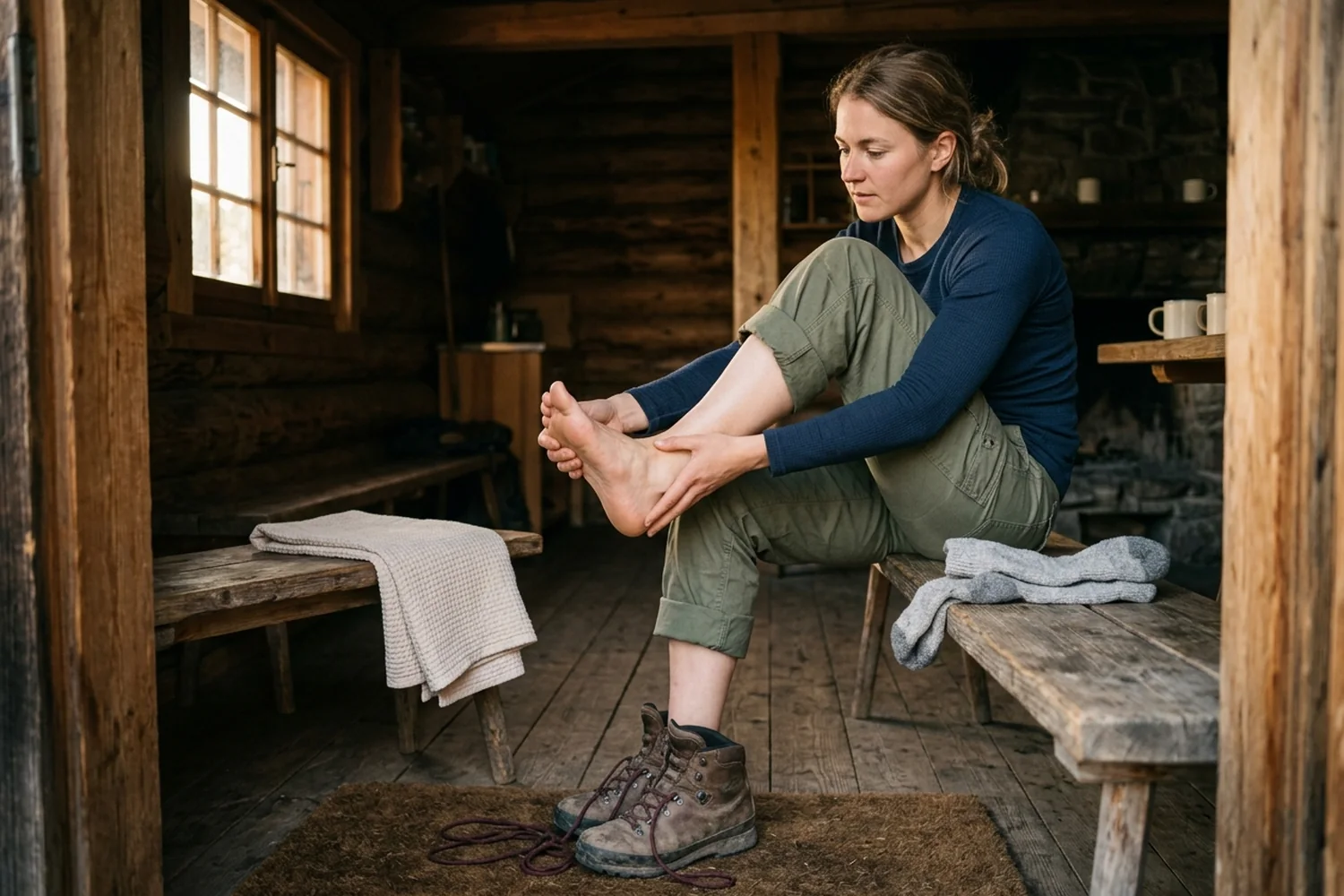
Check your feet right after hiking for red hot spots, intact or burst blisters, prolonged wet-foot heaviness, and ankle or foot swelling before putting on camp socks. Stop the activity immediately if a spot hurts, feels uncomfortable, or turns red so a blister does not form; once a blister is present, gently wash the skin, pat it dry, cover it with a soft plaster, padded dressing, or hydrocolloid moist dressing, and do not burst it yourself, peel the roof, pick the edges, or wear the shoes that caused it until it heals. If your feet stayed wet for long periods and now hurt, swell, and feel heavy, follow the Centers for Disease Control and Prevention (CDC) trench-foot steps: clean and dry the feet, wear clean, dry socks, soak affected feet in warm water for 5 minutes, elevate bare feet while sleeping, and seek medical attention right away.
Ordinary fluid swelling in both feet and ankles often goes away on its own and is often a build-up of fluid called oedema from standing or sitting in the same position for too long; raise your legs or the swollen area on a chair or pillows, take gentle walks to improve blood flow, wash, dry, and moisturize the skin to avoid infections, and switch the next morning to wide, comfortable shoes with a low heel and soft sole without clothes, socks, or shoes that are too tight. Unexplained swelling in 1 ankle, foot, or leg, or painful hot swollen skin from cellulitis, needs an urgent GP appointment or NHS 111; a hot blister filled with green or yellow pus, or a very painful blister, needs NHS 111; and severe heel pain after an injury, including a snap, grinding, or popping noise, an odd angle, or being unable to walk, needs NHS 111 because those signs can mean a broken heel bone or broken ankle rather than a footwear adjustment. Pair this evening inspection with camp foot-washing and wash-water disposal, how to avoid blisters when hiking, and our long-distance walking field guides.
How Do You Check Your Feet Right After Hiking?
Take your boots and damp trail socks off in good light as soon as the hike stops so you can separate localized shear injury from prolonged wetness, fluid swelling, and plantar or heel pain. Rushton and Richie explain that rubbing across the skin surface is not the mechanism that forms foot friction blisters during running, hiking, or military marches; instead, repetitive shear deformation develops from 3 fundamental elements: (1) motion of bone, (2) high friction force, and (3) repetition of the resulting shear events. Knapik and colleagues describe how those frictional forces mechanically separate epidermal cells at the stratum spinosum, filling the space under hydrostatic pressure with plasma-like fluid that has a lower protein level, while NHS notes that blood blisters appear when skin blood vessels are damaged as well.
Skin hydration changes frictional force when the socks come off: Knapik and colleagues note that moist skin increases frictional force, whereas very dry or very wet skin decreases frictional force, and trench foot occurs when feet stay wet for long periods (see keeping feet dry when hiking in rain for boot-collar water entry and trail sock swaps).
| Evening foot finding | Distinguishing signs | Immediate evening care | Next-day footwear and medical escalation |
|---|---|---|---|
| Intact friction blister or red hot spot | Pain, discomfort, or red skin before fluid collects; clear fluid pocket under intact skin, or a blood blister if skin blood vessels were damaged | Stop immediately at pain or red skin; gently wash skin, pat dry, and cover an intact blister with a soft plaster, padded dressing, or hydrocolloid moist dressing without popping or draining it | Do not wear the shoes or use the equipment that caused the blister until it heals; contact NHS 111 or see a doctor if very painful, recurring, hot, or filled with green or yellow pus |
| Blister that has already burst or lost its roof | Torn roof draining fluid or exposed raw skin at the blister base | Wash hands before touching, let fluid drain, wash the area with soap and water, apply petroleum jelly, keep the blister roof in place over raw skin, and cover with a plaster or hydrocolloid dressing | Do not peel skin off a burst blister or pick remaining skin edges, and leave off the causal shoes until healed; see a doctor or board-certified dermatologist if redness, pus, or increased pain or swelling appears |
| Immersion or trench foot | Feet stayed wet for long periods in cold, usually non-freezing damp conditions and now hurt, swell, and feel heavy | Clean and dry the feet, put on clean, dry socks, soak affected feet in warm water for 5 minutes, and elevate bare feet when sleeping | Seek medical attention right away whenever trench foot is suspected because skin and tissue breakdown increases infection risk |
| Ordinary fluid swelling in both feet or ankles (oedema) | Bilateral fluid build-up after standing or sitting too long without hot skin, pus, or sudden injury | Raise the legs or swollen area on a chair or pillows, get gentle exercise such as walking to improve blood flow, and wash, dry, and moisturize the feet to avoid infection | Wear wide, comfortable shoes with a low heel and soft sole and do not wear clothes, socks, or shoes that are too tight; see a GP if bilateral swelling has not improved after a few days at home or gets worse |
| Plantar-fasciitis bottom-of-foot pattern | Pain around the heel and arch that is much worse on first steps after sleeping or resting, improves with movement, worsens with long walks, and hurts when stretching the sole or raising toes | Rest and raise the foot, and place an ice pack or bag of frozen peas wrapped in a towel on the painful area for up to 20 minutes every 2 to 3 hours | Wear shoes with cushioned heels and good arch support, avoid high heels, tight pointy shoes, and barefoot walking on hard surfaces, and see a GP if unimproved within 2 weeks, severe, tingling, or with diabetes |
| Cellulitis, 1-sided swelling, or heel fracture / Achilles red flags | Painful, hot, swollen skin (redness may be less obvious on brown or black skin), unexplained swelling in 1 ankle, foot, or leg, or sudden sharp heel pain with swelling, a popping or snapping sound, and trouble walking | Raise a cellulitis-affected limb on a pillow or chair; do not try to diagnose heel pain or treat a suspected broken heel bone yourself | Ask for an urgent GP appointment or NHS 111 when skin is painful, hot, and swollen, or when 1 ankle, foot, or leg is swollen for no known reason; contact NHS 111 for a suspected broken heel bone; call 999 or go to A&E when cellulitis comes with a very high temperature, a fast heartbeat or fast breathing, purple patches, dizziness or faintness, confusion, cold clammy or pale skin, or unresponsiveness |
Should You Pop a Blister After a Hike, and Which Dressing Works?
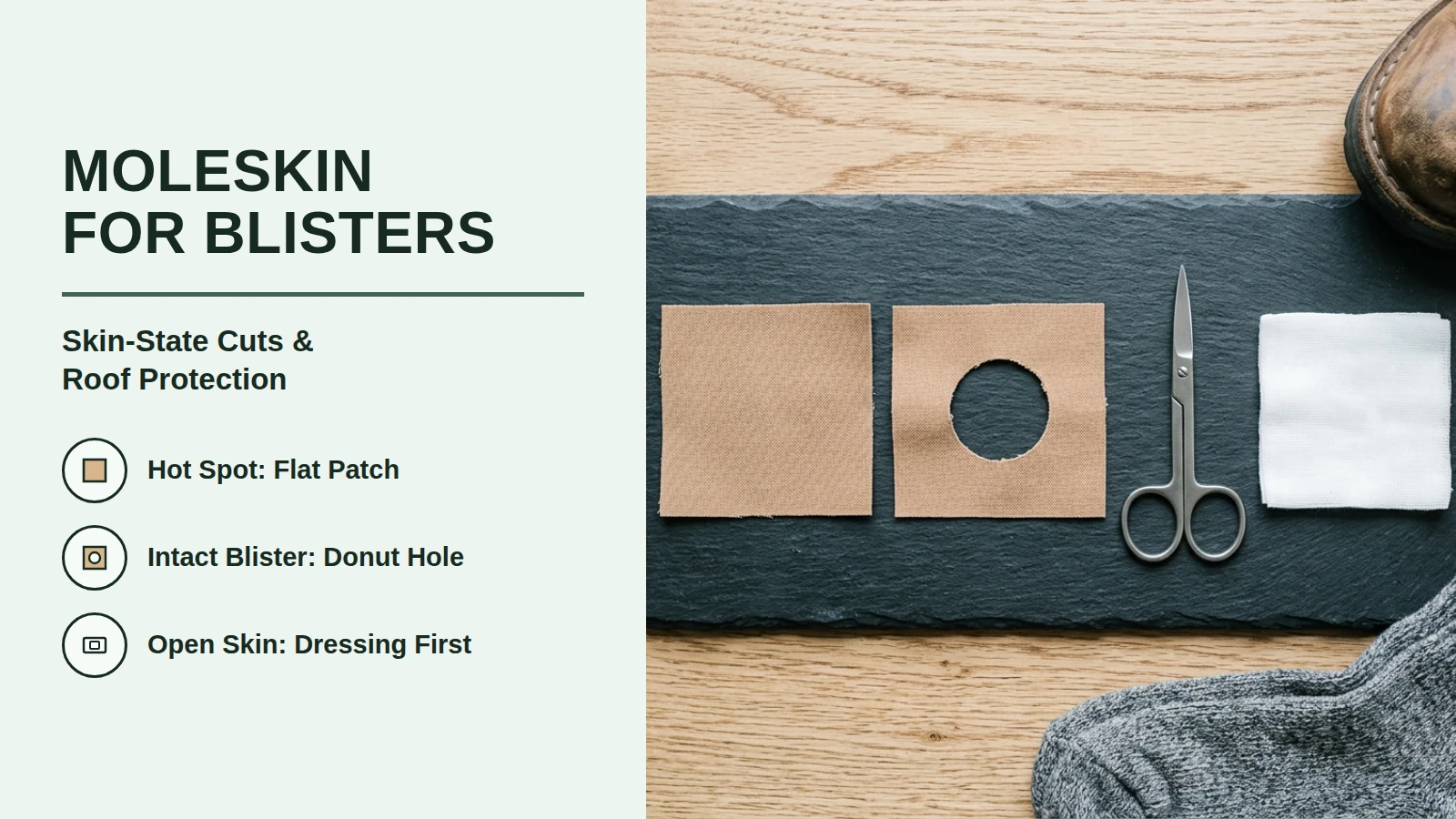
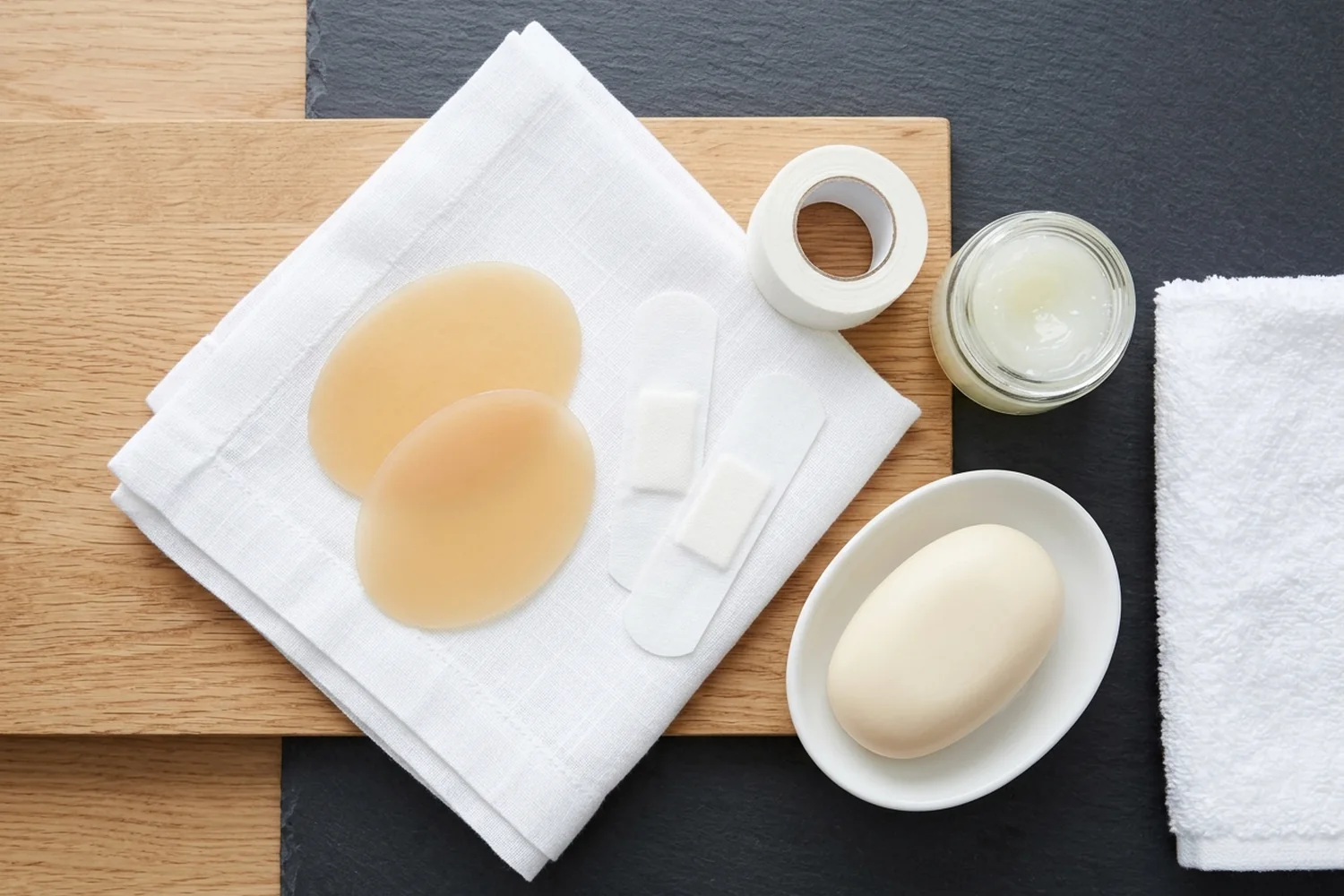
Do not burst, pop, or drain an intact blister yourself after a hike, because both NHS guidance (last reviewed 22 November 2023) and the American Academy of Dermatology (last updated 7/6/26) advise leaving the blister roof intact to avoid infection. NHS notes that blisters often heal on their own within a week and usually do not need a GP visit, while the American Academy of Dermatology states that most blisters heal in one to two weeks and advises not resuming the activity that caused the blister until it has healed; although Knapik and colleagues noted clinical experience draining intact blisters while keeping the roof, NHS places needle drainage strictly with a GP using a sterilized needle for a large or painful blister.
When a blister has already burst inside your sock, NHS instructs washing your hands before touching it, allowing the fluid to drain before covering it with a plaster or dressing, and neither peeling off the roof nor picking at the edges of remaining skin; the American Academy of Dermatology adds washing a drained blister with soap and water, applying petroleum jelly, and keeping the roof intact over the raw skin underneath. NHS describes a hydrocolloid moist dressing as protecting a blister, reducing pain, and speeding up healing, and Knapik and colleagues note both that hydrocolloid dressings on deroofed blisters provide pain relief and may allow continued physical activity if necessary and that blister-base cells begin taking up amino acids and nucleosides about 6 hours after formation, show high mitotic activity in the basal cells at 24 hours, and form a new stratum granulosum at 48 hours and a new stratum corneum at 120 hours.
Published march studies also show that faster or newer blister coverings do not outperform standard adhesive tape in routine first aid:
- At the 2015 Nijmegen Four Days Marches, Janssen and colleagues compared 2 friction-blister regimens across 2907 participants (age 45 ± 16 years, 52% men) receiving 4131 blister treatments. Wide area fixation dressing took 41.5 minutes (SD 21.6 minutes) to apply versus 43.4 minutes (SD 25.5 minutes) for adhesive tape (P = 0.02), saving 2 minutes (4.5%), yet wide area fixation had a higher drop-out rate (11.7% versus 4.0%, P = 0.048) and more delayed blister healing (51.9% versus 35.3%, P = 0.02), so the authors do not recommend it over adhesive tape.
- After a 10-km military road march, Levy and colleagues screened 75 patients and enrolled 51, assigning 26 to 2-octylcyanoacrylate skin adhesive and 25 to standard blister treatment across 80 blisters (40 per group; mean size 12.7 mm, SD 6.2 mm versus 12.0 mm, SD 5.7 mm). Pain scores did not differ significantly, 2-octylcyanoacrylate caused greater procedural discomfort, no infected blisters occurred in either group, and a trend toward returning to normal activity within 48 hours with 2-octylcyanoacrylate was not statistically significant.
What If Your Feet Stayed Wet and Feel Heavy After Hiking?
Clean and dry your feet, put on clean, dry socks, soak affected feet in warm water for 5 minutes, elevate bare feet when sleeping, and seek medical attention right away if you suspect trench foot; in foot care after hiking through sustained rain or flooded boots, CDC guidance (last reviewed August 26, 2026) warns that trench foot occurs when feet remain wet for long periods and causes them to hurt, swell, and feel heavy.
Bush, Lofgran, and Watson classify trench foot as one of three subclasses of immersion foot and a non-freezing cold injury (NFCI) caused by prolonged exposure to cold, usually not freezing, damp, and sometimes unsanitary conditions that ultimately cause skin and tissue breakdown and raise infection risk. Keep the water temperature straight indoors: the 5-minute CDC trench-foot soak uses warm water (whereas a towel-wrapped ice pack up to 20 minutes every 2 to 3 hours belongs to NHS plantar-fasciitis pain care), and while bare feet rest elevated for sleep, follow how to dry hiking boots overnight to air out removable insoles and damp uppers away from direct heat.

How Do Swollen Feet Change Tomorrow’s Shoes and Socks?
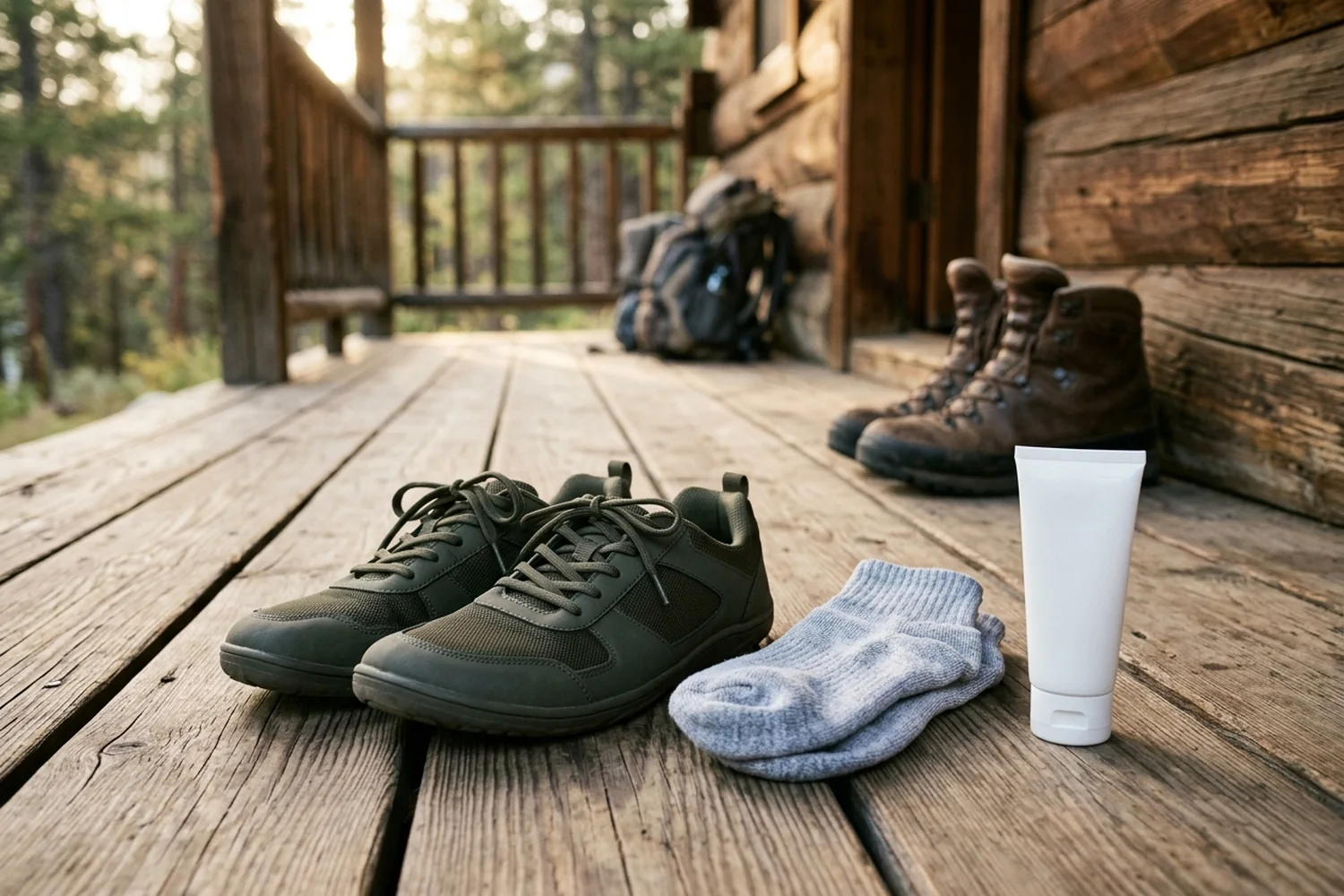
Switch the next morning to wide, comfortable shoes with a low heel and soft sole, put on clean dry socks that are not tight, and leave off any shoe that caused a blister until the skin heals; NHS guidance on swollen ankles, feet, and legs (last reviewed 26 February 2026) notes that post-walk swelling is often fluid build-up called oedema from standing or sitting in the same position too long, and it often eases on its own.
In the evening, raise your legs or the swollen area on a chair or pillows, take gentle walks to improve blood flow, and wash, dry, and moisturize swollen feet to prevent infection, because NHS cellulitis guidance notes that bacteria can enter deeper skin layers through dry, cracked skin even when the break is too small to notice. In multi-day foot care for hiking, the American Academy of Dermatology adds that shoes should be neither too tight nor too loose, and NHS blister guidance advises changing socks frequently if your feet sweat.
Rules-of-Thumb: Keep any shoe that caused a blister off until the skin heals; soak suspected trench foot in warm water for 5 minutes, elevate bare feet when sleeping, and seek medical care right away; for bilateral fluid swelling without heat or pus, elevate the legs and wear wide, low-heel, soft-sole shoes without socks or shoes that are too tight.
| Evening foot finding | Next-morning shoe choice | Next-morning sock and skin routine | What to leave off |
|---|---|---|---|
| Intact or burst friction blister | Wide, comfortable alternative footwear that does not rub the site; pause the blister-causing activity until healed | Wash gently, pat dry, keep a soft plaster, padded dressing, or hydrocolloid dressing over the blister, and apply petroleum jelly if already drained | Do not wear the shoes or use the equipment that caused the blister until it heals |
| Bilateral fluid swelling (oedema) | Wide, comfortable shoes with a low heel and soft sole, fitted neither too tight nor too loose | Wash, dry, and moisturize the feet to prevent skin cracking and infection; wear non-constricting socks | Do not wear clothes, socks, or shoes that are too tight |
| Sweaty feet prone to friction blisters | Well-fitting comfortable shoes that are neither too tight nor too loose | Start in clean dry socks and change socks frequently whenever feet sweat | Damp, sweaty socks left on across consecutive walking stages |
| Prolonged wet exposure (suspected trench foot) | Urgent clinical evaluation before resuming trail miles | Clean and dry feet, wear clean, dry socks during wakeful warmth, and elevate bare feet when sleeping | Damp boots, wet socks, or ignoring heavy, aching, swollen feet |
| Plantar arch-to-heel pain worse on first steps | Shoes with cushioned heels and good arch support | Rest, elevate the foot, and apply a towel-wrapped ice pack for up to 20 minutes every 2 to 3 hours | High heels, tight pointy shoes, and walking barefoot on hard surfaces |
| Painful, hot, swollen skin (suspected cellulitis) | Urgent GP or NHS 111 medical assessment | Raise the affected foot or leg on a pillow or chair to reduce swelling while following prescribed antibiotic care | Do not wear compression stockings until you are better |
When Is Heel Pain, Swelling, or Hot Skin a Medical Emergency?
Stop self-treating and get prompt clinical assessment whenever heel pain starts with a sharp pop or prevents walking, swelling affects only 1 foot or leg without a clear cause, or skin turns hot, painful, swollen, or pus-filled. NHS heel-pain guidance (last reviewed 24 October 2025) states not to diagnose heel pain yourself because a broken bone can be responsible.
Separate arch-and-heel soreness from fracture or tendon red flags before taking another hike step:
- Sharp pain between the arch and heel that hurts much more when you first start walking after sleeping or resting, improves as you move around, worsens again after long standing or walking, and hurts when stretching the sole or raising your toes off the floor matches plantar fasciitis (NHS page last reviewed 14 February 2025). Straining the plantar fascia between the heel bone and toes is more likely from age 40 to 60 and after a sudden jump in walking or running volume; see a GP if bottom-of-foot pain does not improve within 2 weeks, stops normal activities, keeps worsening or returning, comes with tingling or loss of feeling, or occurs with diabetes.
- Sudden sharp heel pain, swelling, a popping or snapping sound, and difficulty walking can indicate a heel fracture or a ruptured Achilles tendon. Contact NHS 111 for severe heel pain after an injury, feeling faint, dizzy, or sick from the pain, an ankle or foot that has changed shape or sits at an odd angle, a snap, grinding, or popping noise, being unable to walk, walk on tiptoes, or walk up stairs, or swelling and bruising in the calf and ankle, because those signs can mean a broken heel bone or a broken ankle. Do not try to treat a suspected broken heel bone yourself; contact NHS 111.
Watch broken or swollen skin just as closely for bacterial infection and systemic red flags. An infected blister feels hot and fills with green or yellow pus, and surrounding redness can be harder to see on brown or black skin; NHS warns that ignoring an infected blister can lead to a skin or blood infection, and the American Academy of Dermatology advises seeing a doctor or board-certified dermatologist if redness, pus, or increased pain or swelling develops. Although Knapik and colleagues report no evidence that antibiotics influence blister healing, NHS cellulitis guidance (last reviewed 18 April 2024) stresses that cellulitis is a bacterial infection of deeper skin layers treated with antibiotics that can become serious quickly, with higher risk in people who have diabetes or a weakened immune system. Ask for an urgent GP appointment or NHS 111 if lower-limb skin is painful, hot, and swollen (with redness less obvious on brown or black skin, sometimes accompanied by blisters, swollen painful glands, or flu-like symptoms), if 1 ankle, foot, or leg swells for no known reason, if swelling is sudden, severe, worsening after injury, or paired with diabetes, and see a GP if swelling in both feet or ankles has not improved after a few days. Mild small-area cellulitis is usually treated with antibiotic tablets for a week; symptoms can worsen in the first 48 hours, require contacting a GP if not improving 2 to 3 days after starting antibiotics, and most people recover in 7 to 10 days. Call 999 if swelling comes with shortness of breath, a tight, heavy, or painful chest, coughing up blood, a more noticeable heartbeat, or feeling lightheaded, faint, confused, sick, or clammy, and call 999 or go to A&E if cellulitis comes with a very high temperature or feeling hot, cold, or shivery, a fast heartbeat or fast breathing, purple skin patches, dizziness or faintness, confusion, cold clammy or pale skin, or unresponsiveness. Browse more evidence-grounded recovery routines in our foot-care field manuals.
Sources
- Centers for Disease Control and Prevention: Preventing Trench Foot or Immersion Foot (last reviewed August 26, 2026)
- Bush, Lofgran, and Watson: Trench Foot, StatPearls
- Knapik et al.: Friction Blisters Pathophysiology, Risk Factors, and Care Review
- Rushton and Richie: Friction Blisters of the Feet Causation
- Janssen et al.: Wide Area Fixation Dressing Versus Adhesive Tape at the 2015 Nijmegen Four Days Marches
- Levy et al.: 2-Octylcyanoacrylate Versus Standard Blister Treatment After a 10-km Military Road March
- NHS: Blisters (last reviewed 22 November 2023)
- American Academy of Dermatology: How to prevent and treat blisters (last updated 7/6/26)
- NHS: Swollen ankles, feet and legs (oedema) (last reviewed 26 February 2026)
- NHS: Cellulitis (last reviewed 18 April 2024)
- NHS: Plantar fasciitis (last reviewed 14 February 2025)
- NHS: Heel pain (last reviewed 24 October 2025)