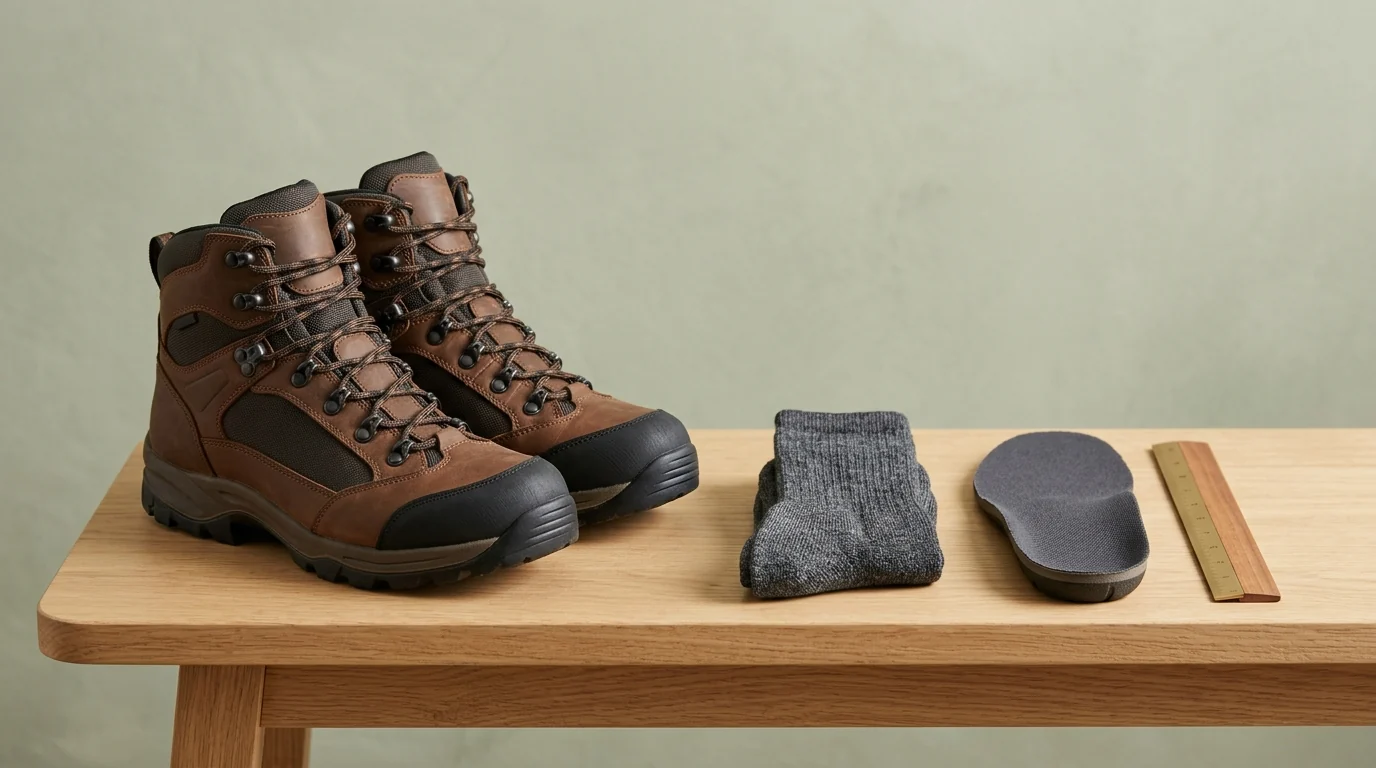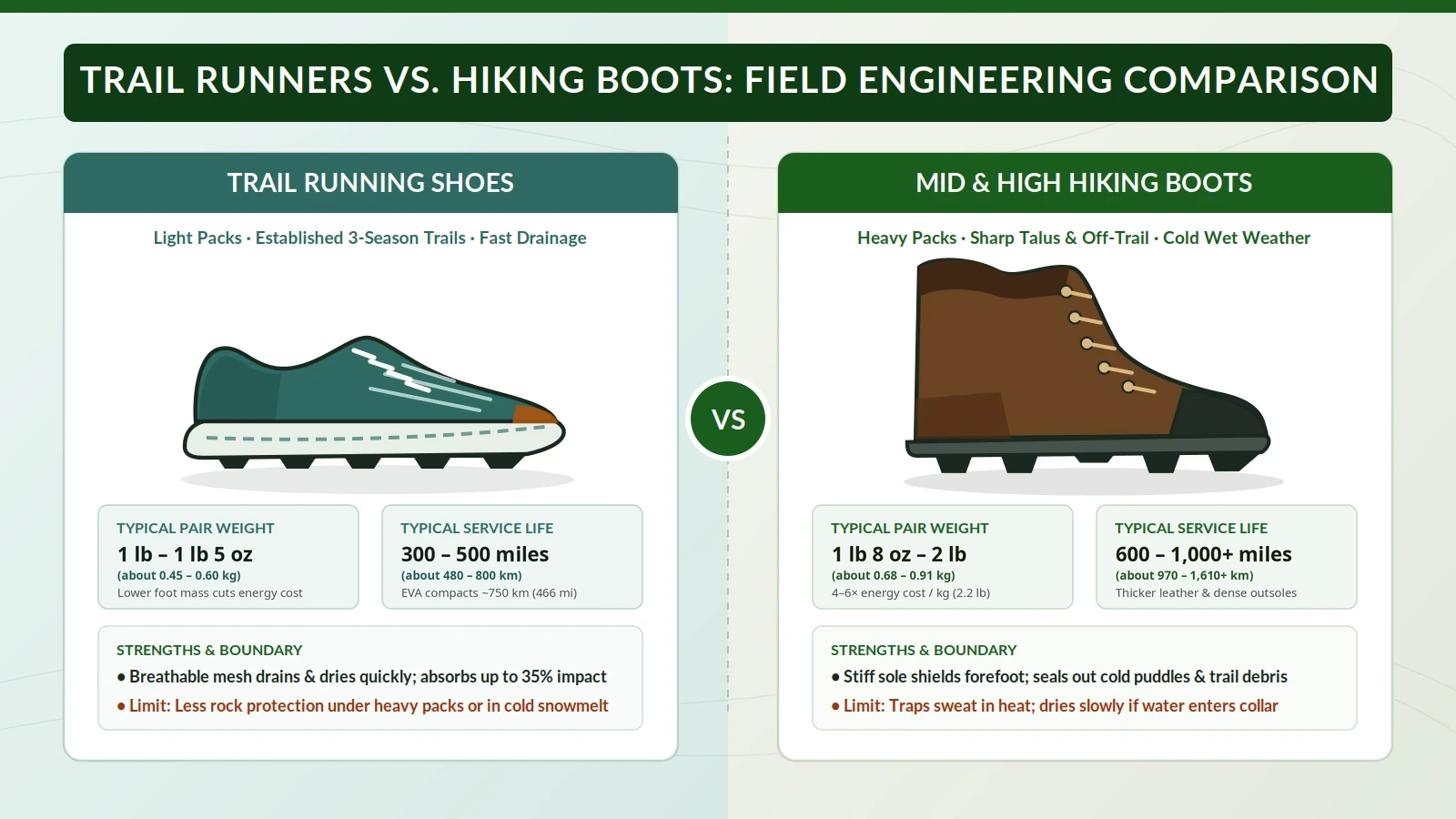
Choose trail runners for established three-season trails, warm weather, and lighter packs when lower footwear weight and fast drainage reduce fatigue. Choose hiking boots when carrying a heavy pack, crossing rough off-trail rock, or walking in cold wet conditions where stiff soles, tough uppers, and waterproof membranes protect your feet and last longer.
Trail runners vs hiking boots for backpacking: how does pack weight decide?
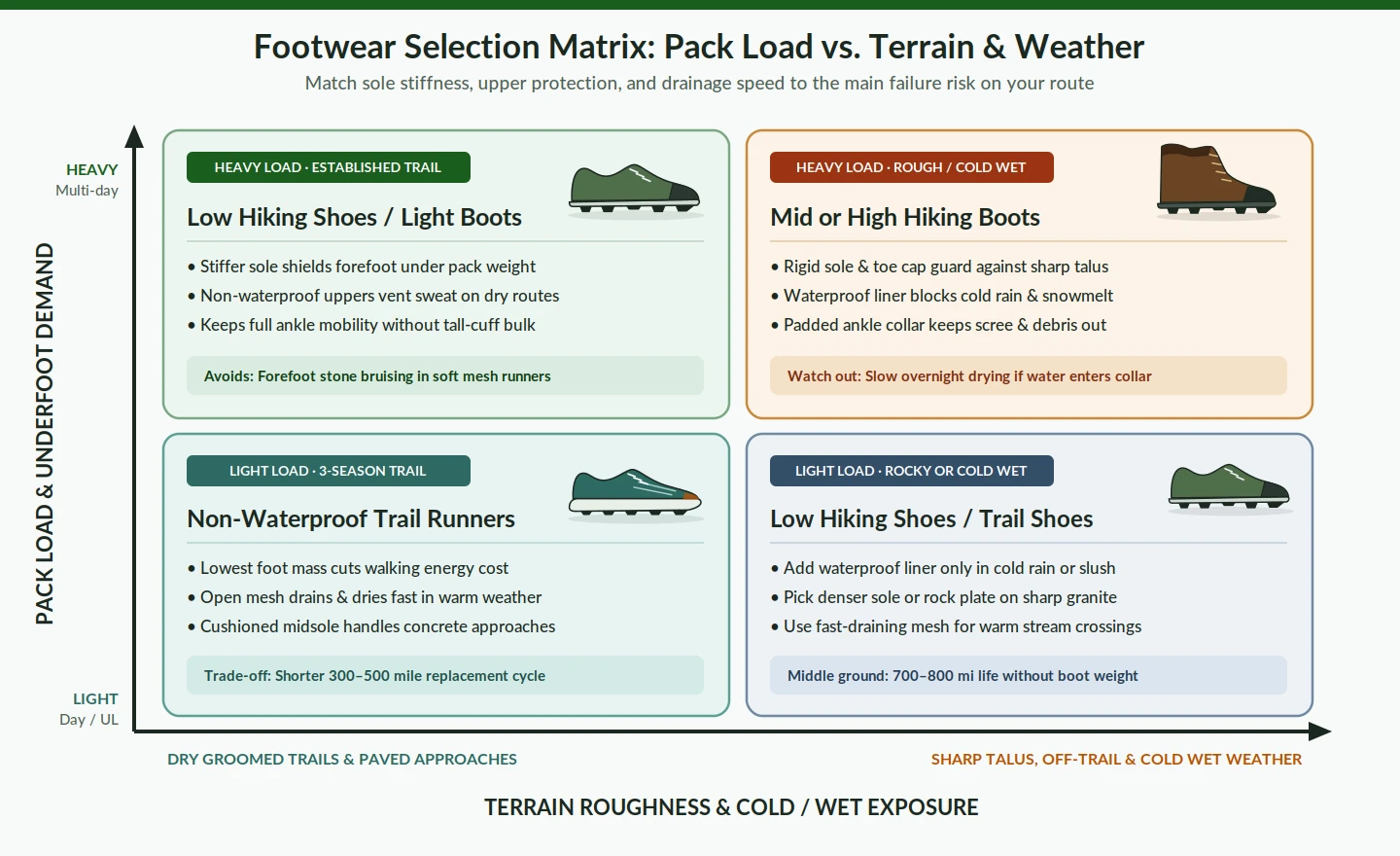
For backpacking with a light load on maintained trails, trail runners save measurable energy on every stride because weight carried on the feet costs several times more oxygen than weight carried on the back. Once pack weight climbs on rocky or unstable ground, stiffer boots protect sore soles from repeated stone impacts.
Foot-weight energy cost and obstacle clearance
Typical waterproof mid hiking boots weigh roughly 1 lb 8 oz to 2 lb (about 0.68 to 0.91 kg) per pair, whereas most trail running shoes sit near 1 lb to 1 lb 5 oz (about 0.45 to 0.60 kg) per pair across standard outdoor-footwear specifications. That seemingly modest difference multiplies across thousands of steps. A footwear biomechanics scoping review on PubMed Central summarizes foundational load-carriage research by Soule and Goldman showing that each kilogram (about 2.2 lb) of added boot mass raises walking energy cost up to four to six times as much as a kilogram of added body mass, alongside work by Holewijn and colleagues measuring two to five times higher oxygen cost per kilogram added at the foot.
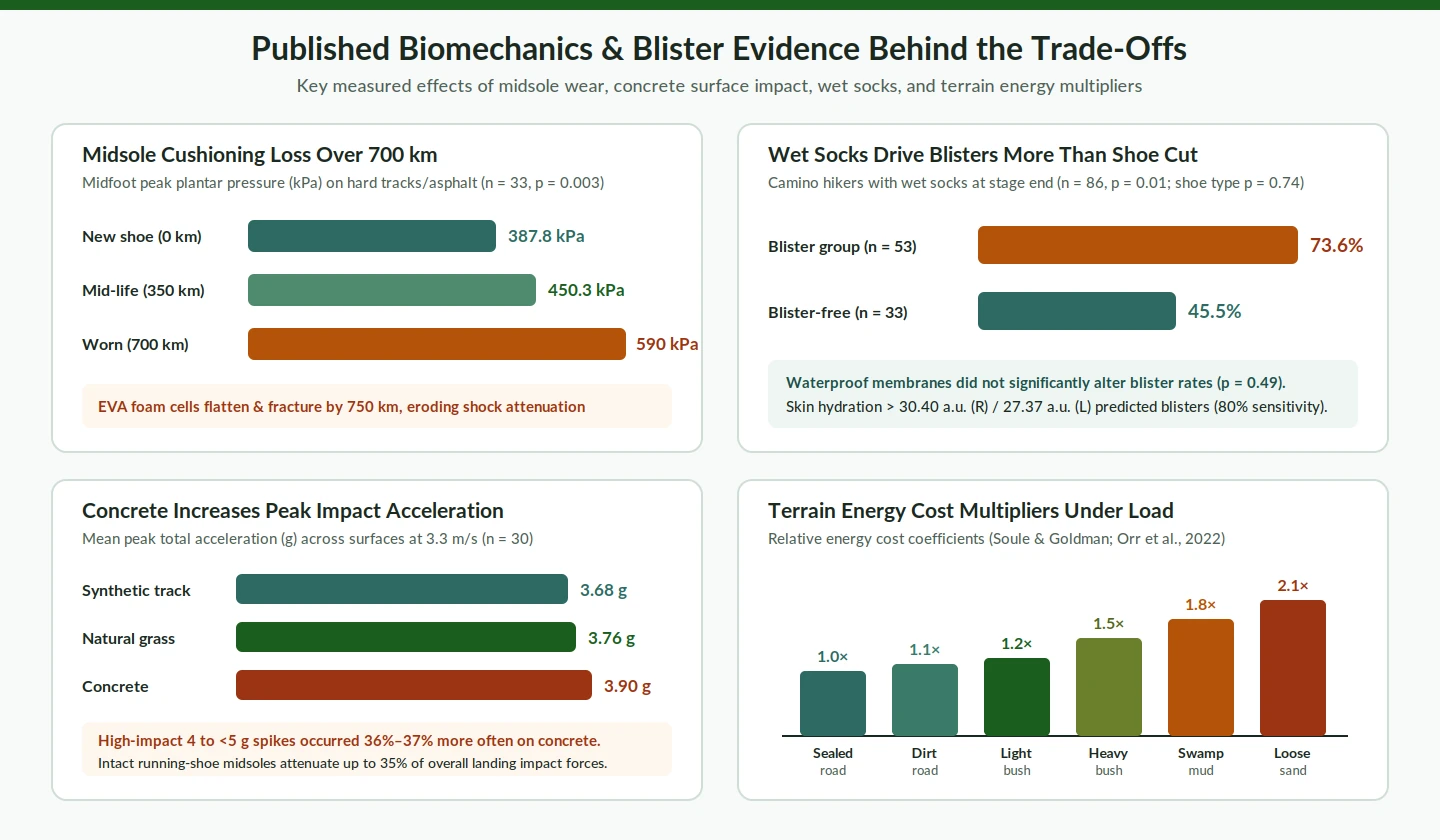
Extra mass at the end of the leg also changes foot clearance as fatigue sets in. In obstacle-crossing studies reviewed by Orr and colleagues, every 1 kg (about 2.2 lb) increase in boot weight reduced trailing-leg clearance by 2.9 to 4.4 cm (about 1.1 to 1.7 inches) over low and high obstacles. Terrain compounds that load penalty: Soule and Goldman’s terrain energy-cost coefficients climb from 1.0 on sealed roads and 1.1 on dirt roads to 1.2 in light bush, 1.5 in heavy bush, 1.8 in swamp, and 2.1 in loose sand. Similarly, USDA Forest Service hiking guidance notes that carrying extra weight wears walkers down and reduces agility over uneven ground.
Pack weight, numbness, and sole stiffness limits
Long-distance trail surveys clarify where pack weight matters more than shoe stiffness alone. A scoping review of trail running and hiking footwear cites an Appalachian Trail survey of 1,259 hikers across the 3,500 km (about 2,175-mile) corridor in which 61% experienced musculoskeletal complaints and 11% stopped their hike due to symptoms. In another study of 128 long-distance hikers on the Appalachian and Pacific Crest trails reviewed in that same paper, foot numbness and tingling increased with stiffer footwear before adjustment (29% in sandals versus 68% in hiking boots), yet footwear type was no longer statistically significant once the authors controlled for pack weight (P = 0.16).
At the other extreme, flexible soles carry a real mechanical ceiling under heavy loads on sharp stone. In rugged-surface work-boot tests compiled by Orr and colleagues, flexible soles produced significantly higher peak pressure under the inner forefoot metatarsals than stiffer soles, while uphill trail testing summarized by Jackson and colleagues showed that increasing sole bending stiffness from 11.0 N/mm to 16.5 N/mm raised uphill metabolic energy cost by 2% (P = 0.04). Backpackers therefore trade uphill economy against underfoot shielding: stay with trail runners when your pack is light and the trail is well groomed, and step up to a stiffer sole once sharp rocks start bruising your forefoot under load.
How do hiking shoes sit between boots and trail runners?
Low-cut hiking shoes function like low-top hiking boots: they pair the tougher leather or synthetic uppers, reinforced toe caps, and stiffer lugged outsoles of a boot with the open ankle freedom of a trail runner. For hikers carrying moderate loads on rocky three-season trails, they eliminate tall-collar bulk without giving up underfoot protection.
In standard outdoor footwear design, hiking shoes and hiking boots both rely on grippy outsoles, sturdy uppers, and protective builds meant for steadier, slower-paced movement than trail running shoes. Removing the above-ankle collar keeps heel-to-toe protection intact while lowering bulk and preserving natural ankle flex.
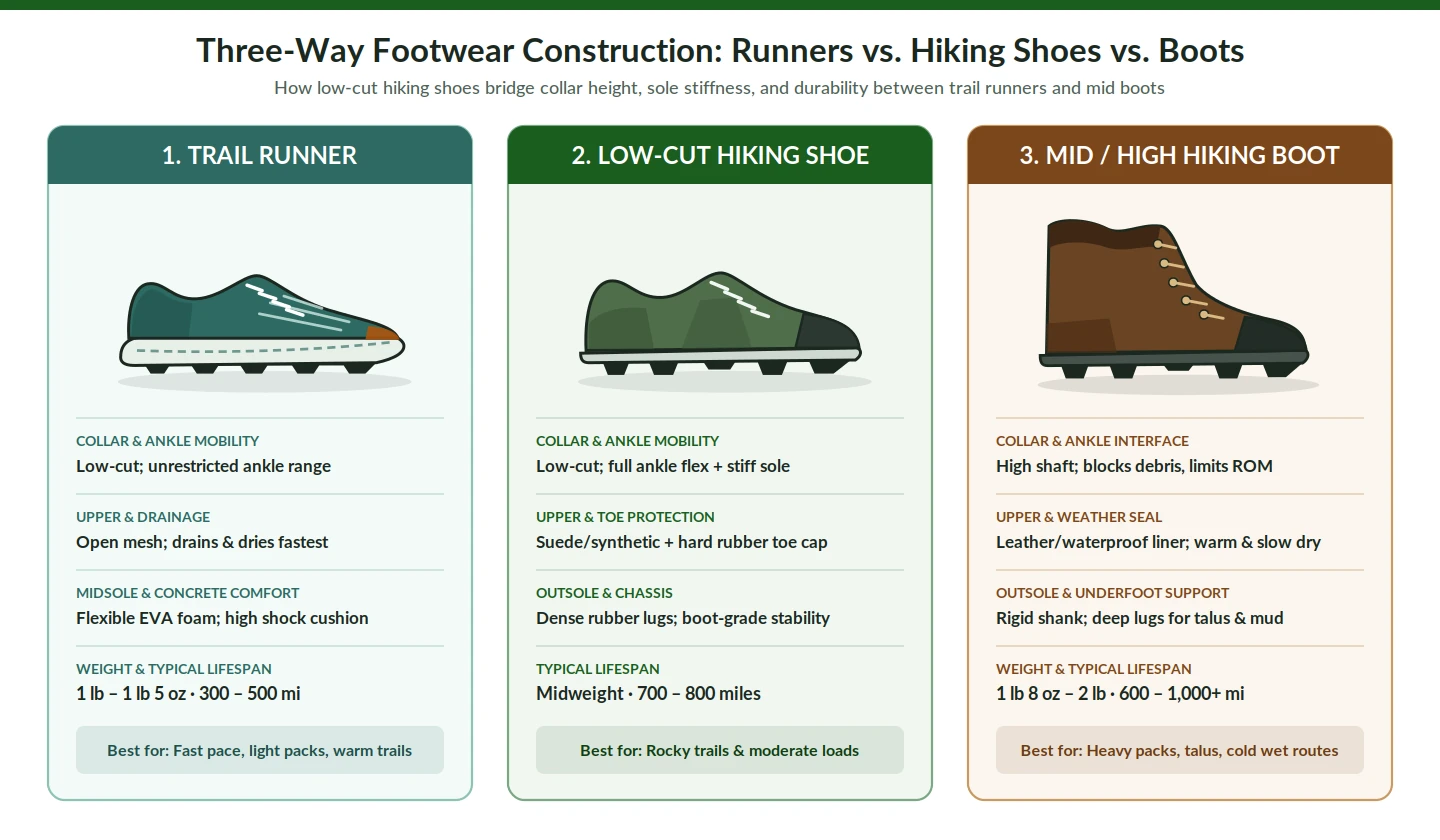
| Feature | Trail running shoes | Low-cut hiking shoes | Mid or high hiking boots |
|---|---|---|---|
| Typical pair weight | 1 lb to 1 lb 5 oz (0.45 to 0.60 kg) | Between runners and mid boots | 1 lb 8 oz to 2 lb (0.68 to 0.91 kg) |
| Ankle collar height | Below ankle bone | Below ankle bone | Covers ankle malleoli |
| Upper construction | Breathable open mesh | Suede, leather, or reinforced synthetic | Thick leather or synthetic with high cuff |
| Sole flexibility | Flexible cushioned EVA foam | Denser rubber with stiffer chassis | Stiffest midsole and deep lugged outsole |
| Water handling | Drains and dries rapidly | Available unlined or waterproof | Often waterproof; slow to dry once flooded |
| Typical trail lifespan | 300 to 500 miles (480 to 800 km) | 700 to 800 miles (1,130 to 1,290 km) | 600 to 1,000 miles (970 to 1,610 km) or more |
What biomechanical studies show about boot shafts and ankle support
High boot shafts do not act like rigid ankle braces, and restricting ankle mobility creates trade-offs further up the leg. In a PLoS One crossover trial comparing boots at 1.228 kg (about 2 lb 11 oz) with running shoes at 0.627 kg (about 1 lb 6 oz), wearing boots cut cadence by 2.9%, extended swing time by 4%, and restricted ankle range of motion. Because the ankle could not flex and extend freely to generate push-off power, the knee and hip compensated with significantly higher joint moments and greater knee positive power.
Evidence synthesized by Orr and colleagues reinforces both sides of collar stiffness. A softer, more flexible shaft that permitted fuller ankle motion increased ankle push-off power by 33% compared with a stiffer shaft, and the authors caution that limiting weight-bearing ankle dorsiflexion can impair the body’s primary ankle balance response and increase slip or trip risk. Real mountain accident data point in the same direction: in a Tyrol study of 405 mountain hiking fall victims, 61% were wearing ankle-height hiking boots with profiled soles, 18% wore low profiled hiking shoes, 12% wore rigid mountaineering boots, and 7% wore running shoes or sneakers. The ankle was the most frequent injury location at 42.4% of identified injuries, yet footwear type showed no significant difference (p = 0.84) between falls that injured the ankle and falls that injured other areas.
Where low-cut hiking shoes solve the stiff-sole trade-off
Separating sole stiffness from collar stiffness explains why low-cut hiking shoes work so well for mixed terrain. In underground-surface trials reviewed by Orr and colleagues, wearers significantly preferred footwear combining a flexible shaft with a stiff sole (p = 0.008) over fully stiff or fully flexible designs. A low-cut hiking shoe delivers that exact split: firm underfoot shielding against jagged gravel alongside unrestricted ankle articulation on steep steps.
Walking boots vs trail shoes: when does each fit terrain and weather?
Choose breathable trail shoes for warm, maintained three-season trails where pace, ventilation, and comfort out of the box matter most. Switch to sturdy walking boots for steep loose descents, cold rain, snowmelt, or off-trail scree where deeper tread, tougher uppers, and extra insulation outweigh added shoe mass.
Terrain difficulty drives injury exposure far more strongly than footwear labels alone. In a survey of 1,016 trail runners summarized by Jackson and colleagues, 39.8% reported an injury—with a sprained ankle the most reported injury—and injury occurrence correlated significantly with highly technical, exposed, sandy, or muddy ground rather than shoe category. On steep volcanic scree, however, structured hiking tread shows a measurable edge: among 1,061 hikers descending Mt Fuji reviewed in the same paper, wearing hiking shoes or mountaineering boots instead of everyday sneakers or running shoes reduced fall odds (OR 0.812), whereas walking on worn-out soles raised fall odds (OR 1.252).
Ambient temperature and elevation changes also push the choice toward boots or breathable mesh. Orr and colleagues highlight thermal trials by Lee and colleagues showing that heavier boots raise sweat rates and body heat production because accelerating mass far from the torso is mechanically inefficient—a clear drawback in hot summer weather, yet helpful warmth in cold alpine air. Because USDA Forest Service guidance notes that temperatures often drop 3 to 5 °F (about 1.7 to 2.8 °C) for every 1,000 feet (about 305 m) of elevation gain, a warm valley start can still demand weather-sealed, insulated boots higher on the ridge.
Whichever category matches your terrain, proper sizing and gradual conditioning matter before a long route. Check toe clearance and heel hold using our hiking boot fit guide, and follow the USDA Forest Service reminder to wear sturdy boots that are already broken in and comfortable by testing stiffer footwear progressively with our hiking boot break-in guide.
Are hiking shoes or trail runners better on concrete and paved approaches?
Trail runners are generally more comfortable than stiff hiking shoes or boots on concrete and asphalt because their cushioned foam midsoles absorb more landing shock. Concrete delivers harder peak impacts than grass or dirt, and rigid hiking outsoles increase lower-limb fatigue over sustained paved miles, though soft trail lugs wear faster on pavement.
Surface stiffness changes every landing force entering the foot and lower leg. In a surface-impact study on PubMed Central, concrete produced higher mean impact acceleration (1.35 g) and higher mean peak acceleration (3.90 g) than either synthetic track (1.30 g mean, 3.68 g peak) or natural grass (1.30 g mean, 3.76 g peak). Crucially, high-magnitude 4 to 5 g impact peaks were 36% to 37% higher on concrete than on grass or synthetic track, and the authors note prior evidence that fatigue can amplify impact acceleration by 50% late in a long effort.
Paved approaches also interact directly with sole hardness and blister risk. In a clinical podiatry study of 315 long-distance Camino hikers summarized by Jackson and colleagues, 74% presented with blisters; footwear category did not predict blistering, while distance walked on asphalt and finishing with wet socks stood out as key risk factors, and foot orthoses were protective (P = 0.001). Occupational hard-floor studies compiled by Orr and colleagues add a fatigue warning for rigid treads: harder footwear raised lower-extremity self-reported fatigue risk (RR 2.6, 95% CI 1.3 to 5.3), and stiffer outer soles were linked to higher odds of new-onset foot and ankle disorders (middle tertile OR 8.2; upper tertile OR 18.9).
Cushioned running-shoe midsoles counter part of that concrete shock. According to a longitudinal shoe-wear study on PubMed Central, intact running shoes can reduce overall landing impact forces by up to 35% before midsole foam breaks down. On mixed road-to-trail routes or urban-approach walks, a well-cushioned trail runner with modest lugs balances pavement shock absorption with dirt grip better than a rigid boot.
Trail runners or hiking boots: which dries faster and wears longer?
Non-waterproof trail runners dry far faster than lined hiking boots because open mesh drains water and vents sweat as you walk, whereas leather and synthetic hiking boots last roughly twice as many trail miles before their soles and uppers break down. Your choice hinges on whether repeated wetting or long-term durability is the bigger failure point.
Wet socks, waterproof membranes, and blister risk
Keeping skin moisture low prevents more friction blisters than picking a tall boot over a mesh shoe. In a Camino hiker case-control study where 61.6% developed blisters and 38.4% remained blister-free, finishing the stage with wet socks showed a significant link to blistering: 73.6% of blistered hikers finished in wet socks versus 45.5% of blister-free hikers (p = 0.01; overall wet-sock association p = 0.009). Across the 86 hikers examined, plantar skin hydration readings above 30.40 a.u. on the right foot and 27.37 a.u. on the left foot predicted blisters with 80% sensitivity. By contrast, neither footwear category (p = 0.74) nor waterproof membranes (p = 0.49) produced a statistically significant difference in blister rates.
That moisture mechanism explains a classic multi-day wet-weather trade-off: a waterproof membrane blocks shallow puddles and slush in cold conditions, yet traps internal sweat in warm weather and dries slowly once rain or stream water pours over the ankle collar. On warm multi-day routes with creek crossings, non-waterproof mesh trail runners let water drain straight back out and dry quickly through body heat and airflow. Pair breathable footwear with quick-wicking socks from our long-distance walking socks guide, manage rain running down your legs with our guide to keeping feet dry hiking in rain, and handle soaked boots safely at camp using our overnight hiking boot drying guide.
Midsole compression and mileage durability
Durability tilts clearly in favor of structured hiking footwear. Across standard outdoor-footwear wear ranges, quality hiking boots can last 600 to 1,000 miles (about 970 to 1,610 km) or more and low-cut hiking shoes run roughly 700 to 800 miles (about 1,130 to 1,290 km), whereas most trail running shoes wear down around 300 to 500 miles (about 480 to 800 km) and are showing their age by 400 to 500 miles (about 640 to 800 km).
Laboratory wear testing shows why soft foam runners fade sooner than their uppers look worn out. In a longitudinal study of 33 runners measured at baseline, 350 km (about 217 miles), and 700 km (about 435 miles), midfoot peak plantar pressure climbed significantly from 387.8 kPa to 590 kPa by 700 km (p = 0.003). The authors cite microscopic foam research by Verdejo and Mills showing that ethyl vinyl acetate (EVA) midsole cells flatten under cyclic load and become damaged and broken by 750 km (about 466 miles), eroding shock attenuation. Because worn-out treads also raise descent fall odds (OR 1.252) in the Mt Fuji data reviewed by Jackson and colleagues, inspect both outsole lug depth and midsole collapse rather than waiting for visible holes in the mesh.
How should you match footwear to pack weight, rockiness, and season?
Use your heaviest single constraint—pack load, sharp rock exposure, or cold water immersion—to pick the right footwear tier before your trip. When two factors point in opposite directions, prioritize preventing the failure mode that cannot be fixed mid-route, such as bruised soles under load or soaked insulated boots in freezing weather.
| Pack load | Trail surface and rockiness | Season and moisture | Recommended footwear | Primary failure mode avoided |
|---|---|---|---|---|
| Light day or overnight pack | Well-maintained dirt or gravel trail | Warm three-season, dry or passing rain | Non-waterproof trail runners | Heavy-boot foot fatigue and trapped sweat |
| Light to moderate pack | Mixed paved approaches and hard-packed paths | Mild or warm weather | Cushioned road-to-trail runners | Concrete impact soreness and rigid-sole fatigue |
| Light pack | Repeated warm-weather stream crossings | Warm rain and humid summer | Fast-draining mesh trail runners | Waterlogged waterproof boots that stay wet overnight |
| Moderate pack | Rocky ridges, roots, and moderate talus | Three-season, dry to damp | Low-cut hiking shoes | Forefoot stone bruising without tall-collar bulk |
| Heavy multi-day pack | Steep off-trail scree, sharp talus, or mud | Cool shoulder season, wet grass, or snowmelt | Waterproof mid or high hiking boots | Underfoot bruising, cold water chill, and scree entry |
Once you narrow your footwear type, match sizing, sock cushioning, and break-in steps together across our foot-care guides.