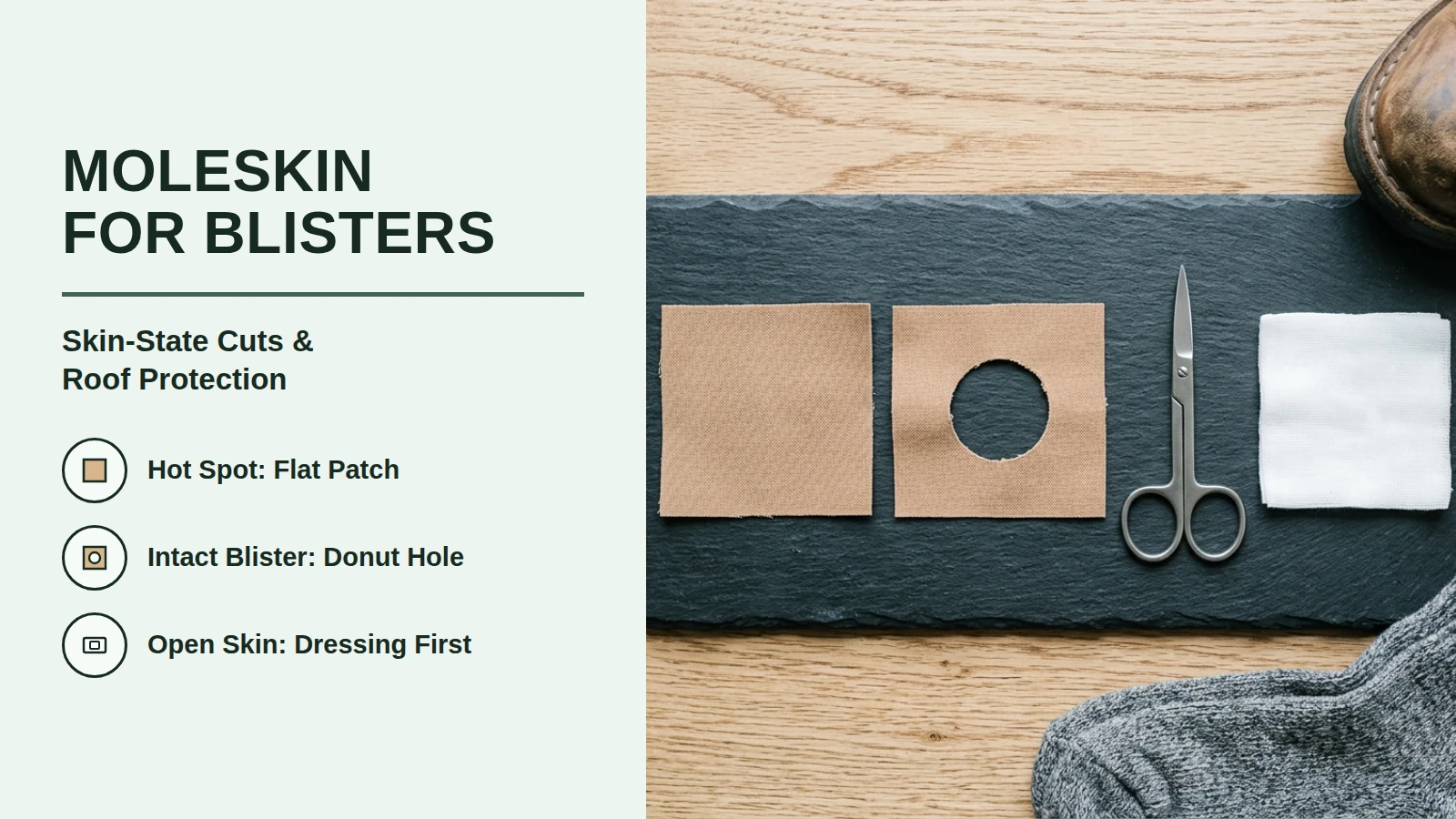
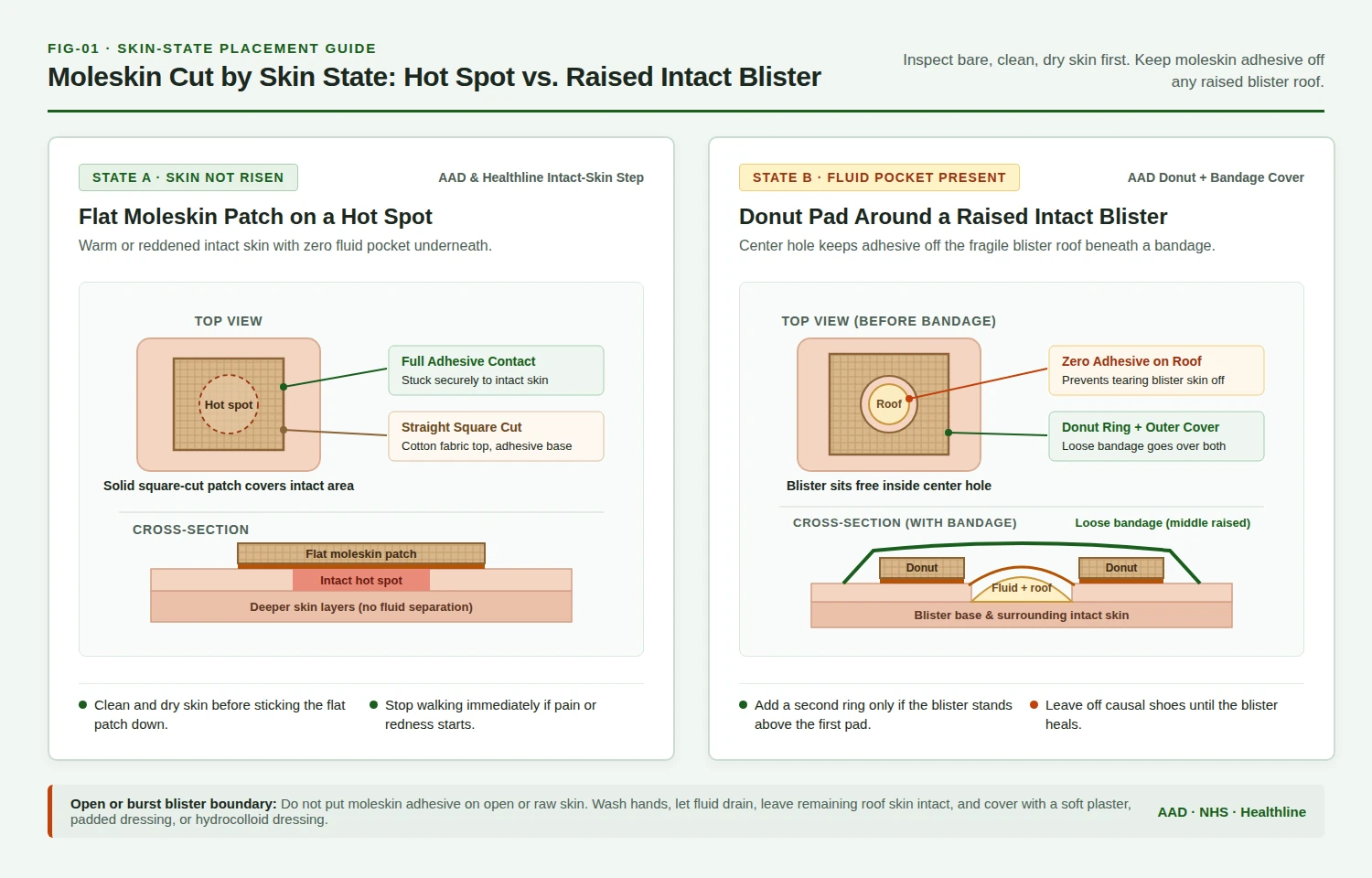
Match how you cut and apply moleskin to whether the skin is still intact or has already risen into a fluid-filled pocket. When a problem spot on the foot has not risen into a blister, the American Academy of Dermatology (AAD) advises considering adhesive moleskin or another soft bandage applied securely to intact problem skin, and Healthline likewise notes placing a flat piece of moleskin over areas that tend to develop blisters. Clean and dry the surrounding skin before sticking any pad in place.
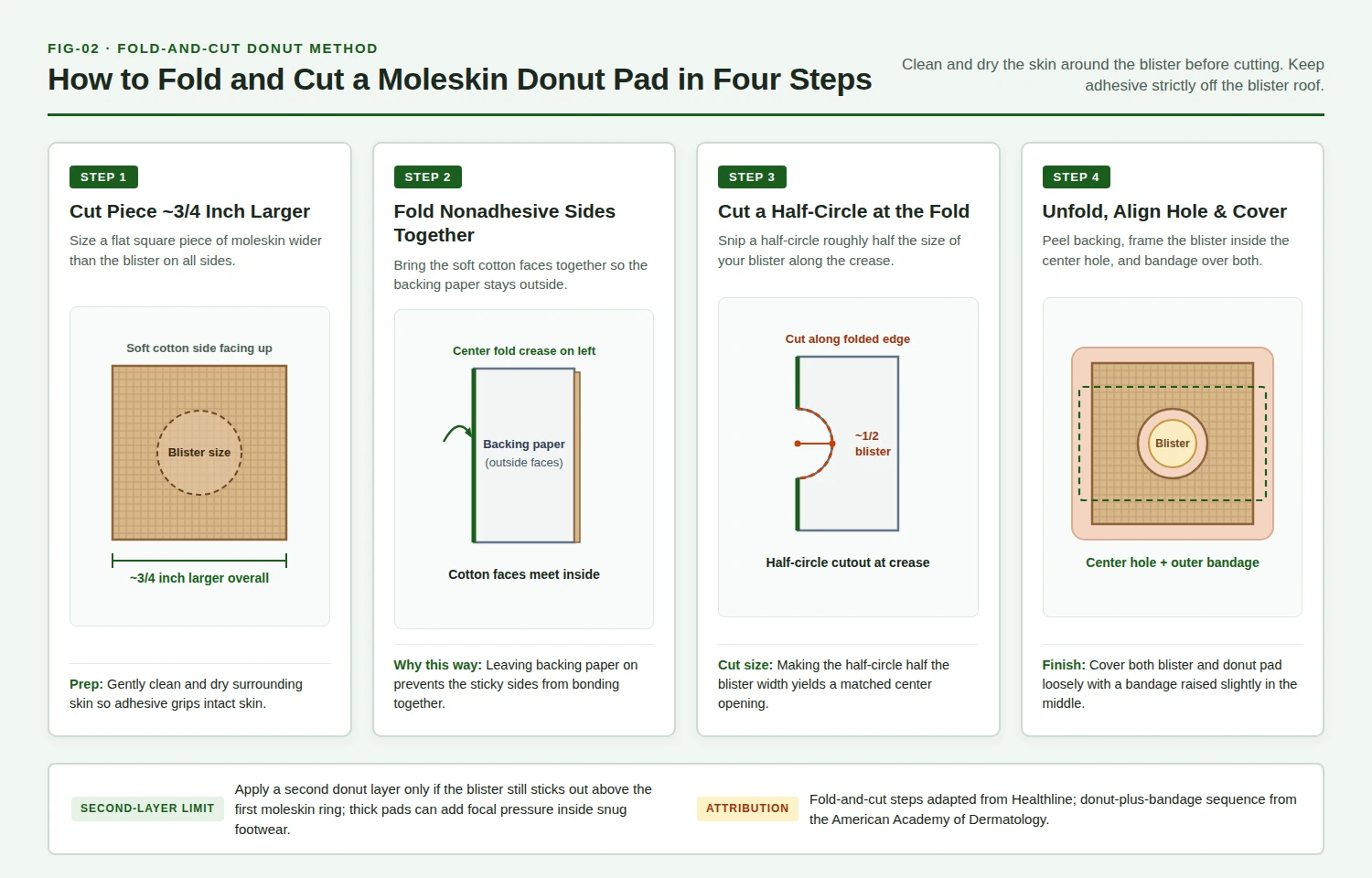
Once a blister has formed and its roof remains intact, do not stick moleskin directly onto that blister roof, because Healthline warns the strong adhesive can rip off the top skin when the pad comes away. Instead, AAD instructs cutting padding into a donut shape with a hole in the middle, placing the ring around the blister, and covering both the blister and the padding with a bandage. Healthline forms that center hole by cutting a piece of moleskin about 3/4-inch larger than the blister, folding the nonadhesive sides together, cutting a half-circle roughly half the size of the blister along the fold, and unfolding so the blister sits inside the center opening while adhesive touches only intact surrounding skin.
If a blister has already burst or been drained, keep moleskin adhesive off the raw area and cover the skin first with a soft plaster, padded dressing, hydrocolloid dressing, or clean bandage. Pair these cutting steps with how to avoid blisters when hiking for early redness checks, blister-prevention products for material comparisons across tape, moleskin, and lubricants, and more manuals in foot care and all walking guides.
Do You Put Moleskin Directly on Skin?
Put moleskin directly onto clean, dry intact skin over a rubbing zone or around a blister, and keep the adhesive face off the blister roof itself. In their 2024 review, Rebecca Rushton and Douglas Richie describe moleskin as a durable cotton fabric, and Healthline describes it as a thin but heavy cotton fabric that is soft on one side with a sticky adhesive backing on the other. Because that backing adheres firmly, skin condition determines where the sticky side lands.
On intact problem areas such as the feet or thighs, the AAD advises considering adhesive moleskin or other soft bandages applied securely, alongside wearing nylon or moisture-wicking socks (or trying two pairs if one pair does not help) and applying powder or petroleum jelly where skin rubs skin or clothing. Healthline similarly notes placing moleskin on intact areas that tend to blister during long walks or while breaking in shoes.
Around a raised intact blister, Healthline and AAD separate the adhesive ring from the fragile roof through a fold-and-cut sequence:
- Gently clean and dry the skin around the blister; NHS likewise advises gently washing the skin around a blister and patting it dry.
- Cut a piece of moleskin about 3/4-inch larger than the blister, as Healthline describes.
- Fold the nonadhesive cotton sides together and cut a half-circle out of the folded crease roughly half the size of the blister so unfolding leaves one blister-sized hole in the center.
- Remove the adhesive backing and align the center hole over the blister so the sticky side bonds only to surrounding skin and does not touch the roof.
- If the blister sticks out above the first moleskin ring, Healthline notes cutting and applying a second donut layer to make the pad thicker, though Rushton and Richie caution that thick bandage products may add pressure to a blistered area.
- Cover both the blister and the donut padding with a loose bandage, bringing in the sides of the bandage as AAD describes so the middle sits slightly raised.
| Skin state | Moleskin cut and placement | Outer cover required | Key failure boundary |
|---|---|---|---|
| Unraised hot spot or blister-prone intact skin | Flat moleskin patch pressed securely onto clean, dry intact skin | None specified by AAD or Healthline when used as a flat intact-skin barrier | Stop activity immediately if pain, discomfort, or red skin develops |
| Raised blister with intact roof | Donut cut with a center hole placed around the blister; add a second ring only if the blister protrudes above the first piece | Loose bandage over both the blister and the padding, with the middle slightly raised | Putting adhesive directly over the blister can tear off the protective roof on removal; thick pads may add pressure |
| Burst, drained, or deroofed blister | Keep moleskin adhesive off open or raw skin; any ring stays strictly on intact surrounding skin outside a primary dressing | Soft plaster, padded dressing, pharmacist-recommended hydrocolloid dressing, or bandage/gauze changed at least once a day | Do not peel remaining skin or pick at edges; leave off the shoes that caused the blister until healed |
Can You Put Moleskin on an Open Blister?
Do not place the adhesive side of moleskin onto an open, burst, or deroofed blister. AAD warns that treating a painful blister the wrong way can slow healing or lead to infection, and Healthline warns against putting moleskin directly over a blister because the strong adhesive can rip off the protective roof. AAD says not to remove the roof because it protects the raw skin underneath as it heals, and Cleveland Clinic says the skin on the blister protects deeper layers of skin from infection.
Published clinical and sports-medicine sources state three distinct positions on draining or managing fluid-filled and open blisters, and keeping those three sources separate prevents turning a medical boundary into routine trail lancing:
- NHS self-care guidance: NHS instructs readers not to burst a blister themselves, not to peel the skin off a burst blister, and not to pick at the edges of the remaining skin, noting instead that a GP might burst a large or painful blister using a sterilized needle. If a blister has already burst on its own, NHS advises washing your hands before touching it, allowing the fluid to drain, and covering it with a soft plaster or padded dressing, or asking a pharmacist about a hydrocolloid moist dressing to protect the blister, reduce pain, and speed up healing.
- AAD dermatology guidance: AAD advises avoiding popping or draining a blister because doing so could lead to infection, while adding that if a blister is large and very painful it may be necessary to drain it to reduce discomfort by sterilizing a small needle with rubbing alcohol and carefully piercing one edge so some fluid drains. Once a blister has drained, AAD instructs washing the area with soap and water, applying petroleum jelly, leaving the roof in place, and covering the area loosely with a bandage.
- Knapik and colleagues (Sports Medicine, 1995 Sep, PMID 8570998): This review reports that clinical experience suggests draining intact blisters while maintaining the blister roof results in the least patient discomfort and may reduce secondary infection, and notes that treating deroofed blisters with hydrocolloid dressings provides pain relief and may allow continued physical activity if necessary.
For home dressing changes on an existing blister, Cleveland Clinic advises washing the area gently with mild soap, covering it with a bandage or gauze, and changing the bandage at least once a day. Check our hiking foot-care kit checklist for packing clean plasters, dressings, and dry spare socks without contaminating clean supplies.
How Do You Apply Moleskin on Heels?
Apply a flat patch to an unraised heel hot spot or a center-hole donut pad around a raised heel blister after gently cleaning and drying the skin, using the same standard flat-patch or donut pattern applied elsewhere on the foot. Because traditional adhesive bandages on the back of the heel often slip off shortly after putting on shoes, Healthline notes that moleskin tends to stay in place better—a practical observation rather than a controlled clinical trial.
When heel rubbing comes from a rigid counter or stitching inside footwear, Healthline notes that moleskin is often applied to the inside of shoes and can be stuck directly over an uncomfortable seam or a narrow heel as an alternative to skin placement. That footwear-lining option applies while skin is intact rather than as a substitute for dressing broken skin.
Rushton and Richie note that ill-fitting shoes are often cited as a primary cause of foot blisters. AAD advises making sure shoes are neither too tight nor too loose, and Rushton and Richie explain why both extremes cause trouble: tightly fitted shoes may increase compressive forces against bony prominences and raise friction forces, whereas loosely fitted shoes may allow excessive foot sliding that increases shear, though no scientific studies have verified footwear fit or lacing techniques in blister prevention. Once a heel blister has formed, NHS states not to wear the shoes or use the equipment that caused the blister until it heals, and Cleveland Clinic likewise advises bandaging the blister and wearing different shoes during healing.
How Do You Use Moleskin on the Bottom of Feet?
On the bottom of the feet, use AAD’s pressure-area donut method when an intact blister has formed: cut padding into a donut shape with a hole in the middle, place the donut around the blister on clean, dry skin, and cover both the blister and the padding with a bandage whose sides are brought in loosely so the middle sits slightly raised. If the plantar skin is only a warm, unraised problem spot, use a single flat piece applied securely to intact skin.
Plantar skin blisters readily under load because of its anatomy. In their 1995 Sports Medicine review, Knapik, Reynolds, Duplantis, and Jones note that blisters are more likely in skin areas where a thick horny layer is held tightly to underlying structures, such as the palms of the hands or the soles of the feet, and report that more vigorous activity and carrying heavy loads during locomotion both appear to increase the likelihood of foot blisters. Cleveland Clinic adds that a blister forms as a fluid-filled sac under the epidermis between skin layers when rubbing builds up clear fluid or blood, with many friction blisters stemming from walking too much in poor-fitting shoes or without socks.
Keep plantar padding low-bulk inside footwear. Rushton and Richie note that bandage researchers recognized thick products may add pressure to a blistered area, and separately warn that folds and excess bulk when applying athletic tape to the foot and ankle should be minimized because they intensify focal pressure. Add a second moleskin ring on the sole only in the specific case Healthline describes — when a raised blister still sticks out above the first piece — rather than building multi-layer stacks inside a snug boot.
Does Moleskin Really Work for Blisters?
AAD suggests considering adhesive moleskin on intact problem areas and a donut-shaped pad around a pressure-area blister, while Rushton and Richie list pressure-deflective padding and tapes other than paper tape among strategies with insufficient or no evidence for preventing friction blisters. Neither AAD nor Cleveland Clinic endorses commercial products or companies.
In their critical review published 2024 Jan 8 in the Journal of Athletic Training (issue date 2024 Jan, PMID 36701678, DOI 10.4085/1062-6050-0341.22), Rebecca Rushton, BSc(Pod), and Douglas Richie, DPM, explain that friction blisters do not come from surface scraping. Instead, a friction blister is an intraepidermal tear caused by repetitive shear deformation beneath the skin surface within the stratum spinosum, which fills with plasma-like fluid that Knapik and colleagues note has a lower protein level than plasma. Rushton and Richie classify spreading shear load across a wider skin area with adherent tapes, moleskin, or dressings as a purely speculative mechanism, stating that no research and very little commentary exist on that mechanism to date.
Donut pads do have laboratory peak-pressure data on felt materials, yet pressure reduction alone is untested for blister outcomes:
| Mechanism or test category | What Rushton & Richie (2024) and Knapik et al. (1995) report | Evidence boundary for moleskin |
|---|---|---|
| Deflective donut-pad pressure reduction | Donut pads typically contain moleskin with a middle aperture placed over a hotspot or blister-susceptible spot; in cited felt-pad studies, 5-mm felt padding cut pressure by 24% to 31%, 7-mm felt padding was more effective than 5-mm felt padding at reducing peak pressure, a 7-mm felt modified donut pad cut pressure by 25%, and 20-mm felt padding cut peak plantar pressure by 49% | Those percentages come from felt-pad pressure measurements, not a moleskin blister trial; the review states that whether deflective-pad pressure reduction prevents friction blisters has not been investigated |
| Cotton fabric moisture handling | Moleskin is a durable cotton fabric; cotton has poor moisture-management capabilities, absorbs 3 times as much moisture as synthetic acrylic fibers, and has a 10-fold greater drying time than synthetic fibers when wet, while moist skin increases frictional force compared with very dry or very wet skin (which decreases frictional force) | Sweat-dampened cotton retains moisture against the skin; AAD likewise advises moisture-wicking, loose-fitting clothes during physical activity and avoiding cotton clothes that soak up sweat and lead to friction and chafing |
| Surface coefficient of friction (COF) | Polliack and Scheinberg measured 11 bandages used to treat blisters, including 2 types of moleskin, finding a mean COF range of 0.57 to 1.54 across all 11 products while noting that thick products may add pressure to a blistered area | The 0.57 to 1.54 range spans all 11 tested bandages rather than moleskin alone |
| Controlled clinical tape trials | Rushton and Richie state that the only tape evidence in prospective randomized trials is for paper tape, that paper-tape evidence is equivocal, and that tapes other than paper tape and pressure-deflective padding have insufficient or no evidence | Read our paper-tape hiking evidence guide for the 2016 ultramarathon trial, which did not test moleskin or dressings on existing blisters |
Field Check: Use moleskin for the mechanical job AAD and Healthline describe — a flat barrier on clean, dry intact skin or a single center-cut ring keeping pressure and adhesive off a raised intact roof — without treating cotton moleskin as a guaranteed blister-prevention cure inside wet boots.
Do Blisters Heal Quicker Covered or Uncovered?
Major clinical guidelines consistently advise covering a blister rather than leaving it uncovered in footwear or open air. Blisters form to protect damaged skin underneath from friction, burns, or skin reactions while deeper layers recover: AAD says to loosely cover a blister with a bandage raised slightly in the center, NHS says to cover with a soft plaster or padded dressing, Cleveland Clinic says to cover with a bandage or gauze changed at least once a day, and the National Institute of Diabetes and Digestive and Kidney Diseases (NIDDK) says to cover a blister, cut, or sore with a bandage.
Published recovery timelines differ slightly across clinical bodies:
- Cleveland Clinic states that blisters generally do not require a healthcare provider or diagnostic tests and that most blisters heal naturally on their own in a few days.
- NHS states that blisters often heal on their own within a week, that you will not usually need to see a GP, and that a moist hydrocolloid dressing can protect the blister, help reduce pain, and speed up healing.
- AAD states that most blisters heal on their own in one to two weeks and advises not resuming the activity that caused the blister until it has healed.
Separate from whole-blister clinical recovery, Knapik’s 1995 review summarizes the microscopic repair clock at the blister base: cells in the base begin taking up amino acids and nucleosides about 6 hours after formation, basal cells show high mitotic activity at 24 hours, and new stratum granulosum and stratum corneum appear at 48 and 120 hours, respectively.
When Should You Stop Using Moleskin and Get Medical Help?
Stop your activity immediately if you feel pain or discomfort or if your skin turns red, as AAD warns that continuing is how a blister forms, and once a blister exists, keep off the causal activity and causal shoes until the skin heals. Blisters can develop anywhere body parts rub together or rub against clothing, yet certain symptoms and medical conditions move foot care straight to a clinician rather than another moleskin pad.
Cleveland Clinic says to see a provider if a blister does not improve after a few days or was caused by a burn or frostbite, and NHS says to get help if a blister is very painful, keeps coming back, or was caused by a burn, scald, sunburn, or an allergic reaction. AAD says to watch for redness, pus, or increased pain or swelling; NHS says to get help if the skin looks infected, is hot, and the blister is filled with green or yellow pus; Cleveland Clinic lists yellowish or greenish pus, a hot or painful area, and red streaks around the blister, and says an infected blister has red swollen skin and fills with white or yellowish fluid rather than clear fluid or blood. NHS warns not to ignore an infected blister because untreated infection could lead to a skin or blood infection, and notes that redness around a blister or from cellulitis can be harder to see or less obvious on brown or black skin. Cellulitis is a skin infection — more common on the lower limbs though possible anywhere on the body — that is treated with antibiotics and can be serious if not treated quickly; NHS advises asking for an urgent GP appointment or urgent help if skin becomes painful, hot, and swollen. If a blister is infected, NHS notes a GP may prescribe antibiotics; although Knapik’s 1995 review states there is no evidence that antibiotics influence blister healing, follow your clinician’s prescription whenever antibiotics are prescribed for an infection.
People with diabetes or reduced foot sensation need a clinical foot-care plan rather than self-cut moleskin rings. The National Institute of Diabetes and Digestive and Kidney Diseases (NIDDK) explains that diabetic nerve damage (diabetic neuropathy) can cause tingling, pain, or loss of feeling in the feet so a person may not feel a pebble inside a sock or a blister on the foot, allowing cuts and sores to become infected. For people whose foot problems raise the risk of sores, NIDDK notes that a hot spot can be the first sign that a blister or an ulcer is starting, and advises covering a blister, cut, or sore with a bandage, calling a health care provider right away if a cut, blister, or bruise does not start to heal after a few days or if foot skin becomes red, warm, or painful, and asking for a referral to a foot doctor (podiatrist) as part of the care team.
Moleskin Cut-and-Apply Field Checklist
- Inspect bare skin early: Stop immediately at pain, discomfort, or redness, then gently clean and pat dry the intact skin before applying any pad.
- Match the cut to the skin state: Press a flat moleskin patch securely onto an unraised hot spot, or fold the nonadhesive cotton faces of a piece about 3/4-inch larger than a raised intact blister, cut a half-circle roughly half the size of the blister, and unfold to one center hole.
- Keep adhesive off the blister roof: Align the raised blister inside the donut opening so sticky backing contacts only intact surrounding skin, adding a second ring only if the blister protrudes above the first pad.
- Cover raised or open blisters properly: Place a loose bandage raised slightly in the middle over a raised blister and its donut pad; if a blister has already burst or drained, keep moleskin adhesive off raw skin, leave remaining roof skin intact, and cover first with a soft plaster, padded dressing, hydrocolloid dressing, or daily-changed gauze/bandage.
- Retire the causal footwear while healing: Leave off the shoes or equipment that caused the blister and pause the causal activity until the skin heals.
- Escalate red flags and high-risk feet: Get prompt medical help for pus, red streaks, hot skin, pain, or swelling (noting redness may be less obvious on brown or black skin), and contact a clinician or podiatrist right away rather than relying on moleskin if you have diabetes or loss of feeling in your feet.