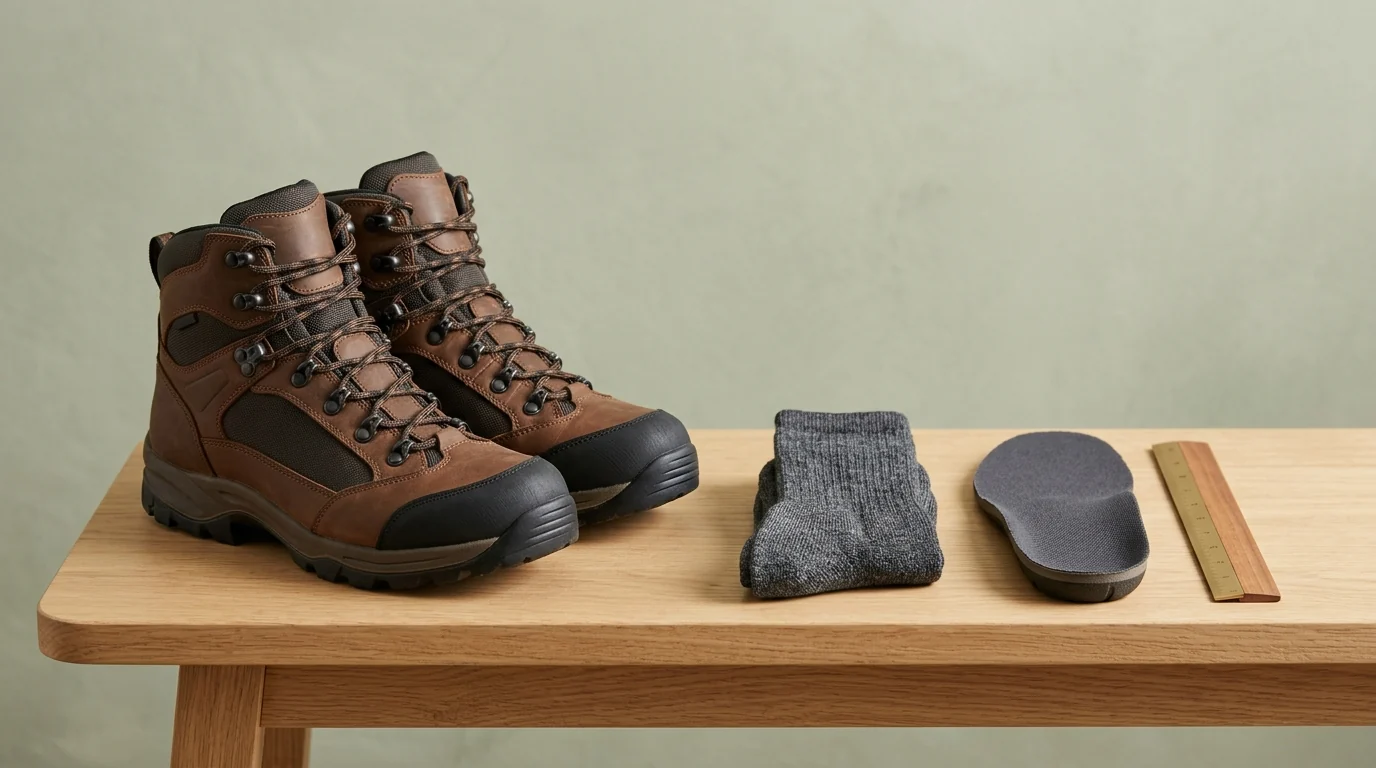
Clinical evidence for intact foot skin supports densely padded acrylic socks, neoprene insoles, and gradual familiarization with footwear and the activity. Rushton and Richie grade surgical paper tape and double-sock setups as equivocal, and they say lubricants and most athletic tapes have not been confirmed in clinical research. Paper tape is the only adhesive tape tested in randomized endurance trials, and those 2 studies split: the first found a 52% blister rate on the taped foot versus 39% on the untreated control foot (P = .22), while Pre-TAPED II cut blisters by 40% (number needed to treat 1.31) even as 83% of runners still blistered.
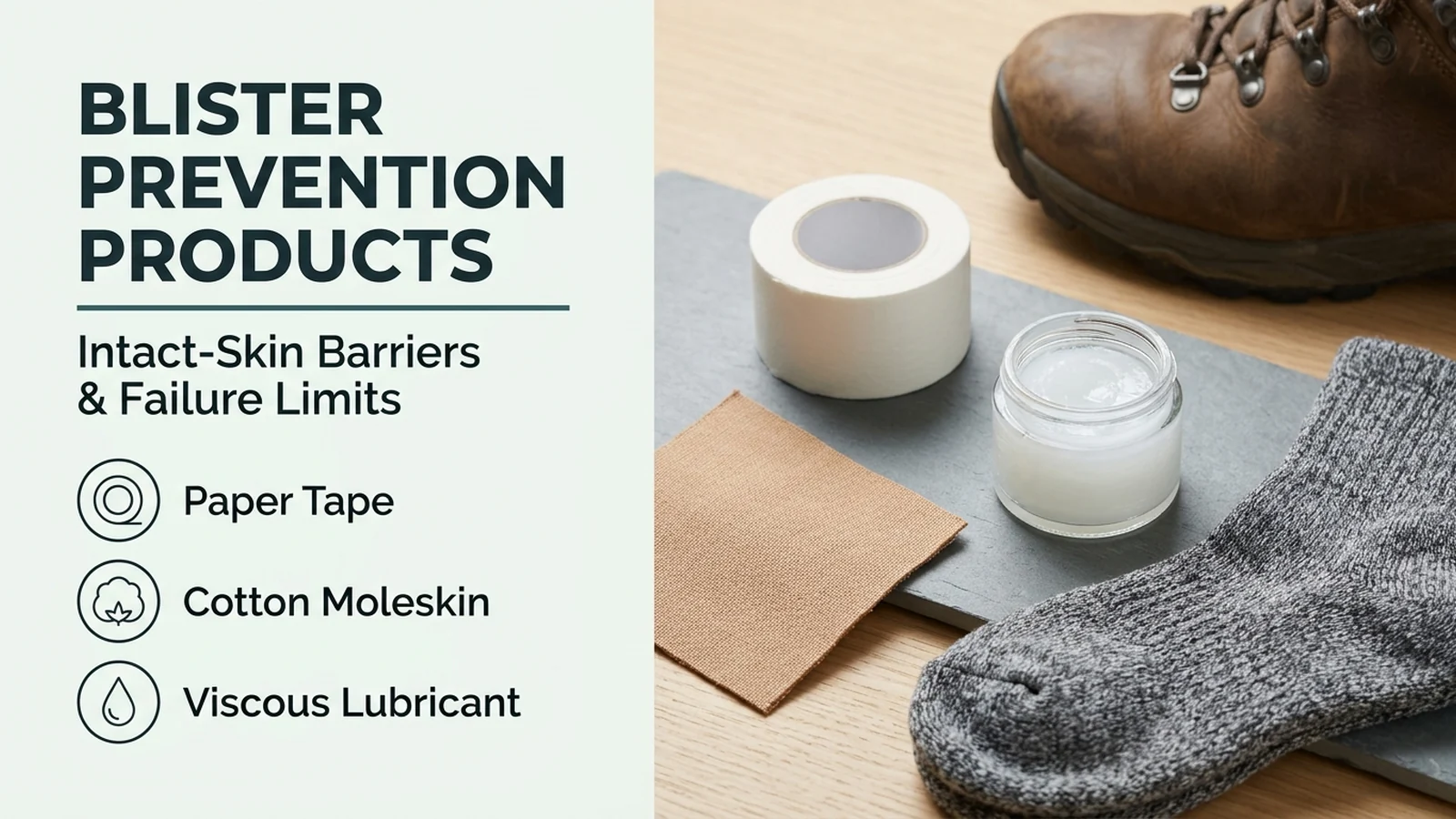
Cotton moleskin, skin lubricants, and multi-day adhesive taping each hit specific physical limits during a loaded walk. Moleskin is a cotton fabric: cotton fibers absorb 3 times as much moisture as synthetic acrylic fiber, take 10 times longer to dry, and thick pads may add pressure inside a tight boot. Viscous lubricants such as petrolatum lowered friction for about 90 minutes in skin-friction tests outside the foot before friction climbed 35% above baseline at 3 hours, while continuous multi-day medical tape on intact skin triggered allergic contact dermatitis in 20 of 26 (77%) affected military conscripts. Pair any barrier choice with gradual hiking-boot break-in and browse our long-distance walking field guides for companion kit routines.
Which Blister-Prevention Products Have Clinical Evidence?
Products prevent foot blisters only when they reduce subsurface shear deformation inside the epidermis. Rather than scraping off the top layer from the outside, a friction blister is an intraepidermal tear within the stratum spinosum: foot bones shift back and forth during push-off while surface traction holds the outer skin still, fatiguing cells until plasma-like fluid collects underneath. Most blister-prevention products address that shear magnitude in 4 ways: lowering friction force, adding shear-absorbing materials, spreading shear across a wider area, or limiting bone movement.
Worthing and colleagues screened 806 discrete articles down to 11 prospective controlled outdoor trials (5 sock, 3 antiperspirant, and 3 barrier studies) and found only 2 studies with moderate confidence in the effect estimate. Outside dense padded acrylic socks, neoprene insoles, and progressive road-march or trail conditioning, popular shop products rest on mixed trials, bench friction tests, or dermatology tips rather than confirmed march blister reductions.
| Product on intact skin | Shear-reduction mechanism | Published clinical evidence | Moisture, bulk, or duration failure limit |
|---|---|---|---|
| Dense padded acrylic socks or dense wool-polypropylene over polyester liner | Moisture storage, cushioning, and inter-sock slip | Supported across 2 double-blind acrylic trials only when the socks were dense and padded; a separate trial in 357 Marine recruits found a dense wool-polypropylene sock over a polyester liner cut overall blisters from 69% to 40% and medical-care blisters from 24% to 11% | Acrylic socks with reduced padding showed no difference in blister frequency versus cotton; foot sweat of 381 to 447 g/h overwhelms thin wicking fibers |
| Surgical paper tape | Thin low-bulk barrier on blister-prone skin | Equivocal across 2 randomized ultramarathon trials: 52% vs 39% (P = .22) in the first study and a 40% blister reduction (95% CI 28 to 52, NNT 1.31) in Pre-TAPED II | Tape folds concentrate focal pressure; among 26 conscripts with tape-related dermatitis after continuous multi-day wear, 20 (77%) had confirmed tape allergy |
| Cotton moleskin and cotton elastic athletic tapes | Surface barrier; unsubstantiated claim of spreading shear load | Suggested by the American Academy of Dermatology for problem spots; clinical trials of these cotton tapes are still required | Cotton absorbs 3 times more moisture than acrylic and dries 10 times slower; thick coverings may add pressure in snug boots |
| Viscous lubricants (petrolatum, mineral oil, glycerin) | Temporary drop in surface coefficient of friction | Prevention of foot blisters unknown; tested only in non-foot skin-friction studies | Friction fell for roughly 90 minutes and rose 35% above baseline at 3 hours; requires mid-march reapplication |
| Polytetrafluoroethylene (PTFE) shoe patches | Low-friction lining stuck inside footwear | Bench cotton-sock COF stayed 0.17 from 0% to 100% sock moisture versus 0.47 on Plastazote; zero clinical blister trials | Sticks to the boot or insole rather than the foot; clinical blister reduction remains untested |
| 20% aluminum chloride hexahydrate antiperspirant | Lowering sweat to avoid moist-skin friction spikes | Cut blisters to 21% vs 48% on placebo on a 21-km hike among 269 cadets using it at least 3 nights | Caused skin irritation in 57% of cadets versus 6% on placebo; nonirritating antiperspirants do not prevent blisters |
| Foot powders (talc and starch) | Dry surface glide | Nonprotective in British Army observations, showing no benefit or higher blister incidence | Wet powder increases friction and combines with sweat into clumped abrasive grit |
How Should You Tape Feet for Long-Distance Walking?
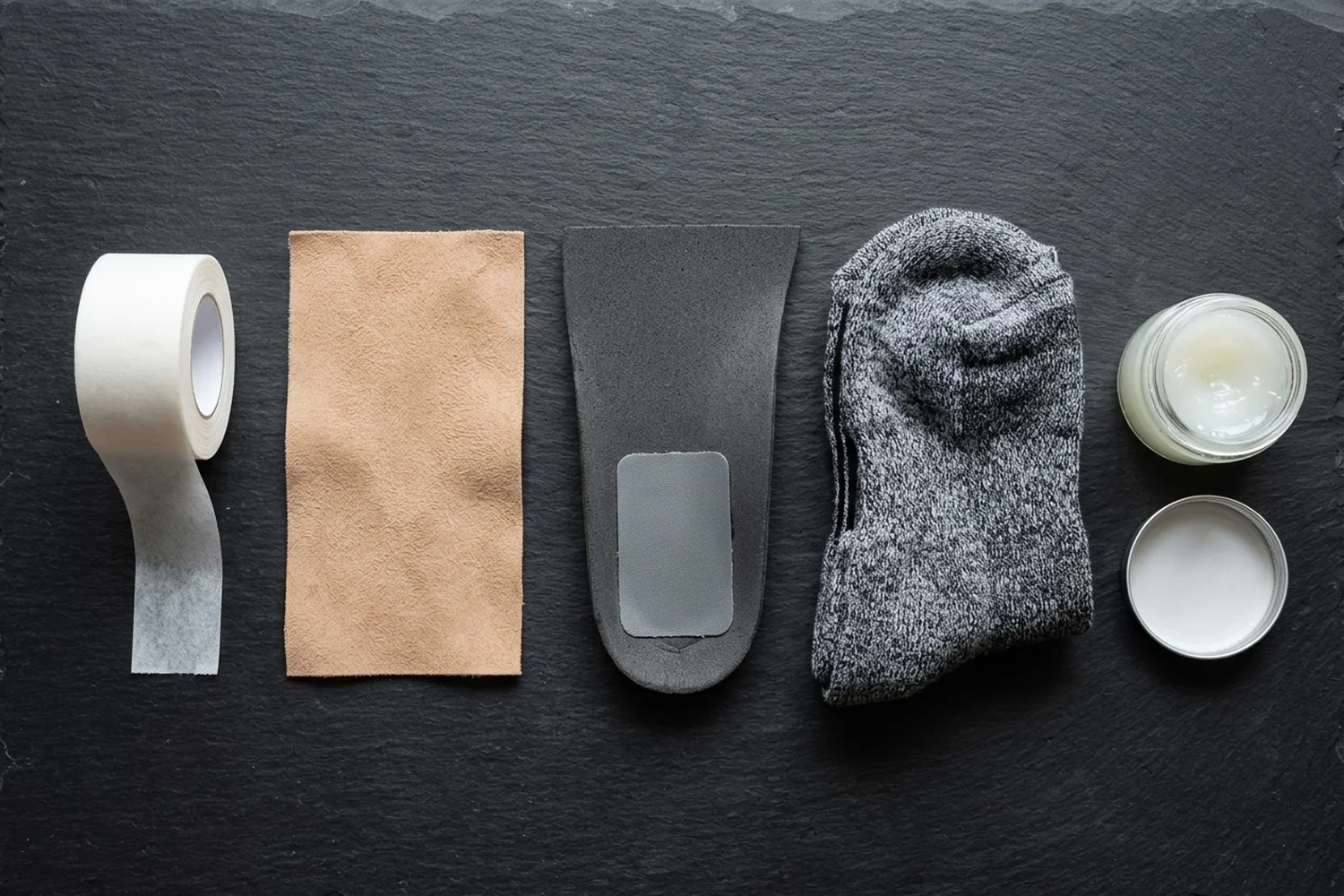
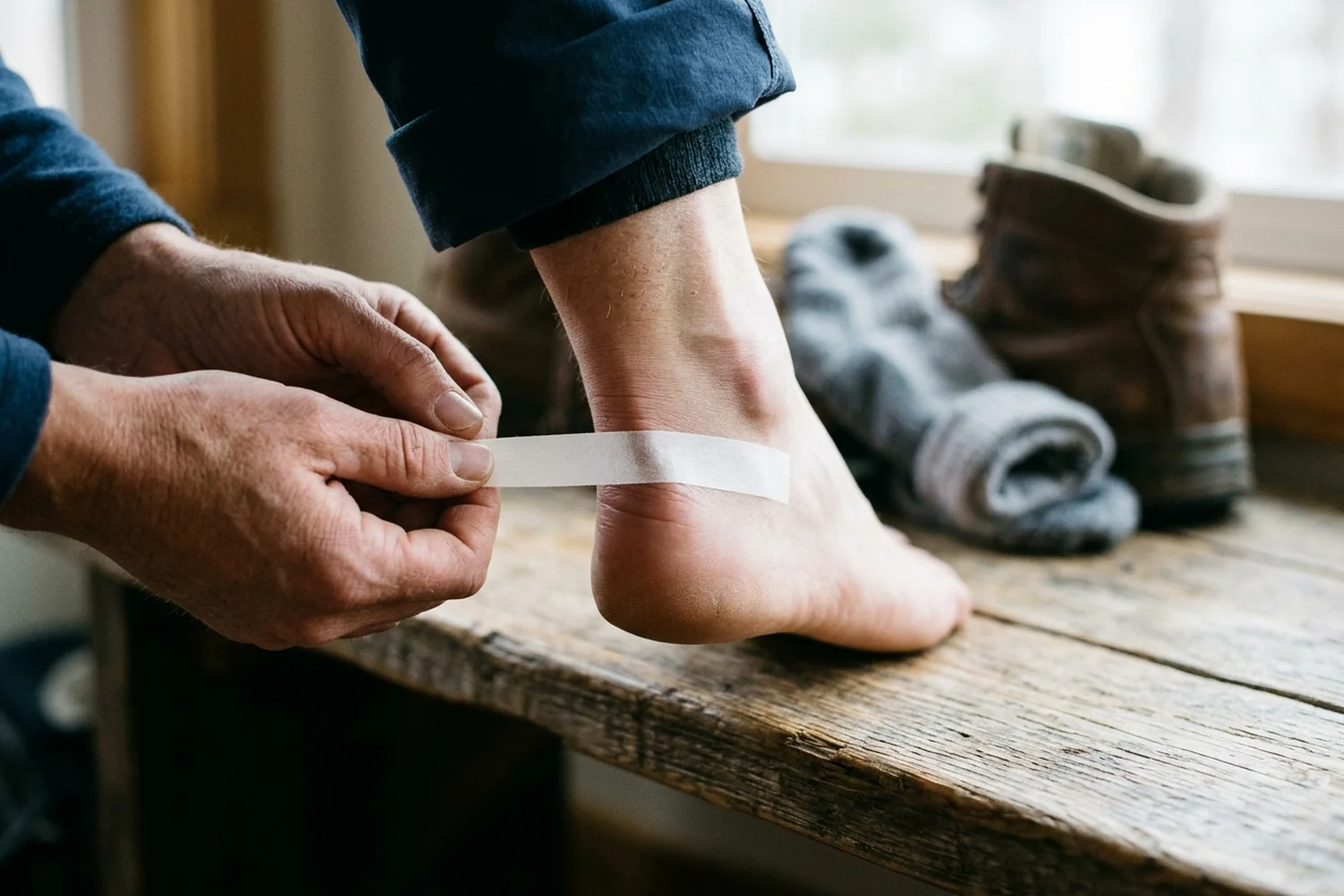
When taping feet for long-distance walking, apply thin surgical paper tape smoothly onto clean, intact, blister-prone skin before the walk begins, keeping every edge flat so creases cannot dig in. In Pre-TAPED II across the 2014 250-km (155-mile), 6-stage desert ultramarathons, investigators taped runners’ blister-prone spots on one randomly selected foot before the race and compared them against untaped areas of the same foot, where toes accounted for 58 of 117 blisters (50%), heels accounted for 27 (23%), and 94 blisters (80%) formed by the end of stage 2. In the earlier trial of 90 runners with complete data, 89% of blisters appeared by day 2 and 59% formed on the toes; see our paper-tape hiking evidence guide for the full trial breakdown.
Keep these mechanical limits in mind whenever you tape intact skin for multi-day miles:
- Eliminate folds and excess tape bulk over the foot and ankle through thin tape choice, smooth placement, and an adhesive enhancer where needed so loosened edges do not bunch like sock creases and intensify focal pressure.
- Do not assume sticking a wide patch of tape or moleskin past a bony prominence spreads shear load into surrounding skin; Rushton and Richie note that shear-load spreading by adherent materials remains a purely speculative mechanism with zero substantiating research.
- Avoid leaving medical adhesive tape stuck continuously to intact skin for several days of marching. In an investigation of 26 Swedish military conscripts who developed tape-related foot dermatitis after multi-day continuous tape wear during a field exercise, patch tests confirmed contact allergy to the adhesive tapes in 20 subjects (77%) and to colophonium in 16 (61%).
Why Does Moleskin Fail in Tight or Wet Boots?
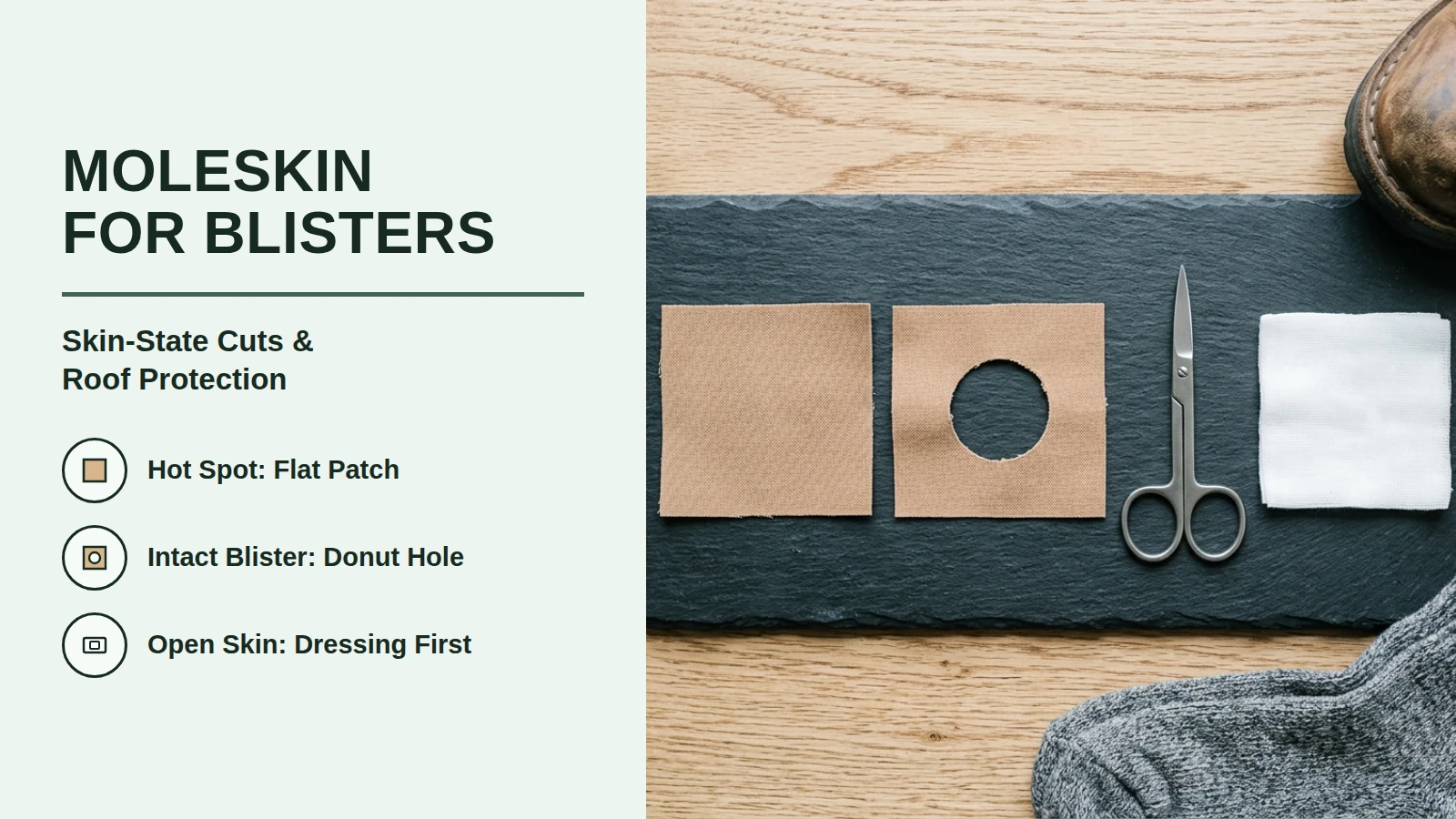
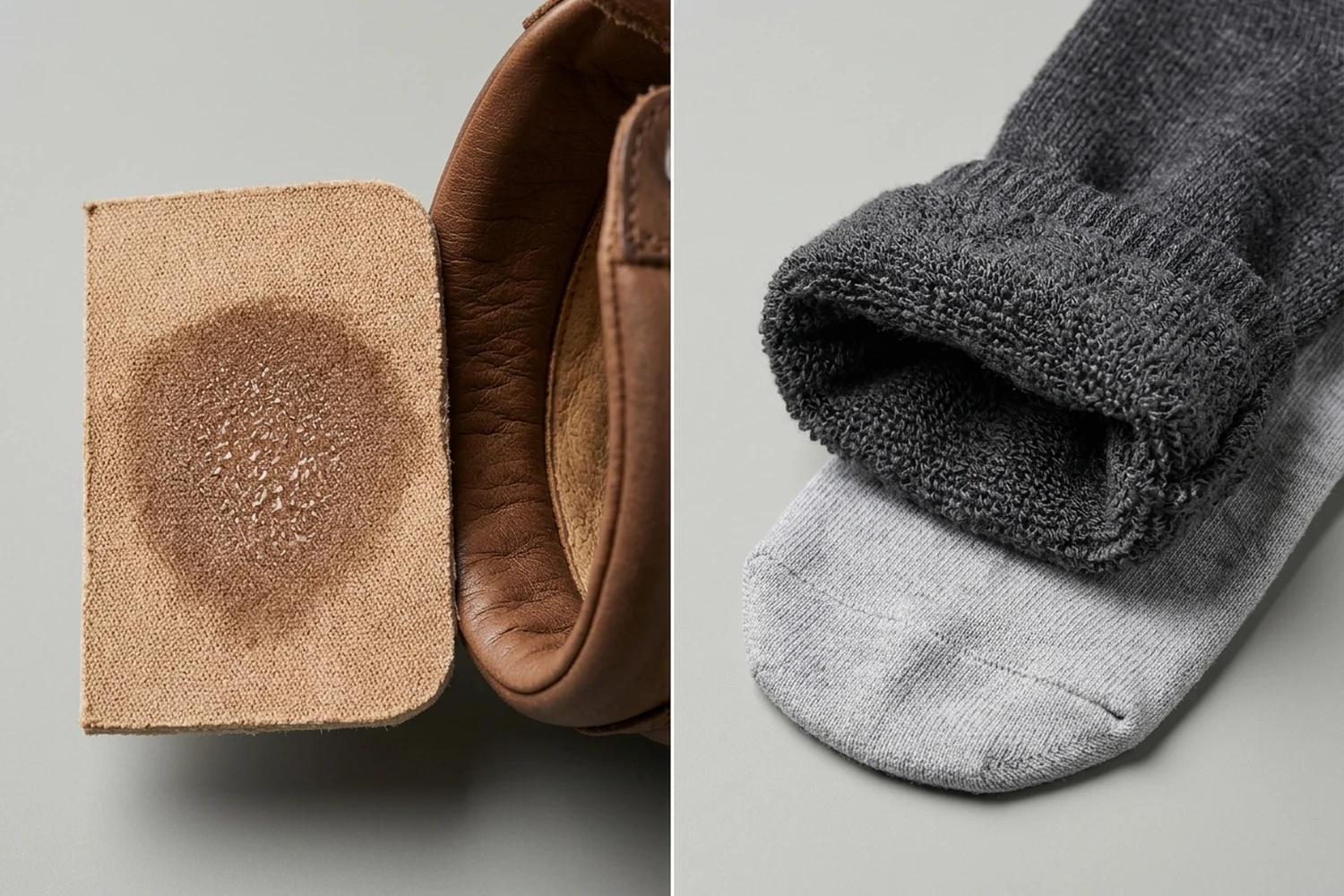
Moleskin struggles inside snug or damp hiking boots because its thick woven cotton body traps sweat while consuming scarce boot clearance over bony spots. Although the American Academy of Dermatology (page updated 7/6/26) lists securely applied adhesive moleskin or soft bandages as an option for problem areas, cotton fibers absorb 3 times as much moisture as synthetic acrylic fibers and take 10 times longer to dry once wet. Several elastic athletic tapes share that same cotton construction and poor moisture handling, and clinical trials of moleskin and those other tapes are still required.
Compressive load explains why thick pads backfire when toe boxes or heel cups fit closely. The coefficient of friction is the dimensionless ratio of friction force to the normal force pressing 2 surfaces together:
Coefficient of friction = Friction force / Normal compressive force
Because friction force scales in direct proportion to both normal compressive force and the coefficient of friction, tightly fitted shoes raise compression and friction over bony prominences, while loosely fitted shoes allow foot sliding that increases shear. A thick bandage may add local pressure without guaranteeing a slicker surface: in Polliack and Scheinberg’s laboratory test of 11 bandages, moleskin posted a 0.67 surface coefficient of friction, 21% higher than the 0.57 lowest-friction bandage tested (which reduced medial tibial shin-skin friction by 31%, from 0.327 to 0.225, in 15 women of mean age 35 outside footwear). Bench studies of felt deflective pads did cut peak plantar pressure by 24% to 31% at 5 mm, 25% for a 7-mm donut pad, and 49% at 20 mm, yet whether pressure-deflective padding prevents friction blisters has not been tested. By contrast, a thin PTFE patch bonded inside the shoe kept a 0.17 laboratory coefficient of friction against a cotton sock across 0% to 100% sock moisture by weight (versus 0.47 on Plastazote), though PTFE patches also await a clinical blister trial.
Socks carry far stronger military and endurance numbers than cotton pads. In 357 US Marine recruits, wearing a thick, dense wool-polypropylene outer sock over a thin polyester liner cut overall blisters to 40% versus 69% in the standard military sock and 77% in the standard sock plus polyester liner, while cutting blisters and cellulitis needing medical attention from 24% down to 11% (and 9% with the standard sock plus liner). In 189 Belgian recruits, a single padded polyester sock (16% blisters) beat both a double-sock pair (32.3%) and the standard sock (51%), leaving double-sock evidence equivocal across three military studies. When footwear resists evaporation, moisture storage beats wicking: foot sweat reaches 381 to 447 g/h, and across 4 march days in 37 recruits wearing vapor-resistant membrane boots, a 50% Merino wool and 33% polypropylene sock absorbed 2.9 times the moisture of a 99% polypropylene sock and kept two skin sites drier (dorsal metatarsals and posterior heel), while the plantar surface showed no moisture difference. Toe socks rely on extra toe-box room for interdigital padding and remain unproven (34% of feet that were taped and wore toe socks sustained blisters, whereas 27% did not incur blisters, and the authors did not state that those blisters were on the toes); compare verified knit constructions in our long-distance walking socks guide.
When Do Lubricants, Powders, and Antiperspirants Backfire?
Lubricants wear off into higher-than-baseline friction within 3 hours, foot powders clump and raise friction once damp, and strong antiperspirants trade lower blister counts for high rates of irritant dermatitis. Moist skin raises frictional force compared with very dry or very wet skin, which explains why hikers reach for chemical coatings, yet each coating breaks down under sustained march sweat.
Hoffman lists frequent use of skin lubricants among prevention strategies, and the American Academy of Dermatology mentions petroleum jelly on rubbing zones, yet no clinical trial has tested whether lubricants prevent foot blisters. In non-foot skin-friction studies cited by Rushton and Richie, water and greasy moisturizers raised friction, while viscous lubricants (petrolatum, mineral oil, and glycerin) lowered friction for roughly 90 minutes before friction climbed 35% above baseline at 3 hours. Stopping mid-march to clean and reapply ointment limits lubricants in endurance events and loaded marches. Powders fail even faster in sweaty boots: wet powder increases frictional force and clumps with sweat into abrasive particles, matching British Army observations where talcum powder produced either no change or higher blister rates.
Antiperspirants split sharply along skin irritation. Among 667 US Military Academy cadets (328 antiperspirant, 339 placebo) instructed to apply 20% aluminum chloride hexahydrate in anhydrous ethyl alcohol for 5 consecutive nights before a 21-km hike on day 6, the 269 cadets who used it for at least 3 nights saw blisters drop to 21% versus 48% on placebo, alongside 57% skin irritation versus 6% on placebo. When researchers added emollients to 20% aluminum zirconium tetrachlorohydrex glycine plus water for 23 men walking on a treadmill at 1.39 m/sec (1% grade) in 28 degrees C and 25% relative humidity with a 21-kg load after 4 treatment days across 2 trials, irritant dermatitis disappeared and so did any benefit for sweat accumulation (p = 0.86), blister incidence (p = 0.36), hot spots (p = 0.83), or blister severity (p = 0.31).
Rules-of-Thumb: When continuous walking exceeds 90 minutes without reapplication, do not rely on viscous lubricants alone because non-foot skin friction rose 35% above baseline by 3 hours in bench tests. Inside low-evaporation boots where foot sweat reaches 381 to 447 g/h, replace cotton moleskin and powders with dense padded acrylic or high-absorption wool-polypropylene socks, and avoid continuous multi-day medical tape wear to prevent colophonium contact allergy.
| Field condition | Vulnerable product | Failure mechanism and published threshold | Practical switch on intact skin |
|---|---|---|---|
| Tight boot clearance over heel or toes | Thick cotton moleskin and bunched athletic tape | Compression raises normal force and friction at bony prominences; moleskin surface COF measured 0.67 (21% above the 0.57 lowest-friction bandage) | Smooth thin surgical paper tape on skin or a thin 0.17-COF PTFE patch inside the boot |
| Sweaty closed boots or wet crossings (381 to 447 g/h sweat) | Cotton moleskin, cotton socks, and foot powders | Cotton absorbs 3x the moisture of acrylic and dries 10x slower; wet powder raises friction and clumps | Dense padded acrylic socks (cotton produced twice as many and 3x larger blisters than dense padded acrylic) or wool-polypropylene over polyester liner |
| Continuous march past 90 minutes without halts | Petrolatum, mineral oil, glycerin, and greasy moisturizers | Greasy moisturizers raise friction; viscous lubricants lower non-foot skin friction for ~90 minutes, then rise 35% above baseline at 3 hours | Use hosiery and broken-in footwear that hold steady without mid-march reapplication |
| Continuous multi-day adhesive wear | Colophonium-containing medical adhesive tapes | Continuous multi-day wear on intact skin produced tape allergy in 20 of 26 conscripts (77%) and colophonium allergy in 16 (61%) | Limit continuous multi-day skin adhesion; inspect bare skin daily and rely on padded socks |
| Pre-hike sweat suppression | 20% aluminum chloride hexahydrate or emollient antiperspirants | Alcohol formulation cut cadet blisters (21% vs 48%) with 57% skin irritation; a separate emollient antiperspirant avoided irritation and showed no blister reduction (p = 0.36) | Skip nonirritating antiperspirants for blister control and manage moisture with spare dry socks |
What Changes Once a Hot Spot Becomes a Blister?
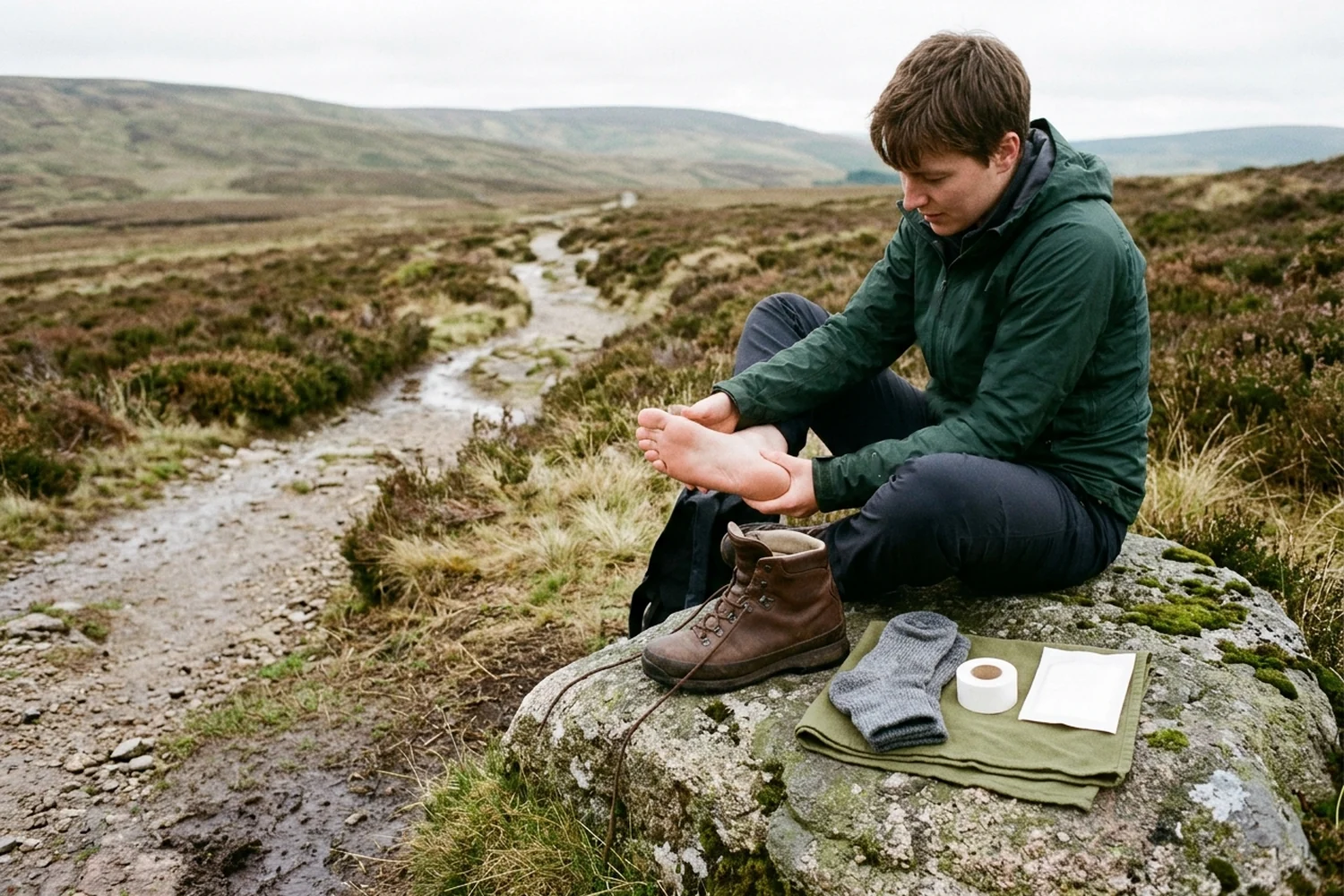
Stop walking as soon as a rubbing spot hurts, feels uncomfortable, or turns red, because prevention barriers apply only while the epidermis remains intact. That immediate stop rule comes from the American Academy of Dermatology, along with wearing comfortable shoes that are neither too tight nor too loose, choosing nylon or moisture-wicking socks, and trying two sock pairs if one pair falls short. NHS prevention guidance (last reviewed 22 November 2023) likewise prioritizes comfortable well-fitting shoes, wearing new shoes in short periods until comfortable, thick moisture-wicking sports socks, and frequent sock changes when feet sweat.
Once plasma-like fluid separates the skin into a blister, pre-walk tapes, lubricants, and powders have missed their window. NHS treatment guidance states not to burst a blister yourself, not to peel skin off a burst blister, not to pick at the edges of remaining skin, and not to wear the shoes or use the equipment that caused the blister until it heals. Hydrocolloid dressings sit on the treatment side of that boundary: NHS describes a hydrocolloid moist dressing as protecting an existing blister, easing pain, and speeding healing, and Knapik’s pathophysiology review notes hydrocolloid dressings on deroofed blisters for pain relief and possible continued activity when required. Follow our guide on how to avoid blisters when hiking for on-trail redness checks and healing windows, and explore more foot-care field manuals.
Sources
- Rushton and Richie — Friction Blisters of the Feet: A New Paradigm to Explain Causation (Journal of Athletic Training)
- Lipman et al. — Pre-TAPED II Randomized Paper-Tape Trial in Multistage Ultramarathons
- Lipman et al. — Pre-TAPED Randomized Paper-Tape Trial in Endurance Distances
- Worthing et al. — Prevention of Friction Blisters in Outdoor Pursuits Systematic Review
- Knapik et al. — Boot-Sock Systems and Foot Blister Incidence in Marine Recruits
- Knapik et al. — Double-Blind Study of 20% Aluminum Chloride Hexahydrate Antiperspirant and Hiking Blisters
- Reynolds et al. — Antiperspirant With Emollients on Loaded Treadmill Walking
- Knapik et al. — Friction Blisters Pathophysiology, Risk Factors, and Care Review
- Hoffman — Etiological Foundation for Practical Strategies to Prevent Exercise-Related Foot Blisters
- Knapik — Prevention of Foot Blisters in Soldiers During Foot-March Operations
- Polliack and Scheinberg — Coefficient-of-Friction Comparison of Bandages Including Moleskin
- Herring and Richie — Friction Blisters and Sock Fiber Composition
- Hamnerius et al. — Outbreak of Allergic Contact Dermatitis From Medical Adhesive Tapes in Conscripts
- NHS — Blisters (last reviewed 22 November 2023)
- American Academy of Dermatology — How to prevent and treat blisters (last updated 7/6/26)