Planning how to protect your feet when hiking and organizing practical foot care for walkers starts with checking boot fit and considering adhesive moleskin or petroleum jelly on problem areas such as the feet. Compare general body chafing sticks, salves, and powders in our anti-chafe balm guide.
| Foot Zone or Preparation Stage | Target Location or Material | Clinical, Regulatory, or Field Evidence |
|---|---|---|
| Primary blister locations | Toes and heel hot spots | In the Pre-TAPED II trial, most study participants had 1 blister (78%), with the most common locations on the toes (n = 58, 50%) and heel (n = 27, 23%), and 94 (80%) blisters occurring by the end of stage 2. |
| Multistage cohort breakdown | Toes, ball, heel, and sole | In the Al Andalus cohort study, most foot blisters formed on the toes (65%), followed by the ball of the foot (16%), heel (14%), and sole (5%). |
| Paper tape trial effect | Blister-prone foot zones | Paper tape reduced blisters by 40% (P < 0.01, 95% confidence interval, 28-52) with a number needed to treat of 1.31. |
| Epidermal hydration effect | Moist skin against textile | Friction coefficients (COFs) between human skin and textile increased typically by 43% in women and 26% in men when skin hydration varied between very dry and normally moist skin. |
| Wet-sock hiker risk | Long-distance stage walking | In the Camino de Santiago hiker study, hiking in wet socks was associated with a 1.94 times greater risk of experiencing foot blisters (95% CI 1.04-3.61, p = 0.035), and the authors recommend changing socks in long stages to maintain dry feet. |
| Occlusive ointment active | Petrolatum skin protectant | Petrolatum and white petrolatum are over-the-counter skin protectant active ingredients at 30 to 100 percent. |
Map Foot Blister Hotspots Across the Toes, Ball, Heel, and Sole
Dermatologists note that blisters can be prevented by preventing chafing; take precautions if you know you’re going to do a lot of walking, running, or other physical activity. Chafing is a painful skin irritation that occurs when body parts rub together or rub against clothing. To prevent chafing that can lead to blisters, dermatologists recommend applying petroleum jelly to problem areas, such as the feet or thighs. Applying powder or petroleum jelly to problem areas helps reduce friction when skin rubs together or rubs against clothing.
Published biomechanical reviews and endurance field studies show where foot blisters concentrate and how walkers attempt to prevent them:
- Epidermal shear and cell necrosis mechanism: Exercise-related foot blisters result from shear forces within the epidermis causing cell necrosis, influenced by friction at skin interfaces, skin characteristics, bony movement, footwear shear modulus, and the number of shear cycles.
- Core shear-reduction and lubricant strategies: Key preventative strategies for exercise-related foot blisters include limiting shear cycles, avoiding moisture and particulate accumulation next to skin, frequent use of skin lubricants, proper fitting shoes, and low shear modulus insoles.
- Interdigital toe perspiration and maceration: Paragraph E-17 states that when feet perspire, skin between the toes usually becomes white and soft, rubs off easily, and is prone to abrasions.
- Lateral foot redness and swelling from marching: Red, swollen, tender skin, which could become blisters, can develop along the sides of the feet from prolonged marching.
- Multistage ultramarathon cumulative incidence: In the 5-day multistage Al Andalus Ultimate Trail cohort study (219 km) of 50 ultramarathon runners, blisters occurred in 76% of participants after 4 days (182 km), compared with 34% after day 1, 54% after day 2, and 72% after day 3.
- Anatomical distribution across toes, ball, heel, and sole: In the Al Andalus cohort study, most foot blisters formed on the toes (65%), followed by the ball of the foot (16%), heel (14%), and sole (5%).
- Sole and heel pain severity and lubricant cohort outcome: In the Al Andalus cohort study, blisters on the sole and heel tended to be the most painful (though not reaching statistical significance), and prophylactic application of antiperspirants, talcum powder, or lubricant to feet did not show any reduction in blister rates.
- French trail ultramarathon prevention and blister rates: In the French trail ultramarathon survey, 61% (N.=329) of runners applied blister prevention methods before the start of the race and 29% (N.=155) reported blisters at the end of the race.
- French trail ultramarathon method breakdown: In the French trail ultramarathon survey, the most commonly used blister prevention methods were anti-friction cream 79% (N.=260), anti-blister socks 33% (N.=107), paper tape 13% (N.=44), and topical lemon application 11% (N.=36).
- Prior blister history odds ratio: In the French trail ultramarathon survey, having a history of blisters in the past was strongly associated with blister onset (OR = 15.950, 9.135-29.640, P < 0.0001).
Diagnose Boot-Fit Faults and Load-Carriage Forces Before Relying on Foot Balm
- Proper shoe fit baseline: For foot blister prevention, shoes should fit properly and should not be too tight or too loose.
- Small-boot pressure versus large-boot friction: Paragraph E-30 states that poor-fitting boots can cause blisters, abrasions, calluses, and corns: pressure is caused by boots being too small and friction is caused by boots being too large.
- Toe-top and toe-end boot-fit diagnostics: If tops of toes are involved, the boot cap is too low or too stiff; if ends of the toes are affected, the boot is too short or too loosely laced.
- Toe-side width and heel-space diagnostics: If sides of the big and little toes become irritated, the boot is too narrow; heel irritation is caused by boots being too long, too loosely laced, or having too wide a heel space.
- Heavy-load propulsive and breaking forces: Paragraph E-10 states that heavy loads increase blister incidence, possibly by increasing pressure on the skin and causing movement of the foot inside the boot through higher propulsive and breaking forces.
- Heavy-load carriage method comparison: When loads are heavy (61 kilograms/134 pounds or more), the double pack method of load carriage has been shown to demonstrate lower blister incidence than the backpack method.
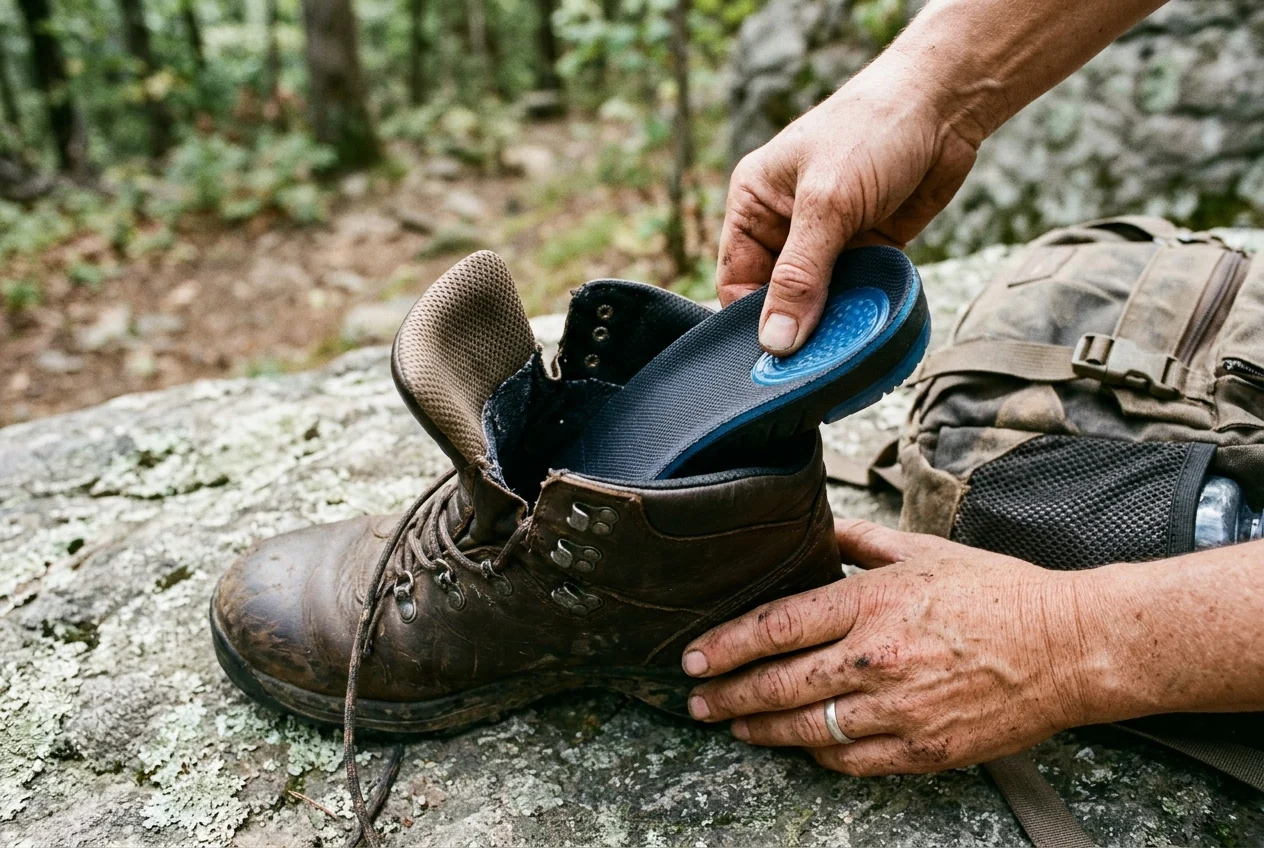
- Gel insole anteroposterior and mediolateral shear absorption: Paragraph E-11 states that gel shoe insoles have been shown to reduce foot blister incidence, possibly because they absorb frictional forces in anteroposterior and mediolateral directions.
- New-boot alternation and pre-march hotspot taping: When getting used to new pairs of boots, Soldiers are advised to alternate with another pair and tape known hot spots before wearing the new pair.
Compare OTC Skin Protectant Active Ingredients and Label Rules
Under § 347.3, a skin protectant drug product is defined as a drug product that temporarily protects injured or exposed skin or mucous membrane surfaces from harmful or annoying stimuli.
| Active Ingredient | Category Role | Federal Monograph Concentration Rule |
|---|---|---|
| Allantoin | Over-the-counter skin protectant active | Under § 347.10, allantoin is an over-the-counter skin protectant active ingredient at a concentration of 0.5 to 2 percent. |
| Cocoa butter | Lipid skin protectant active | Under § 347.10, cocoa butter is an over-the-counter skin protectant active ingredient at a concentration of 50 to 100 percent. |
| Dimethicone | Silicone skin protectant active | Dimethicone is an over-the-counter skin protectant active ingredient at a concentration of 1 to 30 percent. |
| Lanolin | Emollient skin protectant active | Lanolin is an over-the-counter skin protectant active ingredient at a concentration of 12.5 to 50 percent. |
| Mineral oil | Liquid hydrocarbon active | Mineral oil is an over-the-counter skin protectant active ingredient at a concentration of 50 to 100 percent. |
| Petrolatum and white petrolatum | Semi-solid occlusive active | Petrolatum and white petrolatum are over-the-counter skin protectant active ingredients at 30 to 100 percent. |
| Topical starch | Absorbent powder active | Topical starch is an over-the-counter skin protectant active ingredient at a concentration of 10 to 98 percent. |
| Zinc oxide | Skin protectant active | Zinc oxide is an over-the-counter skin protectant active ingredient at a concentration of 1 to 25 percent. |
Federal labeling rules and registered Drug Facts entries also define what over-the-counter skin protectant packaging states regarding indications, warnings, directions, and storage:
- Eligible chafed and cracked skin labeling: Labeling for eligible OTC skin protectants states (optional: helps prevent and) temporarily protects (optional: and helps relieve) (optional: chafed,) chapped or cracked skin.
- Required external-use and seven-day warnings: OTC skin protectant warnings require stating ‘For external use only’, stopping use if symptoms last more than 7 days, and not using on deep or puncture wounds, animal bites, or serious burns.
- Broken-skin warning for kaolin and starch powders: Powder skin protectant products containing kaolin or topical starch must warn ‘Do not use on broken skin’.
- Standard as-needed application direction: Standard directions for topical OTC skin protectants state ‘apply as needed’.
- Dimethicone powder-gel active listing: In the DailyMed Drug Facts label for Monistat Care Chafing Relief Powder Gel, the active ingredient is Dimethicone 1.2% as a Skin Protectant.
- Dimethicone powder-gel storage and silicone vehicle: The Monistat Care Chafing Relief Powder Gel Drug Facts label specifies storage at 20°-25°C (68°-77°F) and lists inactive ingredients cyclomethicone, dimethicone, dimethicone/vinyl dimethicone crosspolymer, silica dimethyl silylate, and vinyl dimethicone/methicone silsesquioxane crosspolymer.
Combine Paper Tape, Moleskin, Petroleum Jelly, and Foot Powder in Pre-March Foot Care
Compare controlled trial data on adhesive dressings in our evidence guide to blister tape for hiking.
- Randomized paper tape ultramarathon protocol: In the 2014 250-km (155-mile) 6-stage RacingThePlanet ultramarathons, paper tape was applied to a randomly selected foot before the race, either to blister-prone areas or a randomly selected location if there was no blister history.
- Paper tape blister reduction and NNT: Paper tape reduced blisters by 40% (P < 0.01, 95% confidence interval, 28-52) with a number needed to treat of 1.31.
- Pre-TAPED II overall blister count and treatment success: In the Pre-TAPED II trial, 83% of participants developed 117 blisters, with treatment success in 98 (77%) runners.
- Pre-TAPED II toe and heel location breakdown: In the Pre-TAPED II trial, most study participants had 1 blister (78%), with the most common locations on the toes (n = 58, 50%) and heel (n = 27, 23%), and 94 (80%) blisters occurring by the end of stage 2.
- Outdoor-pursuits systematic review study scope: In the systematic review of friction blister prevention in outdoor pursuits, screening 806 discrete articles identified 11 studies investigating 5 sock, 3 antiperspirant, and 3 barrier strategies.
- Systematic review confidence for paper tape: The outdoor-pursuits systematic review found a paucity of high-quality evidence in support of socks, antiperspirants, or barriers for preventing friction blisters, while moderate confidence in effect estimate suggests paper tape may be an effective barrier prevention.
Follow these pre-march preparation rules when combining nail care, sock liners, hotspot taping, moleskin, petroleum jelly, and foot powder:
- Toenail trimming and sock-liner preparation: Paragraph E-5 instructs trimming toenails short, square, and straight across before a march, and states that a nylon or polypropylene sock liner can reduce friction and add protection.
- New-boot alternation and pre-march hotspot taping: When getting used to new pairs of boots, Soldiers are advised to alternate with another pair and tape known hot spots before wearing the new pair.
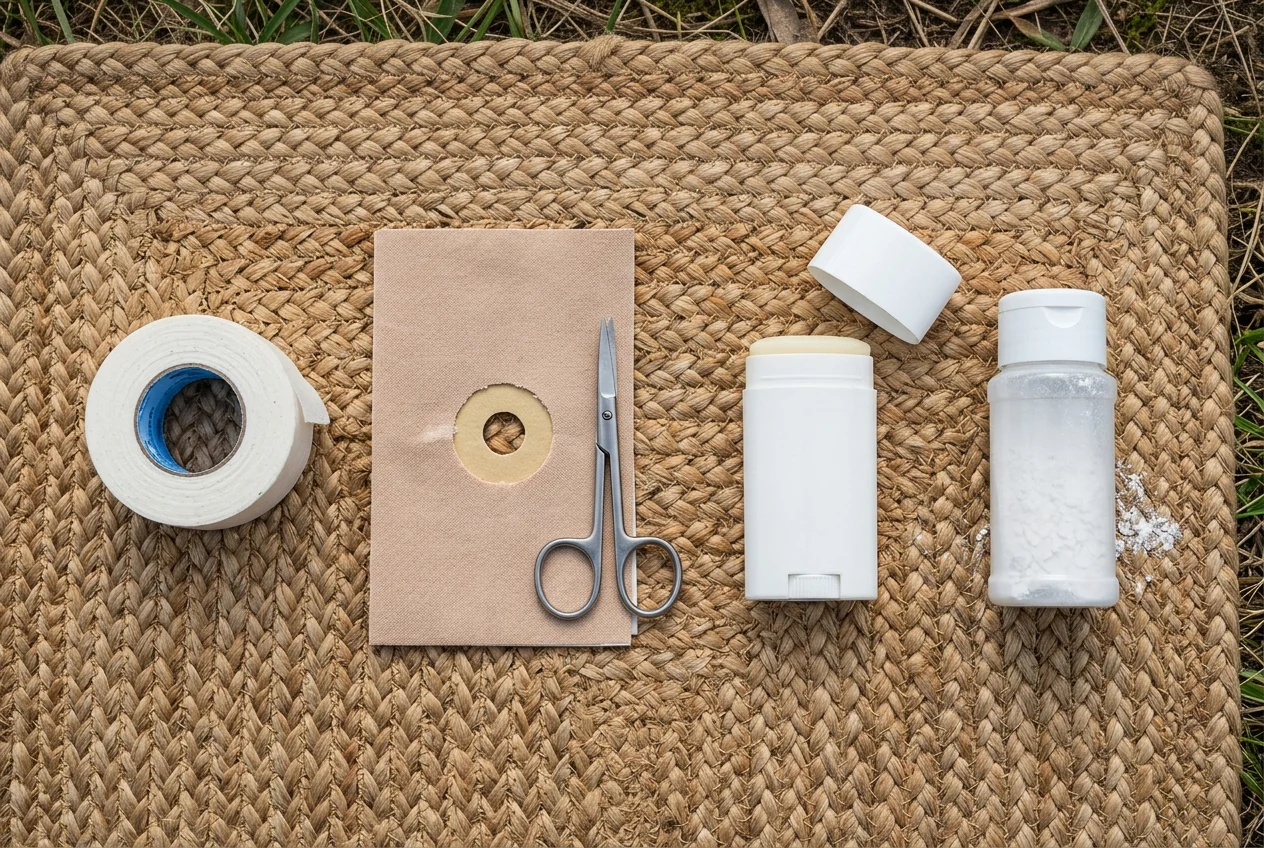
- Secure adhesive moleskin or soft bandages: For problem areas such as the feet or thighs, dermatologists recommend considering adhesive moleskin or other soft bandages applied securely.
- Petroleum jelly on problem areas: To prevent chafing that can lead to blisters, dermatologists recommend applying petroleum jelly to problem areas, such as the feet or thighs.
- Powder moderation and tape-edge anti-sticking rule: Paragraph E-15 cautions to use just enough foot powder because it can harden and become irritating, while noting that foot powder lessens friction and prevents raw edges of bandage adhesive plaster from adhering to socks.
Manage Sweat Hydration and Wet-Sock Friction at March Halts
Review sock fiber construction and layering in our guide to the best long-distance walking socks.
- In-boot sweat accumulation and ventilation limits: In all types of footgear, feet sweat more and are generally less ventilated than other body parts, and moisture accumulates in socks, decreasing their insulating quality.
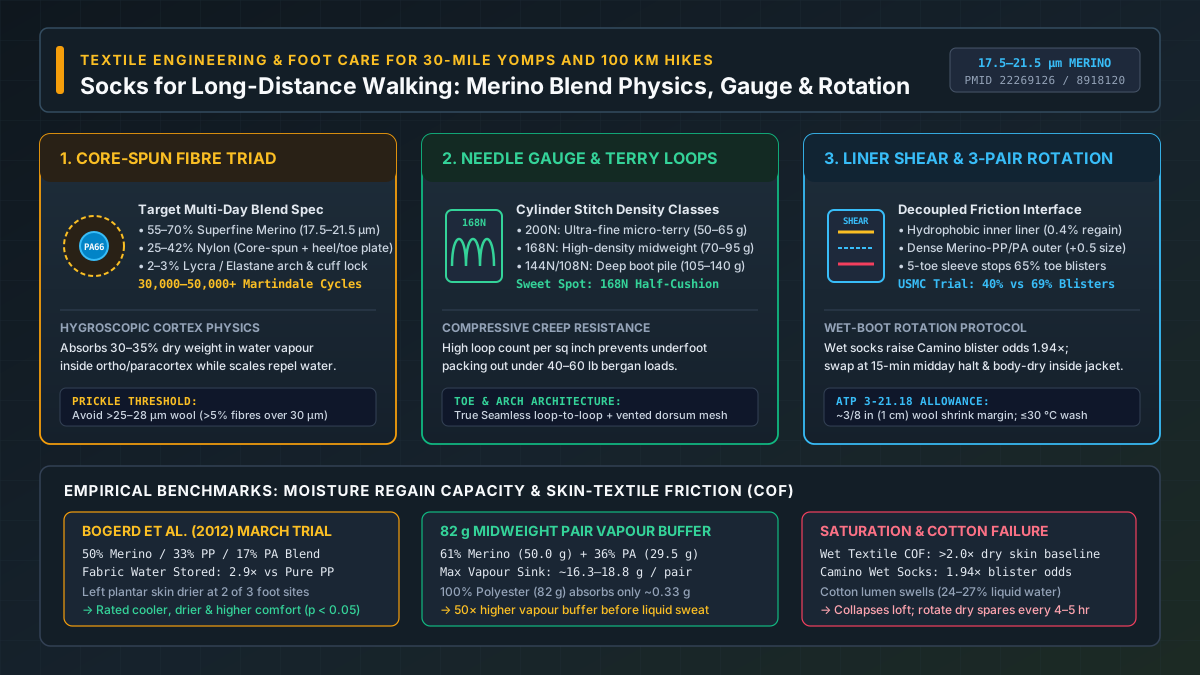
- Skin-textile friction increase from dry to moist skin: Friction coefficients (COFs) between human skin and textile increased typically by 43% in women and 26% in men when skin hydration varied between very dry and normally moist skin.
- More than twofold friction rise against wet fabric: The friction coefficients (COFs) between human skin and completely wet fabric were more than twofold higher than the values for natural skin rubbed on a dry textile surface, as hydration leads to skin softening and increased real contact area and adhesion.
- Plantar sock-skin tribology and knit structure: In sock-skin tribology testing across the inside bottom surface of the sock (in contact with the bottom of the foot), in the dry condition knit structure was the most prominent fabric parameter affecting frictional force, while fiber composition had seemingly no effect.
- Camino de Santiago hiker blister prevalence and sock fibers: Among 203 hikers interviewed on the Camino de Santiago who walked an average of 253.7 km, 68.5% presented foot blisters; 74.2% used predominantly synthetic-fiber socks and 25.9% used mainly natural-fiber socks.
- Wet-sock blister risk ratio and stage sock changes: In the Camino de Santiago hiker study, hiking in wet socks was associated with a 1.94 times greater risk of experiencing foot blisters (95% CI 1.04-3.61, p = 0.035), and the authors recommend changing socks in long stages to maintain dry feet.
Combine moisture-wicking sock systems with disciplined halt maintenance to keep plantar hydration in check:
- Nylon or moisture-wicking sock selection: To prevent blisters on the feet, dermatologists recommend wearing nylon or moisture-wicking socks.
- Double-sock option for extra skin protection: If wearing one pair of socks does not help prevent foot blisters, dermatologists suggest trying two pairs of socks to protect the skin.
- Avoiding sweat-soaking cotton fabrics: During physical activity, cotton clothes should be avoided because cotton soaks up sweat and moisture, which can lead to friction and chafing.
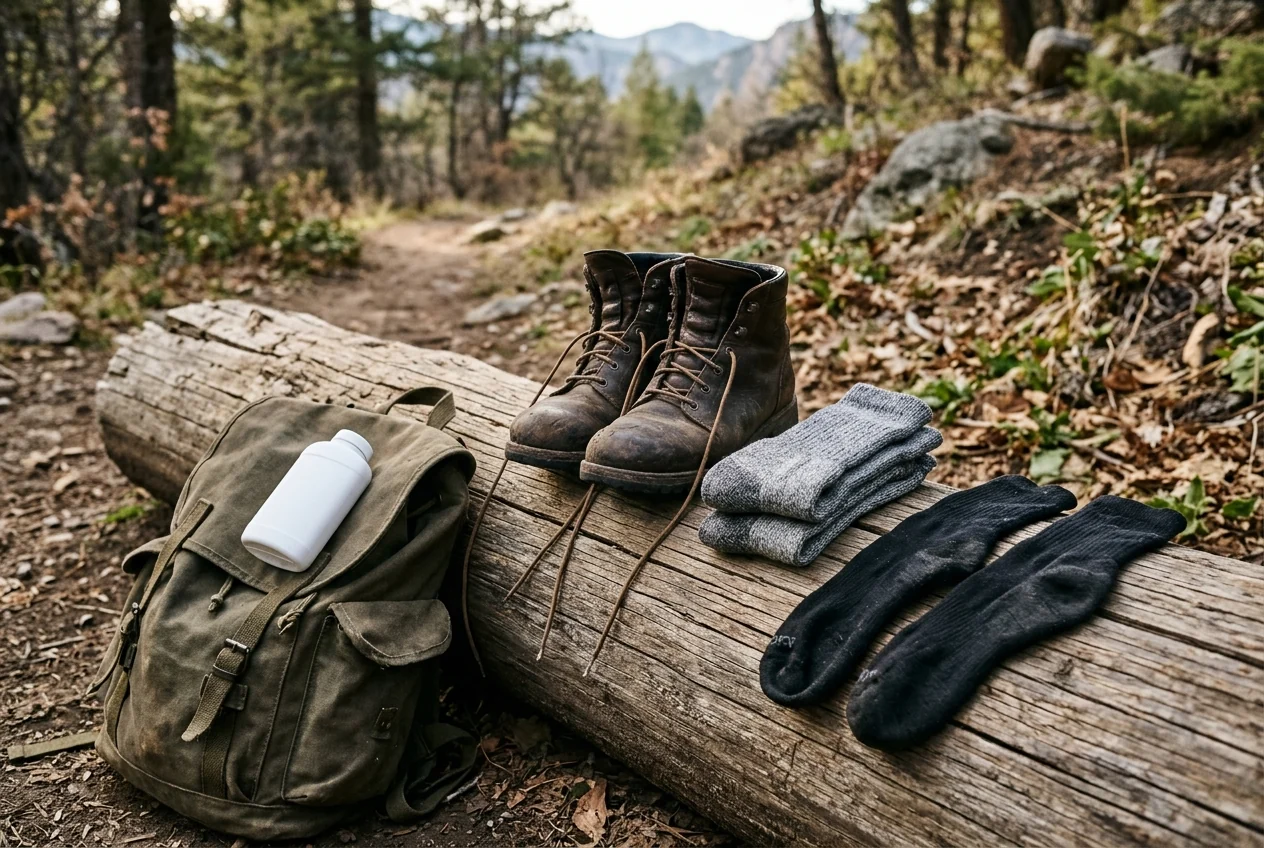
- March halt dry-sock swap and powder routine: Soldiers are directed to keep socks clean and dry, change wet or damp socks as soon as possible, and apply foot powder on feet and inside boots when changing socks.
- Short break-in periods and frequent sock changes: For people who often get friction blisters on their feet, NHS advises wearing comfortable well-fitting shoes, wearing new shoes for short periods, wearing thick moisture-wicking sports socks, and changing socks frequently if feet sweat.
Apply Stop Thresholds, Intact-Blister Care, and the Sequencing Checklist Card
Under § 347.3, a skin protectant drug product is defined as a drug product that temporarily protects injured or exposed skin or mucous membrane surfaces from harmful or annoying stimuli.
- Pre-blister hot-spot recognition and low-friction shielding: Hot spots are a pre-blister stage characterized as a localized warm or burning sensation and a local red (erythema) and tender area, where blisters may be avoided by shielding the affected areas with a low-friction skin covering.
- Immediate activity stop on pain or redness: Dermatologists advise stopping activity immediately if you experience pain or discomfort or if your skin turns red; otherwise, you may get a blister.
- One-to-two-week healing and activity pause: Most blisters heal on their own in one to two weeks, and dermatologists advise not resuming the activity that caused the blister until it is healed.
- Donut-shaped plantar pressure padding: To protect existing blisters in pressure areas such as the bottom of the feet, dermatologists recommend placing padding cut into a donut shape around the blister and covering both with a bandage.
- Typical one-week recovery window: NHS guidance states that blisters often heal on their own within a week.
- Clean soft-plaster cover and no self-bursting rule: To treat a blister yourself, NHS guidance advises keeping it clean, covering blisters with a soft plaster or padded dressing, and not bursting a blister yourself.
- Pausing causative footwear until healed: NHS guidance states not to wear the shoes or use the equipment that caused your blister until it heals.
- Hydrocolloid moist dressing benefits: NHS notes that a hydrocolloid dressing (a moist dressing) can protect the blister, help reduce pain, and speed up healing.
- Infected blister heat, pus, and skin-tone redness signs: NHS states that an infected blister can be hot and filled with green or yellow pus, and surrounding redness can be hard to see on brown or black skin.
Use this step-by-step checklist card before and during a hike:
| Sequence Step | Action Target | Verified Field or Clinical Rule |
|---|---|---|
| Step A — Boot fit check | Heel cup and toe box | For foot blister prevention, shoes should fit properly and should not be too tight or too loose. |
| Step B — Nail and liner prep | Toenails and inner liner | Paragraph E-5 instructs trimming toenails short, square, and straight across before a march, and states that a nylon or polypropylene sock liner can reduce friction and add protection. |
| Step C — Pre-march taping | Known foot hot spots | When getting used to new pairs of boots, Soldiers are advised to alternate with another pair and tape known hot spots before wearing the new pair. |
| Step D — Moleskin padding | High-friction problem areas | For problem areas such as the feet or thighs, dermatologists recommend considering adhesive moleskin or other soft bandages applied securely. |
| Step E — Petroleum jelly barrier | Problem areas on the feet | To prevent chafing that can lead to blisters, dermatologists recommend applying petroleum jelly to problem areas, such as the feet or thighs. |
| Step F — Powder edge dusting | Adhesive bandage edges | Paragraph E-15 cautions to use just enough foot powder because it can harden and become irritating, while noting that foot powder lessens friction and prevents raw edges of bandage adhesive plaster from adhering to socks. |
| Step G — Halt sock swap | Wet or damp march socks | Soldiers are directed to keep socks clean and dry, change wet or damp socks as soon as possible, and apply foot powder on feet and inside boots when changing socks. |
| Step H — Redness stop check | Painful or red skin | Dermatologists advise stopping activity immediately if you experience pain or discomfort or if your skin turns red; otherwise, you may get a blister. |
Browse more field guides and foot-care protocols on our long-distance walking blog.
Sources
- American Academy of Dermatology — How to Prevent and Treat Blisters
- American Academy of Dermatology — Ways to Use Petroleum Jelly for Skin Care
- National Health Service — Blisters Guidance
- Electronic Code of Federal Regulations — Skin Protectant Drug Products for Over-the-Counter Human Use
- DailyMed — Chafing Relief Powder Gel Drug Facts
- Headquarters, Department of the Army — Foot Marches Manual, Appendix on Foot Care
- Clinical Journal of Sport Medicine — Paper Tape Prevents Foot Blisters Randomized Prevention Trial
- Journal of the American Podiatric Medical Association — The Enemy of the Feet: Blisters in Ultraendurance Runners
- Wilderness and Environmental Medicine — Prevention of Friction Blisters in Outdoor Pursuits Systematic Review
- Current Sports Medicine Reports — Etiological Foundation for Practical Strategies to Prevent Exercise-Related Foot Blisters (Hoffman)
- Journal of Foot and Ankle Research — Tribology of the Sock-Skin Interface
- Journal of the Royal Society Interface — Influence of Epidermal Hydration on the Friction of Human Skin Against Textiles
- Journal of Sports Medicine and Physical Fitness — Epidemiology, Prevention Methods, and Risk Factors of Foot Blisters in French Trail Ultramarathons
- International Journal of Environmental Research and Public Health — The Influence of Sock Composition on the Appearance of Foot Blisters in Hikers